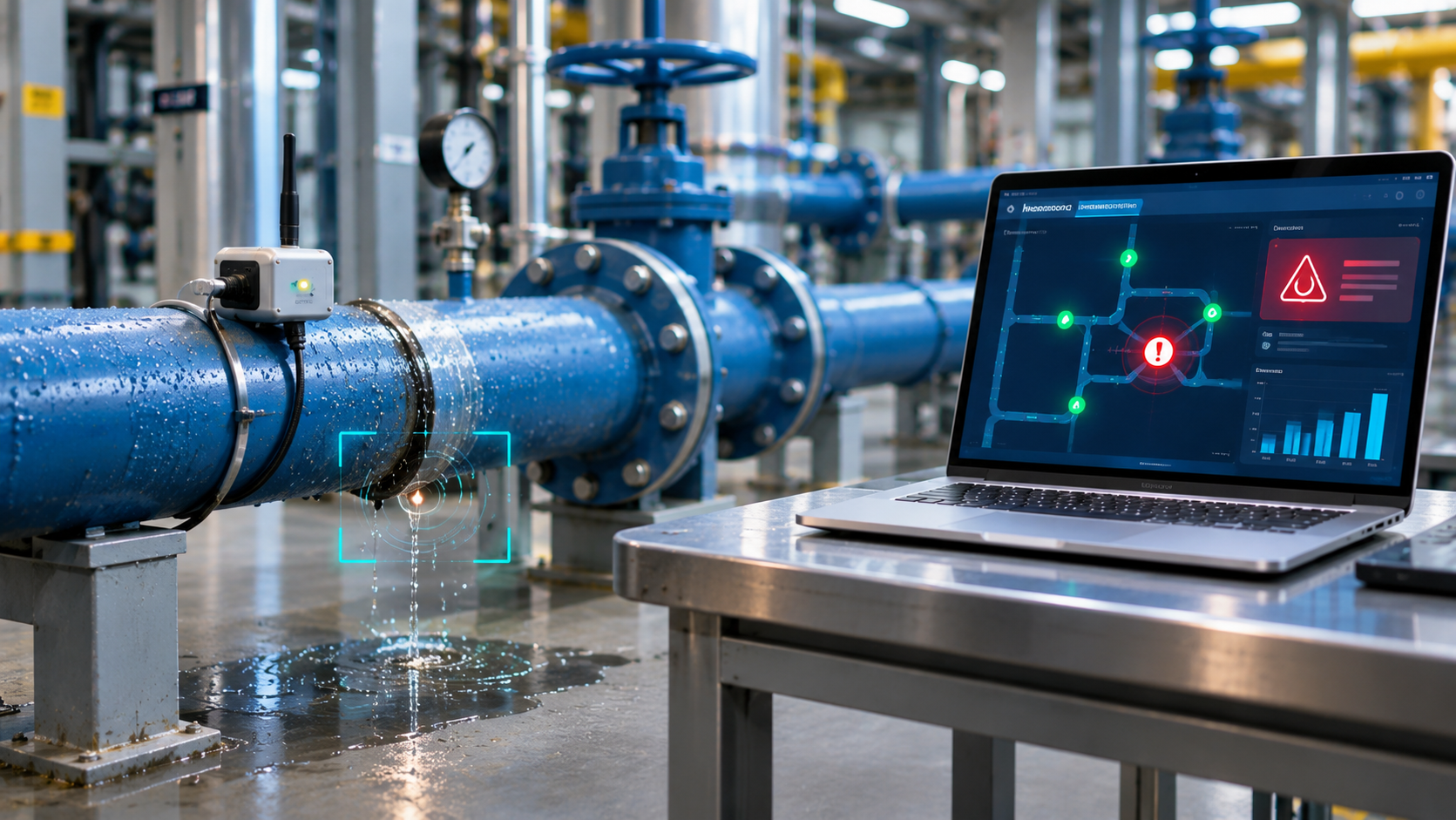


A facility team notices water consumption continuing after normal operating hours. The cause might be scheduled equipment use, a faulty meter, or a leak. Connected monitoring software can help the team examine the evidence and decide where to investigate.
AI-powered water leak detection systems analyse suitable readings or images to identify patterns that may indicate leakage. For Pune infrastructure operators, their value depends on appropriate sensing, dependable software integration, and maintenance teams who verify findings before arranging repairs.
Start With the Infrastructure and Available Evidence
Match Sensing to the Site
Different sensors observe different conditions. Flow meters measure water movement, pressure sensors record hydraulic conditions, and acoustic or vibration devices capture signals associated with pipe behaviour. Moisture sensors detect water near their installation point.
Not every site needs every device. Assess pipe materials, access, supply schedules, existing instrumentation, power, and network coverage before selecting hardware.
IoT and BLE solutions in Pune can support compatible device integration and monitoring applications. BLE is one possible connection method; the appropriate network depends on site requirements.
Build Consistent Monitoring Records
Software needs to associate readings with the correct pipe section, zone, or meter. Record units, timestamps, equipment identifiers, calibration information, and expected operating schedules.
The Jal Jeevan Mission technical report on measurement and monitoring discusses sensor-based water measurement, pressure monitoring, and data transmission. Its context is rural water services, but the measurement principles provide useful background.
Building plumbing and municipal networks still require different designs. Monitoring frequency, coverage, and maintenance responsibilities should reflect the installation.
Understand What AI Adds to Leak Detection
Compare Patterns With Relevant Operating Conditions
A threshold alarm can flag a reading above a defined limit. AI-based analysis can examine relationships across readings, historical patterns, and operating conditions.
For example, persistent flow during an expected low-use period may justify investigation. However, cleaning schedules, tank filling, pump cycles, or changed occupancy could explain the pattern. Pressure changes may also follow normal valve operations.
AI development services in Pune can support analysis tailored to these conditions. The development process should compare the approach with simpler rules and assess whether AI provides useful additional information.
An unusual reading remains evidence to review, not automatic confirmation of leakage.
Use Thermal Images as Inspection Evidence
Thermal cameras measure surface temperature patterns. Under suitable conditions, differences associated with moisture or escaping water may help identify an area requiring inspection.
Interpretation depends on temperature contrast, surface materials, access, weather, and other heat sources. A warm pipe, sunlight, or nearby equipment can also influence an image.
Thermal imaging does not universally see through walls or establish an exact leak location. AI can help analyse images, but qualified staff must evaluate whether the observed pattern is consistent with leakage and determine what further inspection is necessary.
Turn Suspected Leaks Into Verified Maintenance Work
Give Teams a Reviewable Alert
A useful alert identifies the affected asset or zone, relevant timestamps, supporting trends or images, and the reason for investigation. It should also show whether the underlying data is current.
Group related readings where appropriate so staff can review one developing event rather than repeated notifications. Explain any severity or confidence score clearly. A software score should not be presented as a guaranteed probability unless that interpretation has been validated.
Inspect, Repair, and Complete a Closure Check
Assign the review item to a responsible person. Staff can check operating records, inspect the area, and use appropriate diagnostic equipment to confirm the cause.
Once authorised repairs are complete, record the work and compare subsequent readings under relevant conditions. This closure check helps establish whether the reported issue was resolved.
Automatic valve operation requires separate engineering, permissions, and operational validation.
Integrate Hardware With New or Existing Software
Enhance the Existing Monitoring Application
An existing building management system, SCADA platform, or maintenance application may already contain useful information. Available APIs, supported gateways, or approved data exports can connect those records with additional analysis.
Enhancements might include evidence views, asset maps, alerts, and maintenance status. Define which system owns each record and how updates are confirmed.
Access permissions should reflect staff responsibilities. Separate monitoring access from equipment-control permissions, and make unavailable or outdated information visible.
Develop New Software Where Needed
A dedicated application may be appropriate when existing tools cannot support the required connections or review process.
The scope can include device-data collection, storage, dashboards, review queues, notifications, and maintenance records. Hardware supply, firmware, installation, calibration, and software development should have clearly assigned responsibilities.
This helps teams understand what the application can deliver and which dependencies require other specialists.
A Thermal-Inspection Platform Example
Theta’s AI-based water leakage detection platform describes a thermal-inspection software approach combining image analysis with dashboards and inspection records.
This illustrates one possible architecture. Its suitability depends on the infrastructure, observable conditions, and available evidence. A thermal-image implementation should not be assumed to replace flow monitoring, acoustic investigation, or field verification at every site.
Validate the System Before Expanding
Test Against Confirmed Site Events
Begin with a defined area and agreed acceptance criteria. Test normal consumption, pump changes, missing readings, interrupted communications, and confirmed leakage events where available.
Measure false alerts, missed events, detection delay, and localisation error where relevant. Compare the AI approach with a suitable baseline, such as existing alarm rules.
Keep evaluation data separate from development data so results reflect performance on information the system has not already used for development.
Review results as operating conditions change. Staff feedback should distinguish verified leaks, normal events, and sensor issues. This record supports future evaluation and helps identify when settings, data preparation, or analysis need adjustment.
Frequently Asked Questions
Can AI Detect Leaks Without New Sensors?
Sometimes existing meters or monitoring equipment provide useful data. Assess access, measurement quality, sampling frequency, asset mapping, and coverage before deciding whether additional devices are necessary.
Can Thermal Cameras See Through Walls?
No. They measure surface temperature patterns. Those patterns may support an investigation under suitable conditions, but materials, environmental influences, and other heat sources affect interpretation.
Can the System Locate an Underground Leak Exactly?
Localisation depends on the sensing method, sensor placement, network layout, pipe conditions, and available evidence. An alert may identify a zone that requires further investigation rather than an exact excavation point.
What Happens When Connectivity Is Interrupted?
Behaviour depends on the architecture. Devices or gateways may buffer readings for later upload. The application should identify stale data and avoid presenting delayed readings as current conditions.
Does the System Automatically Close Valves?
Only when that capability is separately designed, authorised, and validated. Leak detection alone does not imply automatic control. Supply requirements and equipment behaviour must be considered.
Conclusion
Effective leak monitoring combines suitable sensing, reliable records, validated analysis, and verified maintenance. The software should help teams understand the evidence and prioritise investigation.
Theta Technolabs, a software development company in India serving Pune businesses, can integrate compatible hardware, enhance existing applications, and develop custom monitoring software around defined infrastructure requirements.
Contact: sales@thetatechnolabs.com













_How%20IoT%20Can%20Reduce%20Energy%20Costs%20in%20Smart%20Factories_Q4_25.avif)
_How%20AI%20Development%20Companies%20in%20Ahmedabad%20are%20Transforming%20the%20Shopping%20Experience_Q4_25.avif)
_Node.js%20and%20Blockchain_%20A%20Perfect%20Pair%20for%20Fintech%20Innovation%20in%20Dubai_Q3_24.avif)
_Choosing%20the%20Right%20Computer%20Vision%20Development%20Partner%20in%20Ahmedabad%20for%20Construction_Q3_24.avif)
_The%20Transformative%20Role%20of%20Open%20Banking%20APIs%20in%20Fintech%20for%202024_Q3_24.avif)
_Explore%20the%20Best%20Cross-Platform%20App%20Development%20Frameworks%20of%202024_Q3_24.avif)


_Integrating%20IoT%20with%20Mobile%20Apps%20for%20Advanced%20Renewable%20Energy%20Solutions_Q2_24.avif)
_Top%20Benefits%20of%20Cloud%20Computing%20for%20All%20Business%20Sectors_Q2_24.avif)

_Understanding%20the%20Impact%20of%20AI%20and%20Machine%20Learning%20on%20Fintech%20Web%20Apps%20in%20Dubai_Q2_24.avif)


_Smart%20Manufacturing%20in%20Dubai_%20How%20AI%20is%20Driving%20Efficiency%20and%20Innovation_Q1_In_24.avif)
_Automated%20Checkout%20Systems.avif)
_Smart%20Solutions%20for%20Healthcare_%20How%20IoT%20Development%20is%20Reshaping%20Dubai%20Hospitals_Q1_In_24.avif)
_Computer%20Vision-enabled%20Web%20and%20Mobile%20Interfaces%20for%20Mall%20Management%20in%20Dubai_Q1_In_24.avif)