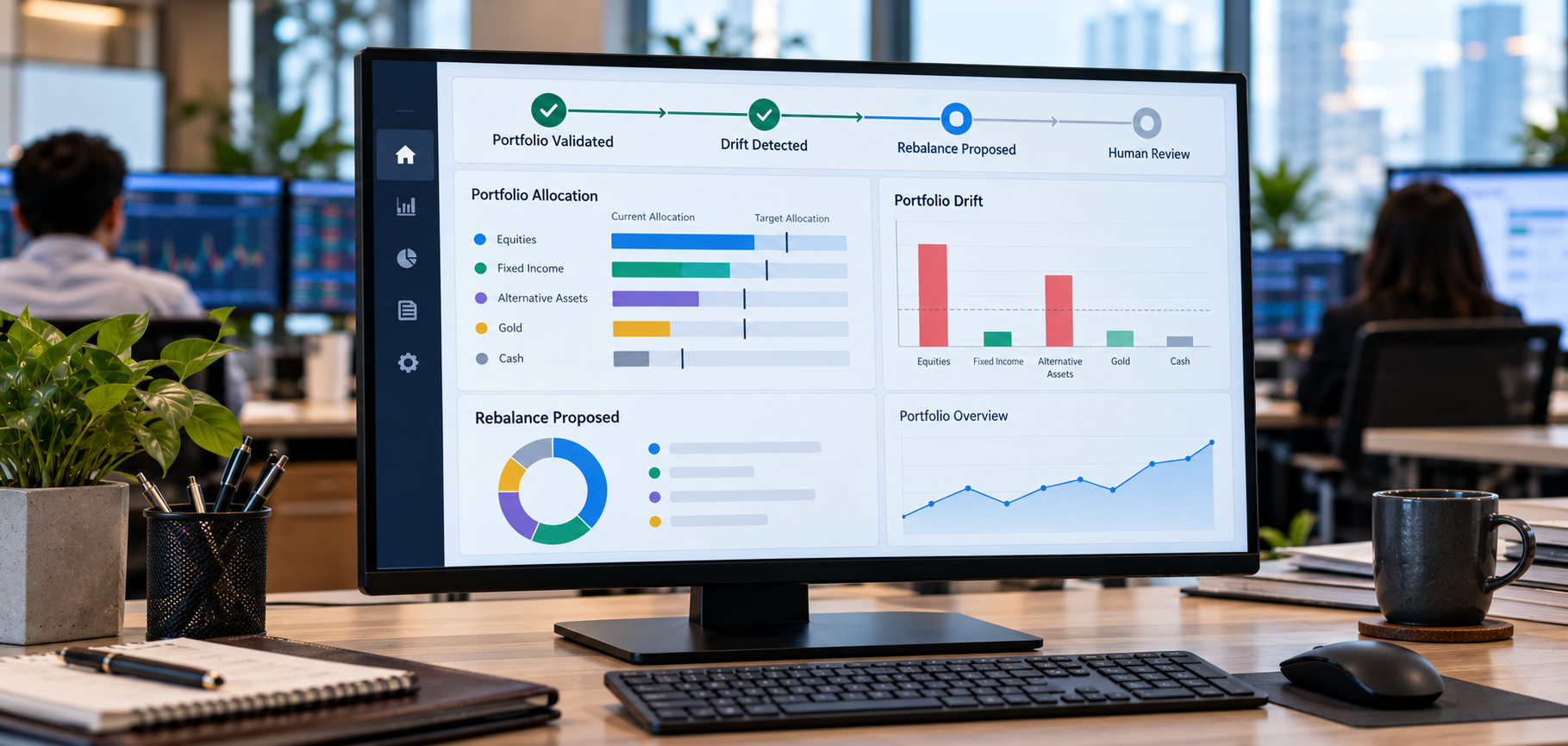


A portfolio rebalancing product has to do more than compare current holdings with target weights. A production-ready AI portfolio rebalancing framework must work with reliable portfolio data, identify meaningful drift, apply portfolio and transaction constraints, create a feasible proposal, and move that proposal through approval, execution, and reconciliation.
For Bengaluru WealthTech and PMS teams, automated portfolio rebalancing is therefore an engineering workflow, not a single AI model. The safest design separates calculations, optimization, controls, and human oversight so each decision can be reviewed and traced.
Rebalancing Starts with Portfolio State, Not With AI
Portfolio drift is the difference between a portfolio's current allocation and its intended allocation. Portfolio drift monitoring measures that difference using current holdings, prices, cash, and target weights.
That sounds simple, but the quality of the result depends on the portfolio state supplied to the engine. A production system may need to account for current positions, available cash, pending orders, deposits and withdrawals, corporate actions, security restrictions, price freshness, and the active target model.
This is especially important in model portfolio management, where a strategy change or a new model version can alter the intended allocation. If the system compares today's holdings against an outdated target or stale price, the resulting rebalance can be technically correct but operationally wrong.
The data layer should therefore validate inputs before a drift calculation is allowed to trigger the next stage.
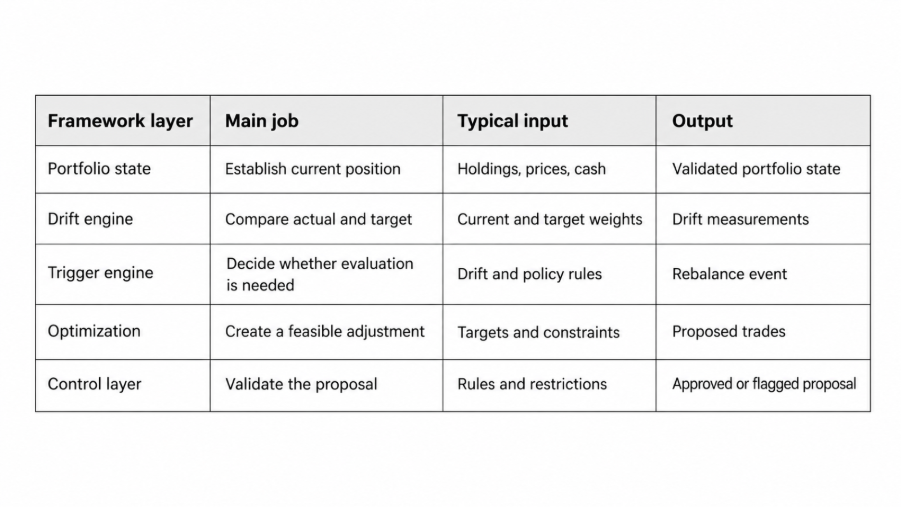
Build the Rebalancing Engine as Separate Decision Layers
A robust engine becomes easier to test when each layer has one clear responsibility.
Calculate Drift Against the Target Allocation
A portfolio rebalancing algorithm first compares current portfolio weights with target weights. Depending on the product, this comparison may happen at security, asset-class, strategy, or overall portfolio level.
The calculation itself does not need AI. It is normally deterministic. The platform should define how weights are calculated, which price is considered valid, how cash is treated, and which target version applies.
Decide Whether the Drift Requires Action
Detecting drift should not automatically create an order. The trigger layer decides whether the difference warrants further evaluation.
A platform can use calendar-based checks, threshold-based rules, a combination of both, or cash-flow-aware logic that considers deposits and withdrawals before proposing trades. The correct policy depends on the investment approach and the platform's operating rules.
This separation is useful because monitoring can run continuously or at scheduled intervals while trade proposals are created only when defined conditions are met.
Generate a Constrained Rebalancing Proposal
Once the trigger condition is satisfied, the optimization layer can determine how the portfolio could move toward its target.
A practical system may need to consider available cash, restricted securities, asset eligibility, liquidity, minimum or maximum exposure rules, existing orders, and trading costs. Transaction-cost-aware rebalancing is particularly useful when a mathematically cleaner allocation would create unnecessary or uneconomic trading.
The team may also evaluate portfolio optimization with machine learning when predictive inputs or learned risk patterns genuinely improve a specific decision. Machine learning is not a substitute for deterministic constraints. Mathematical optimization, statistical methods, business rules, and ML can coexist in the same framework.
Turn a Rebalancing Proposal into a Controlled Execution Workflow
A proposed allocation is not the same as a completed rebalance. Before an AI wealth management platform creates or routes orders, it should validate the proposal against the latest operational state.
Checks can include available cash, portfolio restrictions, pending transactions, duplicated orders, security eligibility, data freshness, and execution limits. If a validation fails, the system should create an exception for review rather than silently forcing the trade through.
A useful production flow is:
Proposal → policy validation → human or authorized approval → broker or execution integration → order status → reconciliation
This matters because real execution can differ from the original proposal. An order can be rejected, partially filled, delayed, or executed after the market price has moved. The portfolio state must be updated from actual execution results before the system decides that rebalancing is complete.
For teams building connected portfolio systems, fintech software development also includes the APIs and backend workflows that connect the rebalancing engine with portfolio records, execution services, reporting tools, and customer-facing applications.
Decide Where AI and Machine Learning Actually Add Value
Portfolio rebalancing does not require AI in every layer. Allocation calculations, policy limits, approval conditions, and portfolio restrictions are often better represented as deterministic logic because the outcome needs to be predictable and testable.
AI and ML can add value where the problem is genuinely analytical. Examples include anomaly detection, risk estimation, forecasting relevant inputs, analyzing patterns across large datasets, or prioritizing cases that require closer review.
Generative AI can support a different part of the workflow. It can explain why a proposal was generated, summarize exceptions, or help operations teams understand the factors behind a flagged portfolio. It should not be treated as an unrestricted substitute for the investment policy.
When custom analytical components are required, machine learning development services can support data preparation, custom models, testing, deployment, and integration with the wider portfolio platform.
Production Safeguards Matter as Much as Optimization Logic
A rebalancing system should make its decisions traceable. For each proposal, the platform should be able to record the portfolio state used, target model version, trigger condition, constraints applied, proposed changes, approval status, overrides, execution outcome, and final reconciliation.
That audit trail helps teams investigate unexpected results, resolve operational exceptions, and understand why a portfolio changed.
For an Indian PMS-oriented product, technology also needs to fit the documented investment process. The SEBI July 2025 Master Circular for Portfolio Managers states that descriptions of an Investment Approach should include elements such as the investment objective, types of securities, basis of selection, portfolio allocation, benchmark, investment horizon, and associated risks. The technology should support the firm's defined process rather than allowing an AI component to create a separate, uncontrolled investment policy.
Other production controls can include role-based access, authenticated APIs, encryption, data lineage, model and configuration versioning, system logs, monitoring, and manual exception handling. Which controls are required will depend on the product architecture, data handled, operating model, and applicable compliance requirements.
A Practical Build Sequence for a Bengaluru WealthTech Team
Teams evaluating how to build an AI portfolio rebalancing engine should start with the investment and operating rules, then design the technology around them.
- Define target allocation logic, drift rules, rebalancing triggers, restrictions, and approval requirements.
- Map holdings, prices, cash, transactions, portfolio models, and other required data sources.
- Build and test the deterministic portfolio-state, drift, and trigger components.
- Add optimization or ML only where it solves a defined analytical problem.
- Connect proposal validation with approval, execution, exception, and reconciliation workflows.
- Test edge cases such as stale prices, missing data, corporate actions, restricted securities, rejected orders, and partial fills.
- Monitor data quality, integration failures, configuration changes, and decision outputs after deployment.
A team working with an AI development company in Bengaluru should also review how data pipelines, APIs, AI or ML components, backend services, security controls, and cloud deployment will operate as one system rather than as separate features.
Frequently Asked Questions
How does automated portfolio rebalancing work?
The system establishes the current portfolio state, compares it with the target allocation, measures drift, applies trigger rules, generates a feasible proposal, validates that proposal, routes it through the required approval or execution process, and reconciles the final order results.
How does AI detect portfolio drift?
The basic drift calculation normally does not require AI. It compares current portfolio weights with target weights. AI or ML can support related tasks such as anomaly detection, risk analysis, forecasting, or prioritizing unusual cases for review.
When should a portfolio be rebalanced?
A platform may use calendar-based, threshold-based, hybrid, or cash-flow-aware rules. The appropriate approach depends on the documented investment process, portfolio design, costs, restrictions, and operating requirements rather than one universal trigger.
Does an AI portfolio rebalancing system automatically place trades?
Not necessarily. A system can create recommendations for human review, route proposals through an authorized approval workflow, or support higher levels of automation where the product's permissions, controls, and operating model allow it.
What data does a portfolio rebalancing engine need?
Typical inputs include holdings, validated prices, available cash, target weights, pending transactions, portfolio restrictions, model versions, and relevant transaction or market data. The exact data set depends on how the investment product is structured.
Conclusion
A reliable portfolio rebalancing system combines accurate portfolio data, transparent drift logic, constrained optimization, controlled execution, reconciliation, and a clear audit trail. AI and ML should be applied only where they improve a defined analytical or operational task.
Theta Technolabs can build these components using technologies such as Python, TensorFlow or PyTorch, and REST APIs, with cloud deployment where appropriate. These technologies are part of the company's Bengaluru AI development stack. The final architecture should remain aligned with the WealthTech platform's investment rules, integrations, security requirements, and review process.
For businesses planning to build an AI-driven portfolio rebalancing solution, Theta Technolabs can support the development and integration process. Contact us at sales@thetatechnolabs.com.