A busy Garba evening involves much more than music and dancing. Organisers coordinate entry gates, answer ticket questions, prepare parking arrangements, and respond as crowds move around the venue. Across nine nights, even small communication gaps can create extra work.
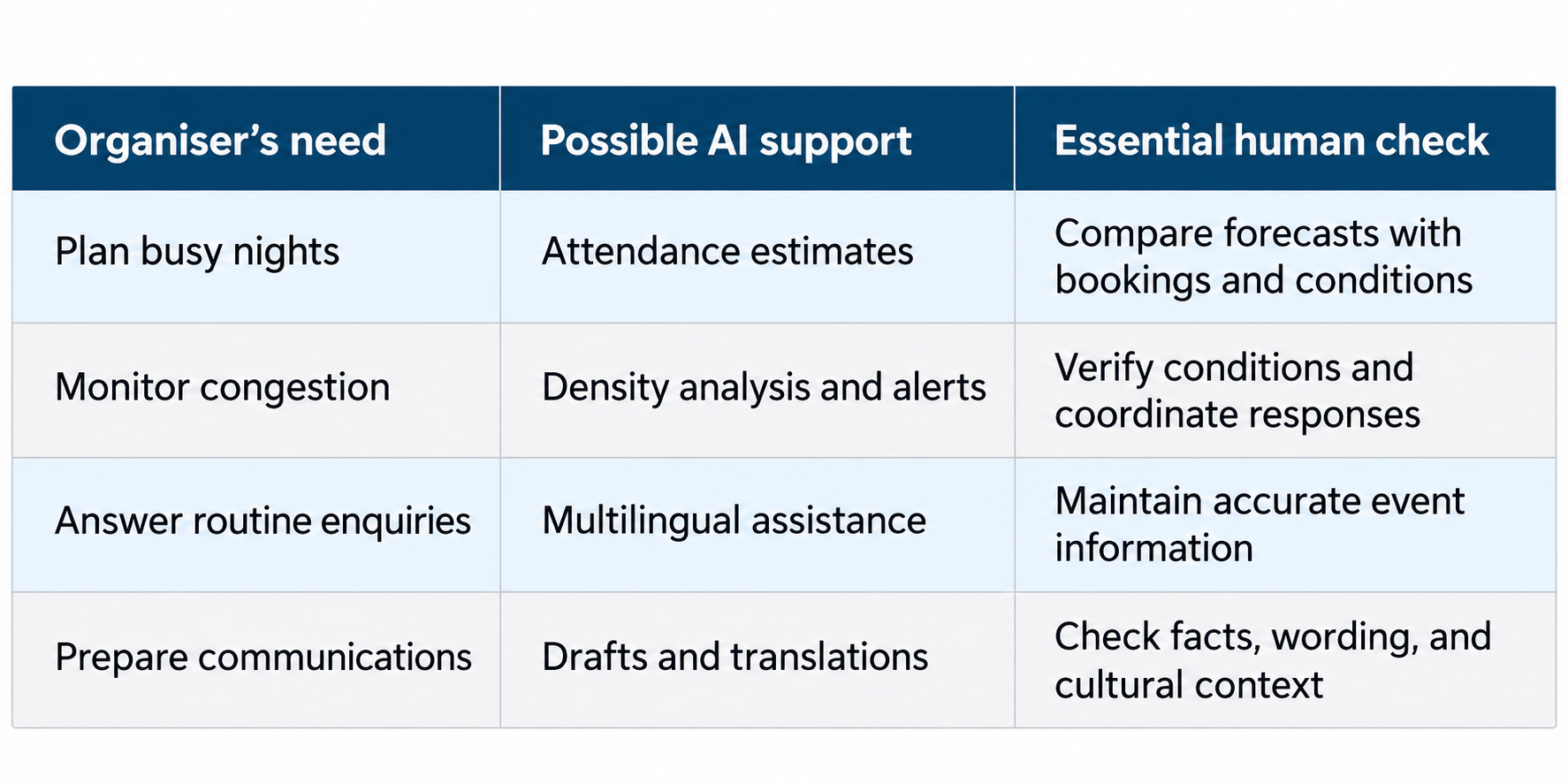
AI can support these responsibilities through attendance estimates, multilingual assistance, and crowd-monitoring insights. Its usefulness depends on reliable information, suitable infrastructure, and people who can review the results.
So, can AI make Navratri celebrations smarter, safer, and more efficient? It can contribute to all three, provided organisers choose appropriate applications and understand their limitations.
Where Can AI Help Navratri Organisers?
AI in Navratri celebrations should begin with a specific operational need. An organiser handling repeated enquiries has different requirements from a venue team monitoring crowded areas.
Three applications are particularly relevant:
- Predictive analytics: Analyses patterns to support attendance and resource planning.
- Computer vision: Analyses camera footage to estimate crowd density or identify conditions requiring attention.
- Conversational AI: Answers questions using approved event information.
Some useful features need ordinary automation instead. QR pass validation, booking confirmations, and scheduled reminders do not automatically require AI.
This distinction matters when assessing AI for Navratri event management. Choosing technology around a clearly defined problem helps organisers avoid unnecessary complexity and focus spending where it can provide value.
Smarter Planning with Attendance Forecasting
Attendance can vary considerably between Navratri nights. Weekends, artist schedules, ticket demand, weather, and nearby events may influence turnout.
Festival attendance forecasting can help organisers examine these factors together. A model could analyse previous check-ins, current bookings, and relevant calendar information to estimate attendance for each night.
Consider an illustrative Garba organiser in Ahmedabad. Bookings suggest stronger demand for Saturday, while earlier seasons show concentrated arrivals shortly after gates open. These patterns could help the team prepare staffing and registration arrangements.
However, ticket sales are not the same as attendance. Season-pass holders may skip nights, and last-minute changes can affect turnout. Forecasts should therefore include uncertainty and be compared with actual results.
For a first-time event with little historical data, simple booking reports and cautious scenarios may be more useful than a complex model.
Supporting Safety with AI Crowd Monitoring
Crowd density monitoring can give operations teams additional visibility into busy areas. Suitable systems analyse video from defined zones and flag conditions that require staff assessment.
For example, a system might highlight increasing density near an entrance. Staff can check the situation, identify the cause, and coordinate a response under the venue’s crowd-management procedures.
A local example comes from Gujarat Samachar, which reported in September 2026 that Ahmedabad police planned AI-enabled cameras to assess crowd density and monitor capacity at Garba venues. This establishes a reported plan for AI crowd monitoring in Ahmedabad, rather than proof of improved safety outcomes.
Organisers exploring computer vision development services should assess camera coverage, lighting, processing needs, and compatibility with existing equipment. Low light, overlapping people, and obstructed views can affect estimates.
NDMA’s crowd-management guide places technology within a broader framework of planning, preparedness, and coordinated responsibilities. AI crowd management for Garba events should support those arrangements, with trained personnel responsible for decisions and responses.
Improving Entry Flow with Connected Event Systems
Organisers asking how to reduce queues at Garba events should first examine the complete entry process. Delays may come from unclear instructions, incorrect passes, payment disputes, or insufficient scanning capacity.
Connected registration and ticketing systems can address several of these problems without AI. They can validate pass dates, identify previously scanned credentials, and give staff consistent information.
AI may provide additional support by analysing arrival patterns or estimating queue conditions from suitable camera feeds. Its contribution should be evaluated separately from the booking platform.
The Indian Express reported that Vadodara district police introduced a Navratri safety app involving QR registration, location tracking, and SOS communication. These digital features illustrate why event technology should not automatically be described as AI.
Entry arrangements also need fallback procedures. Staff should know how to handle connectivity failures, device problems, and exceptions without creating confusion.
Multilingual AI Assistants for Attendee Questions
Ticket enquiries can occupy staff throughout the day. Attendees ask about timings, parking, age restrictions, pass validity, and venue facilities.
Multilingual AI chatbots for events can answer routine questions in Gujarati, Hindi, and English when connected to approved information.
For instance, an attendee might ask whether a season pass allows re-entry. The assistant should retrieve the organiser’s published rule. If the information is missing, it should direct the person to staff instead of inventing an answer.
Effective AI chatbot development services involve maintaining that information, testing language quality, and connecting relevant systems where needed.
Booking-specific requests require appropriate identity checks. Refund disputes and urgent concerns need clear access to human support. Organisers should also update changed schedules promptly so the assistant does not repeat outdated details.
Reducing Repetitive Promotional and Administrative Work
Generative AI can assist with routine drafting around the event. Teams might use it to prepare caption options, translate an announcement, or summarise recurring attendee enquiries.
For example, staff could provide approved parking instructions and request shorter versions for different communication channels. A reviewer would check that directions and timings remain accurate.
AI-assisted translation needs particular care with regional expressions and venue names. Generated images should also be reviewed before publication.
What Organisers Should Check Before Using AI
Successful Navratri event management in India depends on preparation as much as software.
Start with data quality. Duplicate booking records, incomplete check-ins, and outdated venue details can undermine useful outputs. Assign responsibility for maintaining each information source.
Test systems under realistic conditions. Crowd analysis needs suitable evening footage, while chatbots need questions written in everyday language, including mixed Gujarati-English or Hindi-English messages.
Privacy requirements should shape the design. Limit information collection to the purpose, control access, and define retention arrangements. Aggregate crowd counting and facial identification are different applications; monitoring density does not automatically require identifying attendees.
Finally, document fallback procedures and staff responsibilities. A person should own each alert, information update, and unresolved enquiry. Measure performance using relevant indicators such as answer accuracy, false alerts, or forecast error.
Choosing the Right AI Solution for Your Event
An existing platform may already meet the organiser’s needs. Custom development becomes more relevant when several systems must exchange information or a specific workflow is missing.
Businesses exploring AI development services in India should define one priority problem, review available data, and agree on measurable outcomes. Evaluate results before expanding the scope.
Conclusion
AI can help organisers plan more carefully, communicate consistently, and identify conditions requiring attention. Its contribution depends on good information, tested systems, and responsible staff. Thoughtful implementation can support a smoother Navratri experience while preserving the celebration’s human and cultural character.
Frequently Asked Questions
1. Can AI guarantee safety at Garba venues?
No. AI can support monitoring, but venue planning, trained personnel, and coordinated responses remain essential.
2. Do QR passes require AI?
No. Standard ticketing software can validate QR passes and record entry without AI.
3. Can small organisers use AI?
Yes. They can start with existing tools for routine enquiries or communication drafts, with appropriate review.
4. Can existing CCTV cameras support AI?
Possibly. Suitability depends on coverage, image quality, connectivity, and the proposed analysis.
5. What data helps attendance forecasting?
Useful inputs include bookings, previous check-ins, schedules, and relevant conditions. Limited data increases uncertainty.
Discuss Your AI Requirements with Theta Technolabs
Theta Technolabs helps businesses assess and develop AI solutions for web, mobile, and cloud applications. For attendee support, video analysis, or connected operational tools, contact us at sales@thetatechnolabs.com to discuss your requirements.


_Explore%20the%20Best%20Cross-Platform%20App%20Development%20Frameworks%20of%202024_Q3_24.avif)

_Integrating%20IoT%20with%20Mobile%20Apps%20for%20Advanced%20Renewable%20Energy%20Solutions_Q2_24.avif)
_Top%20Benefits%20of%20Cloud%20Computing%20for%20All%20Business%20Sectors_Q2_24.avif)
_Understanding%20the%20Impact%20of%20AI%20and%20Machine%20Learning%20on%20Fintech%20Web%20Apps%20in%20Dubai_Q2_24.avif)


_Smart%20Manufacturing%20in%20Dubai_%20How%20AI%20is%20Driving%20Efficiency%20and%20Innovation_Q1_In_24.avif)
_Automated%20Checkout%20Systems.avif)
_Smart%20Solutions%20for%20Healthcare_%20How%20IoT%20Development%20is%20Reshaping%20Dubai%20Hospitals_Q1_In_24.avif)
_Computer%20Vision-enabled%20Web%20and%20Mobile%20Interfaces%20for%20Mall%20Management%20in%20Dubai_Q1_In_24.avif)