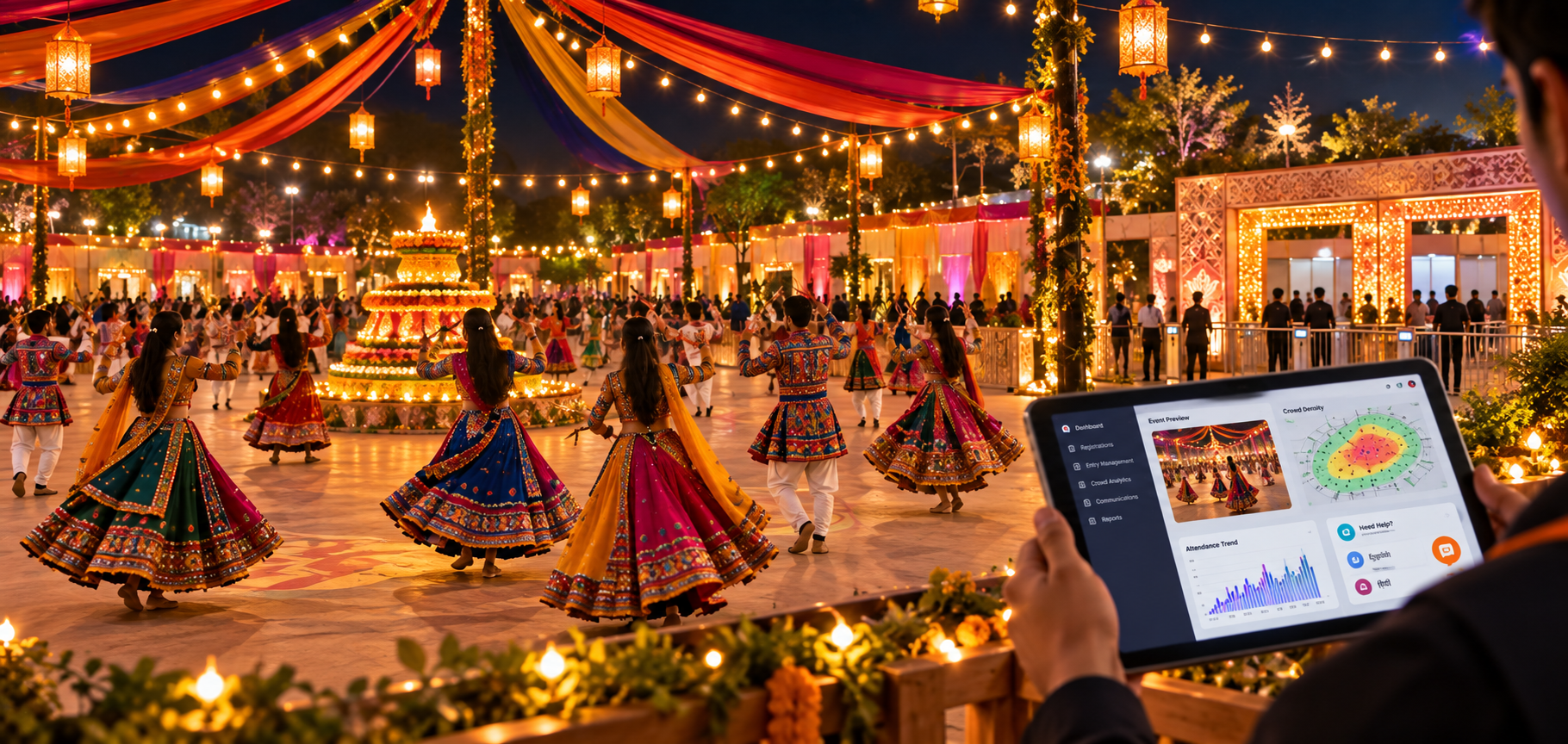


The music begins, colourful outfits fill the Garba ground, and groups gather for another evening of celebration. Behind the festive atmosphere, organisers manage a different rhythm: promotional updates, ticket enquiries, entry queues, parking questions, and changing attendance.
Artificial intelligence can support parts of this work. Participants can explore creative ideas, while organisers can use AI to draft content, answer common questions, and analyse information for planning.add
However, AI in Navratri celebrations involves more than generating festive photographs. Its value depends on choosing useful applications, checking the results, and keeping people responsible for important decisions. Here is where the technology fits and what Indian organisers should consider.
Where AI Fits into Navratri Celebrations
Different festival needs call for different technologies. Generative AI produces content such as images, text, and music concepts. Analytical AI identifies patterns in data, supporting tasks such as attendance forecasting. Computer vision analyses images or video to help estimate crowd density.
Ordinary automation also plays a role. Sending a booking confirmation or checking a QR pass does not necessarily require AI. Understanding this distinction helps organisers invest in tools that address an actual problem.
For example, a community committee might need help drafting invitations. A larger Garba organiser might need multilingual support connected to event information. Each requirement deserves a suitable solution, rather than adding AI everywhere.
Generative AI for Festive Images, Invitations, and Promotions
Navratri creates plenty of demand for visual content. Participants want festive portraits, while organisers need invitations, artist announcements, sponsor creatives, and reminders across nine nights.
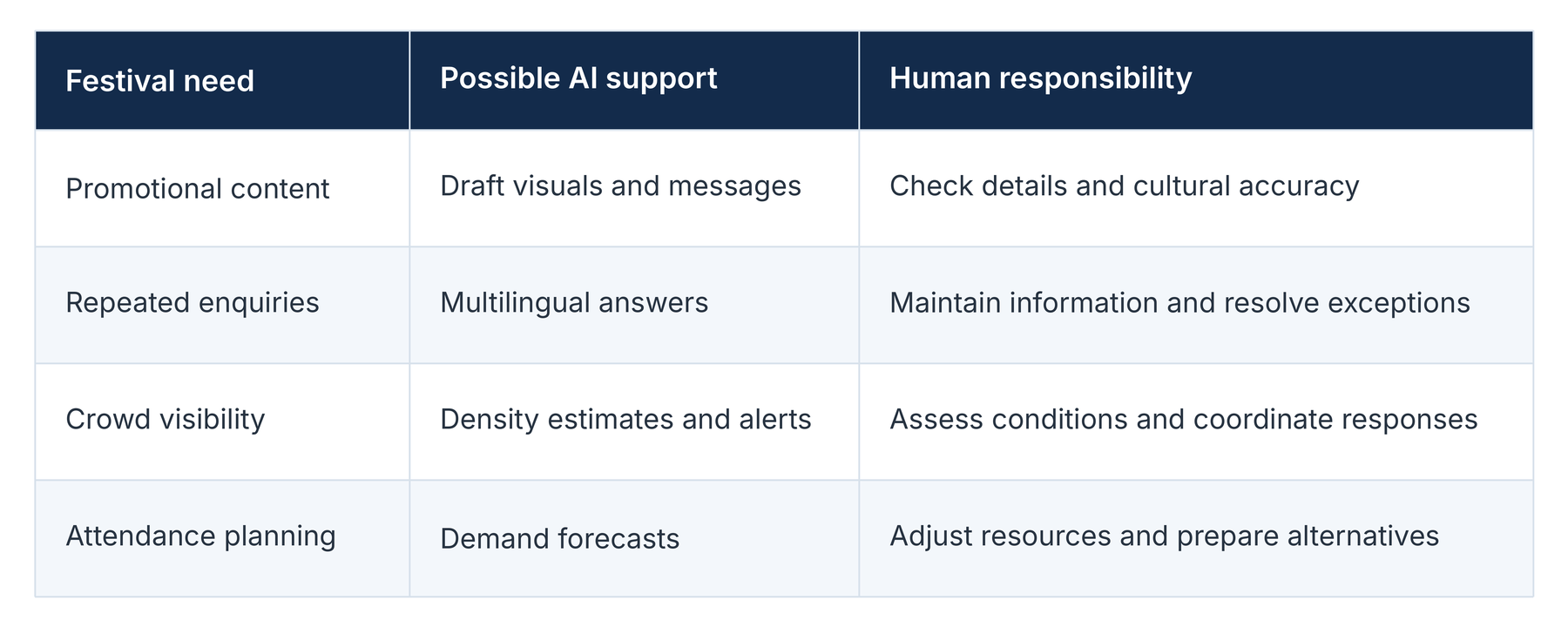
Generative AI for Navratri can help teams explore design directions and prepare first drafts. An organiser could describe traditional colours, mirror-work details, and a Garba setting to generate a background concept. A designer can then add verified event details and refine the final layout.
Google has announced text- and voice-based AI photo editing in India, including support for several Indian languages. This illustrates how users can describe an edit instead of making every adjustment manually.
People looking for Navratri AI photo prompts can start with a clear description of clothing, lighting, and surroundings. However, generated images need checking for distorted hands, incorrect accessories, or misleading cultural details.
AI-generated Navratri invitations require the same care. Dates, venue names, prices, and Gujarati text should be checked before publishing. Important lettering can be added separately using design software.
For businesses producing content regularly, generative AI development services can help build a workflow around approved assets, templates, and review steps.
AI-Assisted Music and Creative Planning
Music remains central to Garba. AI-assisted Garba music creation can support early experimentation with lyric drafts, instrumental ideas, and short promotional audio concepts.
For example, a creative team might explore different arrangements for an event announcement before asking musicians to develop the final version. AI can also suggest decoration themes or draft a night-wise content calendar.
These outputs still need cultural judgement. Gujarati pronunciation, devotional wording, rhythm, and the meaning of lyrics should be reviewed by people who understand the tradition.
Teams should also check permissions and tool terms before using generated music commercially. Copying a recognisable song or imitating a singer’s voice without permission can create problems. AI works best here as creative assistance, with artists and organisers guiding the final result.
Multilingual AI Assistants for Attendee Questions
As an event approaches, the same questions often arrive repeatedly. What time do the gates open? Is parking available? Are children allowed? Where can someone collect a pass?
Multilingual AI chatbots for events can help answer these questions using approved information. For Indian audiences, support in Gujarati, Hindi, and English can make communication more accessible, provided each language is tested properly.
Consider an attendee asking, “Can I use my season pass on Saturday?” The assistant should refer to the organiser’s actual pass rules. If it cannot find a reliable answer, it should direct the person to a staff member.
This requires more than a conversational interface. Organisers need a maintained information source, a process for updating changes, and clear limits on what the assistant can answer.
Through AI chatbot development services, businesses can connect an assistant to relevant systems and verified event details. Booking-specific answers should require appropriate identity checks, while refunds, disputes, and urgent concerns should have a clear route to human support.
AI for Crowd Monitoring and Attendance Planning
Large Garba venues need visibility into how people arrive, move, and gather. AI crowd management for Garba events can support staff by analysing camera feeds and flagging areas that may need attention.
In September 2026, Gujarat Samachar reported that Ahmedabad police planned to use AI-enabled cameras to assess crowd density and monitor capacity at Garba venues. This is a reported local plan, rather than evidence of guaranteed safety outcomes.
Such systems depend on camera positioning, lighting, venue layout, and testing under realistic conditions. An alert is useful only when trained staff can assess it and respond. Technology must sit alongside physical crowd-management arrangements.
Festival attendance forecasting addresses a separate planning need. Historical ticket sales, check-in records, day-of-week patterns, and current bookings may help estimate demand for individual nights.
These estimates can inform staffing, gate preparation, and vendor coordination. Unexpected weather or programme changes can still affect attendance, so organisers should treat forecasts as planning support.
Using AI While Respecting Privacy and Tradition
Navratri carries religious, cultural, and community meaning. Garba of Gujarat was inscribed on UNESCO’s Representative List of the Intangible Cultural Heritage of Humanity in 2023, highlighting the importance of the living tradition.
Applications of artificial intelligence in Indian festivals should respect that context. Generated content should be reviewed for inaccurate symbols, inappropriate scenes, and confusion between regional customs. A design that looks festive may still misrepresent a practice.
Privacy also deserves practical attention. Organisers should explain what information they collect and how it will be used. Access to attendee records, photographs, and camera footage should be limited to appropriate personnel.
Crowd counting and facial identification serve different purposes. Organisers should assess whether identification is necessary rather than assuming every monitoring application needs it.
Teams should obtain permission before uploading someone else’s photograph to an AI tool. Clearly distinguish generated promotional scenes from photographs of a real event, especially when the image could influence booking decisions.
Choosing the Right AI Solution for Your Event
Start with the most time-consuming or recurring problem. Is the team struggling with content production, repeated enquiries, or fragmented information?
An existing tool may be sufficient for occasional image concepts or caption drafts. Custom development becomes more relevant when a business needs approved workflows, multiple system connections, controlled access, or support across several events.
Before commissioning a solution, assess the information available, integration requirements, expected usage, and people responsible for maintaining it. A chatbot with outdated answers will create confusion, even if its responses sound natural.
Businesses exploring AI development services in India should define measurable goals, such as answer accuracy, fewer repetitive enquiries, or shorter content-review time. Begin with one manageable application, evaluate the results, and expand when the evidence supports it.
Conclusion: Supporting the Spirit of Navratri
Navratri brings people together through devotion, music, dance, and shared experiences. AI can support the preparation and coordination around those experiences when its role is clearly defined.
From creative drafts to multilingual assistance and planning insights, useful applications begin with real needs and careful review. Theta Technolabs helps businesses assess and develop suitable AI solutions, keeping their operational requirements, available data, and users at the centre of the process.
Frequently Asked Questions
1. How can AI help Navratri event organisers?
AI can help organisers draft promotional content, answer common attendee questions, analyse booking patterns, and monitor crowd density. The right application depends on the event’s requirements, available data, and staff capacity.
2. What is the difference between generative AI and automation in Garba events?
Generative AI creates content such as invitation drafts, images, and promotional messages. Automation follows predefined steps, such as sending booking confirmations or validating QR passes. These automated tasks do not always require AI.
3. Can an AI chatbot answer Navratri event questions in Gujarati and Hindi?
Yes, a suitably developed and tested chatbot can answer questions in Gujarati, Hindi, and other supported languages. It should use verified event information and direct uncertain or sensitive enquiries to a staff member.
4. Can small Navratri organisers use AI without developing custom software?
Yes. Existing AI tools can help with occasional tasks such as drafting captions, exploring decoration ideas, and preparing invitation concepts. Custom software becomes more relevant when organisers need connections to booking systems, controlled workflows, or support across multiple events.
5. Can AI replace staff responsible for crowd management?
AI can support staff with crowd estimates and alerts, but trained personnel remain essential. They must assess conditions, manage entry, coordinate responses, and follow the venue’s safety procedures.
Discuss Your AI Requirements with Theta Technolabs
Looking to simplify attendee enquiries, improve festive content workflows, or connect AI with your existing event systems? Theta Technolabs develops custom AI solutions for web, mobile, and cloud applications based on your business needs. Contact us at sales@thetatechnolabs.com to discuss a suitable approach for your organisation.


_Explore%20the%20Best%20Cross-Platform%20App%20Development%20Frameworks%20of%202024_Q3_24.avif)

_Integrating%20IoT%20with%20Mobile%20Apps%20for%20Advanced%20Renewable%20Energy%20Solutions_Q2_24.avif)
_Top%20Benefits%20of%20Cloud%20Computing%20for%20All%20Business%20Sectors_Q2_24.avif)
_Understanding%20the%20Impact%20of%20AI%20and%20Machine%20Learning%20on%20Fintech%20Web%20Apps%20in%20Dubai_Q2_24.avif)


_Smart%20Manufacturing%20in%20Dubai_%20How%20AI%20is%20Driving%20Efficiency%20and%20Innovation_Q1_In_24.avif)
_Automated%20Checkout%20Systems.avif)
_Smart%20Solutions%20for%20Healthcare_%20How%20IoT%20Development%20is%20Reshaping%20Dubai%20Hospitals_Q1_In_24.avif)
_Computer%20Vision-enabled%20Web%20and%20Mobile%20Interfaces%20for%20Mall%20Management%20in%20Dubai_Q1_In_24.avif)