Telemedicine now plays a pivotal role in transforming how modern healthcare services are delievered. Hospitals and healthcare providers are increasingly relying on virtual consultations to manage rising patient volumes, extend care access, and reduce operational strain. However, as telemedicine adoption grows, triage accuracy and efficiency have emerged as major challenges.
This is where AI telemedicine triage systems are transforming how virtual care is delivered. AI aids clinicians by offering intelligent decision support and risk analysis, helping healthcare providers enhance patient care while alleviating clinician burden.
In 2026, AI-driven triage has transitioned from a competitive advantage to a regulatory necessity. By leveraging ABDM-compliant systems, healthcare providers are now reducing 'Time-to-Treatment' (TTT) by over 25% while automating up to 40% of preliminary clinical documentation, directly addressing the critical nursing shortage crisis
Key Challenges in Current Telemedicine Triage Workflows
While telemedicine offers great convenience, several healthcare providers continue to use manual or partially structured triage methods in virtual consultations. These workflows introduce several operational risks.
Common challenges include:
- Inconsistent symptom evaluation across clinicians
- Difficulty identifying high-risk cases during peak consultation hours
- Increased clinician burnout due to repetitive decision-making
- Delays in escalating critical patients
- Fragmented documentation within virtual care platforms
Manual triage heavily relies on clinician experience and available time, which often introduces inconsistencies in patient risk assessment and clinical workflows. As virtual care volumes grow, these inefficiencies become more pronounced.
While telemedicine has expanded access, it has also introduced a 'digital bottleneck' where clinicians face acute decision fatigue from manually sorting through high-volume, low-acuity inquiries
Role of AI in Modern Telemedicine Triage Systems
AI introduces speed, consistency, and structure to telemedicine triage, while preserving the essential role of clinical judgment. Instead, it acts as a decision-support layer that enhances how clinicians assess patient urgency.
With AI-powered clinical triage, healthcare providers can:
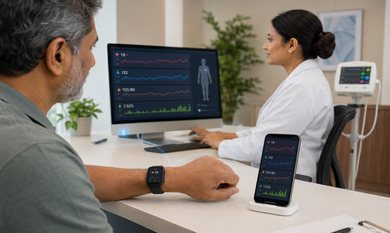
- Analyze patient symptoms in real time
- Identify risk patterns that may not be immediately visible
- Prioritize patients based on severity rather than arrival order
- Support clinicians with data-backed recommendations
Trained on past clinical data, symptom patterns, and outcomes, AI models assist clinicians in delivering quicker and more evidence-based triage decisions.
How AI-Enabled Telemedicine Triage Works in Practice
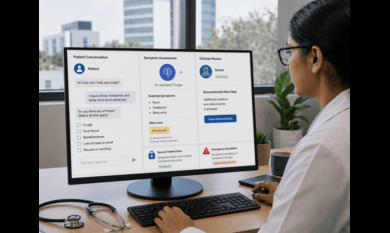
An AI-driven triage system integrates seamlessly into existing virtual care platforms. The process typically follows a structured flow:
- Patients report their symptoms using voice input, forms, or chat-based interfaces.
- AI classifies symptoms using predefined clinical logic and learning models
- Risk levels are assigned based on urgency and historical outcomes
- Clinicians receive alerts for high-risk or time-sensitive cases
- The AI system evolves over time by learning from real-world outcomes and clinician feedback.
This approach ensures that critical patients are identified early while routine cases are handled efficiently, improving overall clinical workflows.
Technical Architecture and System Integration Considerations
For AI triage systems to deliver real value, they must integrate smoothly with existing hospital infrastructure. Most implementations rely on modular, API-driven architectures.
Key technical considerations include:
- Integration with telemedicine platforms and EHR systems
- Secure data exchange through encrypted APIs
- Cloud-based deployment for scalability and availability
- Ongoing monitoring and model performance management
Today's telemedicine decision support systems integrate with existing clinical tools to streamline operations without causing workflow disruptions. By utilizing RAG (Retrieval-Augmented Generation) systems, our AI provides clinically grounded responses that are always verified against the latest hospital-specific protocols, eliminating the risk of AI 'hallucinations
Data Privacy, Security, and Healthcare Compliance Readiness
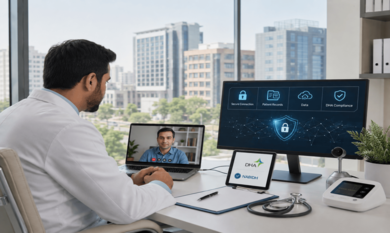
Healthcare data security is a critical concern, especially in virtual care environments. AI triage systems must adhere to strict privacy and compliance standards to maintain trust and accountability.
Key compliance and security aspects include:
- Complete encryption protocols are applied to safeguard all patient data transmissions.
- Explainable AI models for clinical transparency
- Detailed audit trails for triage decisions
- Alignment with NABH Digital Health Standards
- Interoperability readiness under the ABDM framework
By embedding compliance into system design, healthcare providers can adopt AI-driven triage confidently and responsibly.
Real-World Scenario: AI-Driven Telemedicine Triage in Urban Hospitals
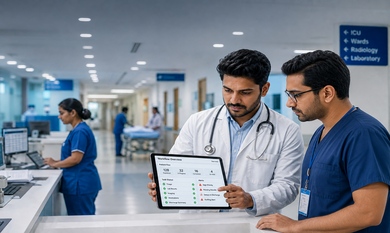
Imagine a major urban hospital that handles thousands of teleconsultations on a monthly basis. During peak hours, clinicians struggle to quickly identify patients who require urgent attention.
By introducing AI-assisted triage:
- Patient symptoms are pre-analyzed before clinician review
- High-risk cases are flagged automatically
- Clinicians focus on critical decision-making rather than manual screening
- Clinician response times accelerate without adding pressure to existing staff workloads.
This scenario highlights how AI enhances patient safety while supporting clinicians under operational pressure.
Measurable ROI and Operational Impact for Healthcare Providers
AI-driven triage systems deliver measurable business and clinical benefits, making them a strategic investment for healthcare organizations.
Healthcare providers commonly report:
- to 15 percent drop in errors related to triage after AI adoption.
- 20 to 30 percent faster patient prioritization
- Nearly 20 percent reduction in clinical documentation time
- Improved clinician efficiency and satisfaction
Beyond cost savings, these improvements directly contribute to better patient outcomes and scalable virtual care delivery.
Why Hospitals Are Adopting AI-Based Triage Systems Today
Hospitals are under growing pressure to deliver consistent, high-quality care across both physical and virtual channels. Factors driving AI adoption include:
- Patients increasingly expect quicker and more responsive virtual care experiences.
- Ongoing clinician shortages
- Increasing complexity of patient cases
- The need for standardized clinical decision-making
In healthcare hubs like Ahmedabad, where patient volumes continue to grow, AI-based triage systems are becoming essential for sustainable telemedicine operations.
Conclusion: Building Safer and More Scalable Telemedicine Models
AI is redefining telemedicine triage by injecting speed, intelligence, and uniformity into virtual care processes. When implemented responsibly, AI supports clinicians, reduces burnout, and improves patient safety without compromising clinical autonomy.
To modernize virtual care systems, many healthcare organizations now turn to seasoned partners like an AI development company in Ahmedabad to design compliant, scalable, and clinically aligned solutions.
Talk to our team
At Theta Technolabs, we help healthcare organizations build secure and scalable AI-driven healthcare platforms. Our expertise spans Web, Mobile, and Cloud development, enabling seamless integration of intelligent systems into existing healthcare workflows.
If you are exploring AI-powered telemedicine solutions tailored to your clinical and operational needs, connect with our team at sales@thetatechnolabs.com.
Frequently Asked Questions
- How does AI improve accuracy in telemedicine triage?
AI analyzes symptom patterns and historical outcomes to support clinicians with consistent risk assessment and prioritization.
- Is AI-based triage safe for clinical decision-making?
Yes. AI functions as a decision-support tool, while final clinical decisions remain with qualified healthcare professionals.
- Can AI triage systems integrate with existing hospital software?
Modern systems are designed for seamless integration with telemedicine platforms and EHRs using secure APIs.
- How does AI triage help reduce clinician burnout?
By automating repetitive screening tasks, AI allows clinicians to focus on complex and high-risk cases.
- Are AI telemedicine triage systems compliant with Indian healthcare regulations?
When properly designed, these systems align with NABH Digital Health Standards and ABDM interoperability guidelines.
- Is AI-driven triage ABDM compliant in 2026?
Yes, modern systems are certified for ABDM M3 compliance, allowing for the secure generation of ABHA-linked health records.