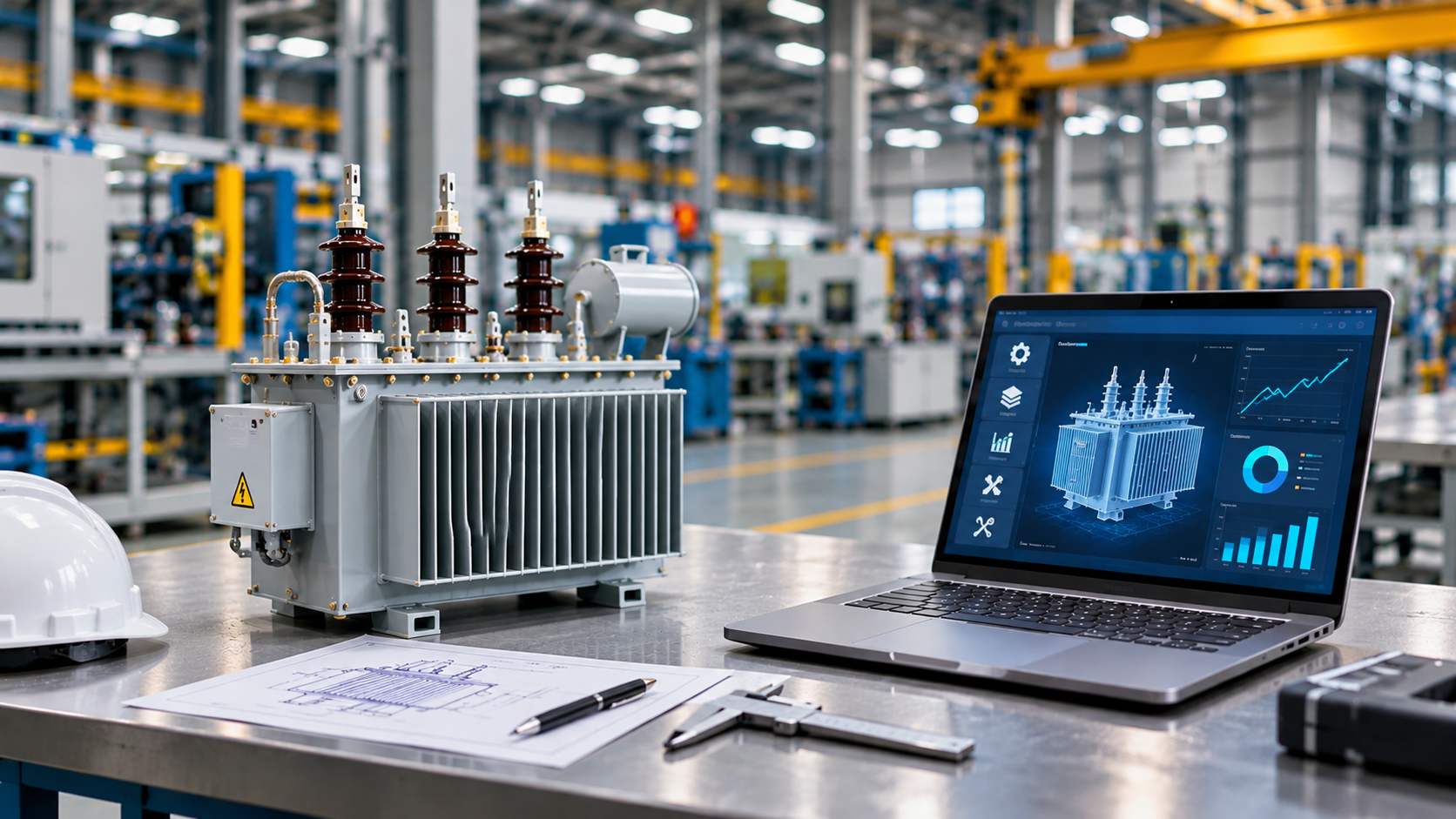


Electrical transformer manufacturing involves complex engineering calculations, material planning, production coordination, and technical documentation. Every customer may have different requirements related to transformer capacity, voltage, cooling methods, operating conditions, and budget.
Managing these requirements manually can increase engineering workloads, delay quotations, and make cost control difficult. For small and mid-sized manufacturers, these challenges can become even more demanding when teams and resources are limited.
Artificial Intelligence (AI) offers practical ways to simplify these processes. From assisting with transformer design to automating quotations and improving inventory management, AI can help manufacturers streamline operations and make informed business decisions.
Let's explore how AI can support different aspects of electrical transformer manufacturing.
1. Automating Transformer Design and Engineering with AI
Transformer design requires engineers to evaluate electrical specifications, calculate winding parameters, determine core dimensions, and select suitable insulation materials. For customized orders, these calculations and design modifications can consume considerable time.
AI-powered design automation can assist engineers by analyzing historical transformer designs, engineering records, and previously completed work orders.
For example, an AI-assisted system can use customer specifications, such as kVA rating, primary and secondary voltage, frequency, and cooling requirements, to generate preliminary design configurations.
It can also help with:
- Preliminary winding and core calculations.
- Copper and electrical steel requirement estimation.
- Comparing alternative design configurations.
- Generating technical datasheets.
- Identifying potential inconsistencies in design inputs.
With transformer design automation, engineers can spend less time on repetitive calculations and more time evaluating technical requirements and improving design efficiency.
However, AI-generated calculations and designs must undergo validation by qualified engineers before manufacturing.
2. Optimizing Transformer Material Usage and Costs
Copper, electrical steel, insulation materials, and transformer oil contribute significantly to transformer manufacturing costs. Inefficient material utilization or inaccurate estimation can affect production expenses and order profitability.
AI can support transformer material optimization by analyzing historical consumption, current inventory, design specifications, and material prices.
For instance, when preparing a customized transformer design, an AI-enabled system can estimate the required copper and core materials and compare different technically acceptable configurations.
If a particular material is unavailable, the system can identify potential alternatives or design adjustments for engineering evaluation.
Manufacturers can use these capabilities to:
- Estimate raw material requirements for individual orders.
- Monitor copper and electrical steel consumption.
- Identify potential material wastage.
- Compare material costs across design options.
- Forecast upcoming procurement requirements.
This helps manufacturers make better use of available inventory while maintaining the required electrical, thermal, and mechanical performance of their transformers.
3. Automating Transformer Sales and Quotation Generation
Preparing quotations for customized transformers involves several activities, including understanding customer specifications, calculating material costs, coordinating with engineering teams, and preparing technical documents.
When these activities are performed manually, even minor changes in transformer specifications can require additional calculations and documentation.
Transformer quotation automation can simplify this workflow.
A salesperson can enter basic customer requirements, including transformer capacity, voltage ratio, number of phases, frequency, cooling method, and other technical specifications.
An integrated system can then use approved engineering rules, design information, material prices, and business pricing logic to assist in generating:
- Technical datasheets.
- General Arrangement (GA) drawings.
- Preliminary material estimates.
- Customer quotations.
- Estimated manufacturing timelines.
In one reported transformer manufacturing business, automating this process reduced the time required to prepare ten quotations from approximately one hour to 15 minutes. Repeat quotations with minor specification changes took around seven minutes.
This demonstrates how customized software can reduce repetitive work and help sales teams respond to customer inquiries more efficiently.
4. Improving Procurement and Transformer Inventory Management
Managing raw materials and supplier relationships is another important responsibility in transformer manufacturing.
Manufacturers regularly purchase copper, electrical steel, insulation materials, bushings, transformer oil, and other electrical components. Tracking availability, supplier prices, delivery schedules, and purchase requirements manually can become complicated.
AI-powered transformer inventory management can help businesses analyze current stock, historical consumption, confirmed orders, and upcoming production requirements.
Some useful applications include:
- Identifying materials approaching minimum stock levels.
- Forecasting raw material requirements.
- Comparing supplier quotations and purchasing history.
- Monitoring potential material shortages.
- Supporting purchase planning based on production schedules.
- Tracking material consumption across transformer orders.
For example, when multiple transformer orders are scheduled for production, an integrated system can consolidate their material requirements and alert procurement teams about potential shortages.
This allows manufacturers to plan purchases more effectively and reduce unnecessary inventory expenses.
5. Improving Financial Visibility and Transformer Pricing
Understanding the actual cost of manufacturing every transformer is essential for maintaining profitable operations.
However, product costing involves more than calculating copper and electrical steel expenses. Manufacturers must also consider labour, electricity, machinery maintenance, testing, transportation, and other production overheads.
AI-powered financial management systems can connect these expenses and provide better visibility into product-wise costs and profit margins.
Manufacturers can use these systems to:
- Calculate estimated manufacturing costs.
- Track material and labour expenses.
- Compare estimated and actual production costs.
- Monitor order-wise profit margins.
- Track outstanding customer payments.
- Generate financial reports.
For example, one transformer manufacturer reported that improved financial visibility helped reduce customer quotations by 15–25% during its initial beta phase, while subsequently winning more orders.
Such pricing decisions should always consider actual costs, market conditions, and required profit margins. AI can support the analysis, helping management make better-informed decisions.
6. Connecting Engineering, Production and Business Operations
Transformer manufacturing involves several interconnected departments. Engineering, procurement, production, quality testing, sales, and dispatch must coordinate to complete every customer order.
When these departments operate using separate spreadsheets or disconnected applications, important information can become difficult to track.
Custom manufacturing software can connect these workflows through a centralized platform.
For example, once a customer confirms a transformer order, the system can create connected workflows for:
- Engineering design and approval.
- Raw material procurement.
- Inventory allocation.
- Production scheduling.
- Quality testing and documentation.
- Dispatch and delivery tracking.
AI can further support these processes by identifying pending activities, summarizing production updates, and highlighting possible delays.
A connected system improves information sharing and gives business owners better visibility into order progress without requiring constant manual follow-ups.
7. Integrating AI with Existing Hardware and Software Systems
AI implementation does not always require manufacturers to replace their existing software or industrial equipment.
Businesses can enhance their current ERP, CRM, production management applications, and compatible hardware through customized software development and integration.
For example, manufacturers can connect compatible sensors and industrial equipment with software platforms to collect operational data and support equipment monitoring.
Similarly, existing applications can be enhanced with AI-powered features for document processing, reporting, inventory analysis, and workflow automation.
With suitable IoT development services, manufacturers can explore integrations involving connected devices, industrial sensors, testing equipment, and centralized software platforms.
The right approach depends on existing infrastructure, equipment compatibility, communication protocols, and business requirements.
8. Developing Custom AI Software for Transformer Manufacturers
Every transformer manufacturing business has different engineering processes, production requirements, and operational challenges. A standard software platform may not cover every specialized workflow.
Custom AI software for transformer manufacturers can address these specific requirements.
As an AI software development company in India, Theta Technolabs helps businesses explore solutions through new software development, enhancement of existing applications, and hardware-software integration.
Whether manufacturers need AI-assisted engineering applications, automated quotation systems, connected inventory platforms, or integrated business software, the solution can be designed around their operational requirements.
The process begins with understanding existing workflows, identifying suitable automation opportunities, and developing solutions that can grow with the business.
Frequently Asked Questions
1. How can AI help electrical transformer manufacturers?
AI can assist transformer manufacturers with preliminary design calculations, material estimation, quotation generation, inventory management, procurement planning, and financial analysis.
2. Can AI automate transformer design calculations?
AI can assist engineers with historical design analysis, preliminary calculations, and design comparisons. Qualified engineers must validate final calculations and approve designs before manufacturing.
3. How can AI reduce material wastage in transformer manufacturing?
AI can analyze material consumption, inventory levels, and design requirements to identify potential wastage, estimate material needs, and compare alternative configurations.
4. Can AI integrate with existing transformer manufacturing software?
Yes. AI capabilities can be integrated into compatible ERP, CRM, inventory, and production management applications through customized software development and suitable system integrations.
5. How can transformer manufacturers develop custom AI software?
Manufacturers can begin by identifying operational challenges, evaluating available business and engineering data, selecting suitable AI applications, and working with a software development partner to build and validate the required solution.
Replace the existing conclusion with this revised version:
Conclusion
AI is creating practical opportunities for electrical transformer manufacturers to improve engineering workflows, optimize material usage, automate quotations, and streamline business operations.
By combining engineering expertise with customized software and AI-powered automation, manufacturers can reduce repetitive work, improve cost visibility, and manage resources more effectively.
At Theta Technolabs, we help businesses turn these opportunities into practical technology solutions. From developing new AI-powered software and enhancing existing applications to integrating software with compatible industrial hardware, we help manufacturers build solutions around their specific operational requirements.
Looking to make your transformer manufacturing operations smarter and more efficient? Let's talk about building the right AI and software solution for your business.















_How%20IoT%20Can%20Reduce%20Energy%20Costs%20in%20Smart%20Factories_Q4_25.avif)
_How%20AI%20Development%20Companies%20in%20Ahmedabad%20are%20Transforming%20the%20Shopping%20Experience_Q4_25.avif)
_Node.js%20and%20Blockchain_%20A%20Perfect%20Pair%20for%20Fintech%20Innovation%20in%20Dubai_Q3_24.avif)
_Choosing%20the%20Right%20Computer%20Vision%20Development%20Partner%20in%20Ahmedabad%20for%20Construction_Q3_24.avif)
_The%20Transformative%20Role%20of%20Open%20Banking%20APIs%20in%20Fintech%20for%202024_Q3_24.avif)
_Explore%20the%20Best%20Cross-Platform%20App%20Development%20Frameworks%20of%202024_Q3_24.avif)


_Integrating%20IoT%20with%20Mobile%20Apps%20for%20Advanced%20Renewable%20Energy%20Solutions_Q2_24.avif)
_Top%20Benefits%20of%20Cloud%20Computing%20for%20All%20Business%20Sectors_Q2_24.avif)

_Understanding%20the%20Impact%20of%20AI%20and%20Machine%20Learning%20on%20Fintech%20Web%20Apps%20in%20Dubai_Q2_24.avif)


_Smart%20Manufacturing%20in%20Dubai_%20How%20AI%20is%20Driving%20Efficiency%20and%20Innovation_Q1_In_24.avif)
_Automated%20Checkout%20Systems.avif)
_Smart%20Solutions%20for%20Healthcare_%20How%20IoT%20Development%20is%20Reshaping%20Dubai%20Hospitals_Q1_In_24.avif)
_Computer%20Vision-enabled%20Web%20and%20Mobile%20Interfaces%20for%20Mall%20Management%20in%20Dubai_Q1_In_24.avif)