Surgical instrument trays often move between operating theatres, central sterile services departments (CSSD), storage rooms and transport areas. Separate records can make equipment difficult to find, particularly for hospital groups managing inventory across Ahmedabad locations.
BLE surgical instrument tracking helps address the location problem. Bluetooth Low Energy (BLE) tags on suitable trays, transport containers or carts send signals to nearby receivers. A dashboard can show where equipment was last detected. This article explains what BLE can track, how it works across hospitals and why it cannot replace instrument counts or sterilization checks.
What Can Hospitals Actually Track Using BLE?
A surgical instrument tracking system may need to answer two different questions: Where is the tray, and which instruments are inside it? BLE is primarily useful for the first question when appropriate tags and receiver coverage are available.
Hospitals can tag compatible transport containers, carts and selected trays when cleaning and sterilization requirements allow. Conventional battery-powered BLE tags must not be assumed safe for an autoclave or suitable for direct attachment to surgical tools. A removable tag on a transport container may need to be detached before reprocessing.
For Bluetooth tracking for surgical instruments, the required tracking level matters. If the hospital needs to confirm individual forceps, clamps and scissors in a set, barcodes or specialized, sterilization-compatible RFID may be more appropriate.
BLE vs RFID and Barcode Tracking for Surgical Instruments
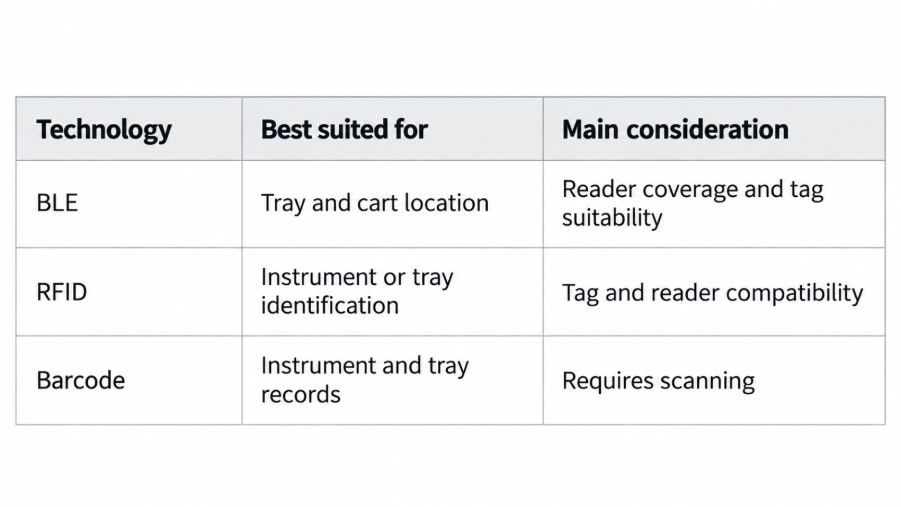
A combination of RFID and BLE tracking can provide both location visibility and instrument identification without expecting one technology to perform every task.
How BLE Tracking Works Inside a Hospital
BLE asset tracking in hospitals uses small, low-power tags that periodically broadcast identifiers. Compatible receivers or gateways listen for those signals and send observations to tracking software. Depending on the system and reader placement, software may estimate a room or zone rather than an exact position.
From BLE Tags to a Hospital Inventory Dashboard
First, staff create an inventory record for the relevant tray, container or transport cart. They associate that record with a BLE tag, so the software knows which physical asset the tag represents. This relationship must remain accurate when tags are removed, replaced or transferred between containers.
Next, the hospital installs readers in chosen areas, such as sterile storage, CSSD dispatch points and operating theatre corridors. When a reader detects the tag, its observation reaches a central platform through the hospital network. Software updates the asset's last-detected location and time, subject to configured checks and signal quality.
A surgical tray tracking system can display this information beside manually confirmed inventory details. For example, a dashboard might show that a transport cart was last detected near sterile storage. That does not confirm the instruments on it are complete, sterile or ready for use.
Hospitals using BLE application development services should consider reader placement, tag batteries, network interruptions and access permissions. Staff also need a clear way to correct an outdated or incorrect location record.
Tracking Surgical Instrument Inventory Across Ahmedabad Hospital Locations
Consider a hypothetical healthcare group operating Hospital A and Hospital B in Ahmedabad. The group wants authorized teams to locate shared instrument sets and see whether equipment has been dispatched, received or assigned to a department.
A shared hospital asset tracking platform can show information from both facilities, provided each site has compatible hardware, reliable connectivity and a common asset-identification process. The platform should distinguish a location observation from a confirmed transfer.
How a Shared Dashboard Supports Inter-Hospital Transfers
Suppose Hospital A needs to send a tray to Hospital B. Staff first check the tray contents and applicable processing records, then confirm dispatch in the inventory system. A BLE reader may record the tagged transport container leaving a covered area. During the journey, ordinary hospital BLE readers will not necessarily provide location updates.
On arrival, Hospital B records receipt, checks the consignment and associates it with the receiving department. Its local BLE readers may then update the container's detected zone. If either site misses a scan or tag observation, staff can investigate using the dispatch and receipt records.
This approach supports surgical instrument tracking across hospitals without treating a BLE signal as proof of custody. It supports surgical instrument inventory management by combining location, stock, transfer and availability records.
Hospitals planning these integrations can align them with existing healthcare software development solutions, rather than creating another disconnected dashboard.
What Ahmedabad Hospitals Need to Implement BLE Tracking
Implementing BLE tracking solutions in Ahmedabad begins with understanding how equipment moves, not with purchasing tags. Hospital IT teams, CSSD staff and operating theatre personnel should agree on which items require tracking and where a missing location creates operational delays.
Assess Instrument Movement and Tracking Zones
Map the journey from instrument preparation to storage, dispatch and use. Identify receiving desks, CSSD exits, transport-cart parking areas and other points where location updates would help. Decide whether each point requires a BLE observation, a barcode scan or a staff-confirmed transaction.
Select Tags, Readers and Inventory Software
Test prospective tags for safe attachment, durability and suitability for the hospital's cleaning procedures. Confirm manufacturer instructions before placing any tag near a sterilization process. Install readers where coverage is useful, and test them around metal cabinets, doors and densely packed equipment.
Software needs an asset registry, location history, device health and user roles. Screens should clearly distinguish the last detected location from a continuously updated location estimate.
Connect Existing Hospital Systems and Test a Pilot
APIs can exchange relevant inventory and transfer records with existing hospital software, subject to compatible interfaces and access controls. A limited pilot should check whether detected zones match observed movements, whether staff can resolve exceptions and whether tag maintenance is manageable.
For hospitals evaluating IoT and BLE development services in Ahmedabad, the implementation should cover hardware integration, gateways, secure data exchange, dashboard development and ongoing device support. Deployment should expand only after the hospital reviews pilot results and operating procedures.
Where BLE Tracking Needs Additional Checks
BLE signals can be affected by metal equipment, building layout, interference and gaps in receiver coverage. Tags also depend on power and correct association with physical assets. A missing signal does not automatically mean an instrument tray has been lost.
More importantly, surgical instrument traceability involves more than knowing a container's location. Hospitals still need documented instrument counts, cleaning and inspection steps, sterilization records and appropriate staff verification. The WHO guidance on decontamination and reprocessing of medical devices emphasizes proper procedures and quality control throughout medical-device reprocessing, from collection and cleaning to storage and distribution.
A location dashboard must never mark a tray sterile merely because it was detected near a sterilizer. Readiness should come from the hospital's approved clinical and reprocessing workflow.
How Hospitals Can Evaluate a BLE Tracking Pilot
A pilot should test whether staff can find reliable information. Before installation, record how teams locate trays. Afterwards, compare the same tasks under similar conditions.
Review time spent locating equipment, the share of planned zones with dependable detection, unresolved location discrepancies and completeness of transfer records. Ask CSSD and operating theatre teams whether dashboard information matches what they observe. Battery maintenance, reader faults, cleaning compatibility and training effort also belong in the evaluation.
Financial value depends on the hardware required, integration work, maintenance and the improvements actually observed. A pilot may reveal that some movements are better recorded through barcode scans than additional BLE receivers. That is a useful outcome, not a failed project.
Frequently Asked Questions
Can BLE track every surgical instrument individually?
Not by default. BLE is usually more practical for locating suitably tagged containers, trays or carts. Individual instrument identification often needs barcodes or sterilization-compatible RFID and separate verification procedures.
Can BLE tags withstand hospital sterilization?
Do not assume standard battery-powered BLE tags can withstand sterilization. Suitability depends on the specific product and process. Hospitals should follow manufacturer instructions and validate any proposed attachment or removal procedure.
What is the difference between BLE and RFID tracking in hospitals?
BLE commonly supports location detection from active tags within receiver coverage. RFID can identify suitably tagged instruments or trays at designated reading points. Selection depends on the item and workflow.
Can Ahmedabad hospitals track surgical instruments across multiple locations?
Yes, a shared software platform can combine asset records from multiple hospitals. Each site still needs suitable detection infrastructure, and transfers between facilities require dispatch and receipt confirmation.
Can BLE tracking connect with existing hospital software?
It may connect through supported APIs, integration services or compatible data exports. Integration requirements depend on the existing inventory system, its vendor interfaces and the hospital's security controls.
Connecting Surgical Instrument Tracking With Hospital Operations
BLE can help Ahmedabad hospital groups locate tagged trays and transport equipment, while barcode or RFID identification and staff records provide additional control over instrument movement. A practical solution connects these functions without confusing location data with sterilization approval.
Theta Technolabs develops connected workflows using BLE, IoT gateways and REST APIs to support equipment visibility and existing inventory systems. For surgical equipment tracking and inventory system integration, contact us at sales@thetatechnolabs.com.


_Integrating%20IoT%20with%20Mobile%20Apps%20for%20Advanced%20Renewable%20Energy%20Solutions_Q2_24.avif)
_Top%20Benefits%20of%20Cloud%20Computing%20for%20All%20Business%20Sectors_Q2_24.avif)

_Understanding%20the%20Impact%20of%20AI%20and%20Machine%20Learning%20on%20Fintech%20Web%20Apps%20in%20Dubai_Q2_24.avif)


_Smart%20Manufacturing%20in%20Dubai_%20How%20AI%20is%20Driving%20Efficiency%20and%20Innovation_Q1_In_24.avif)
_Automated%20Checkout%20Systems.avif)
_Smart%20Solutions%20for%20Healthcare_%20How%20IoT%20Development%20is%20Reshaping%20Dubai%20Hospitals_Q1_In_24.avif)
_Computer%20Vision-enabled%20Web%20and%20Mobile%20Interfaces%20for%20Mall%20Management%20in%20Dubai_Q1_In_24.avif)