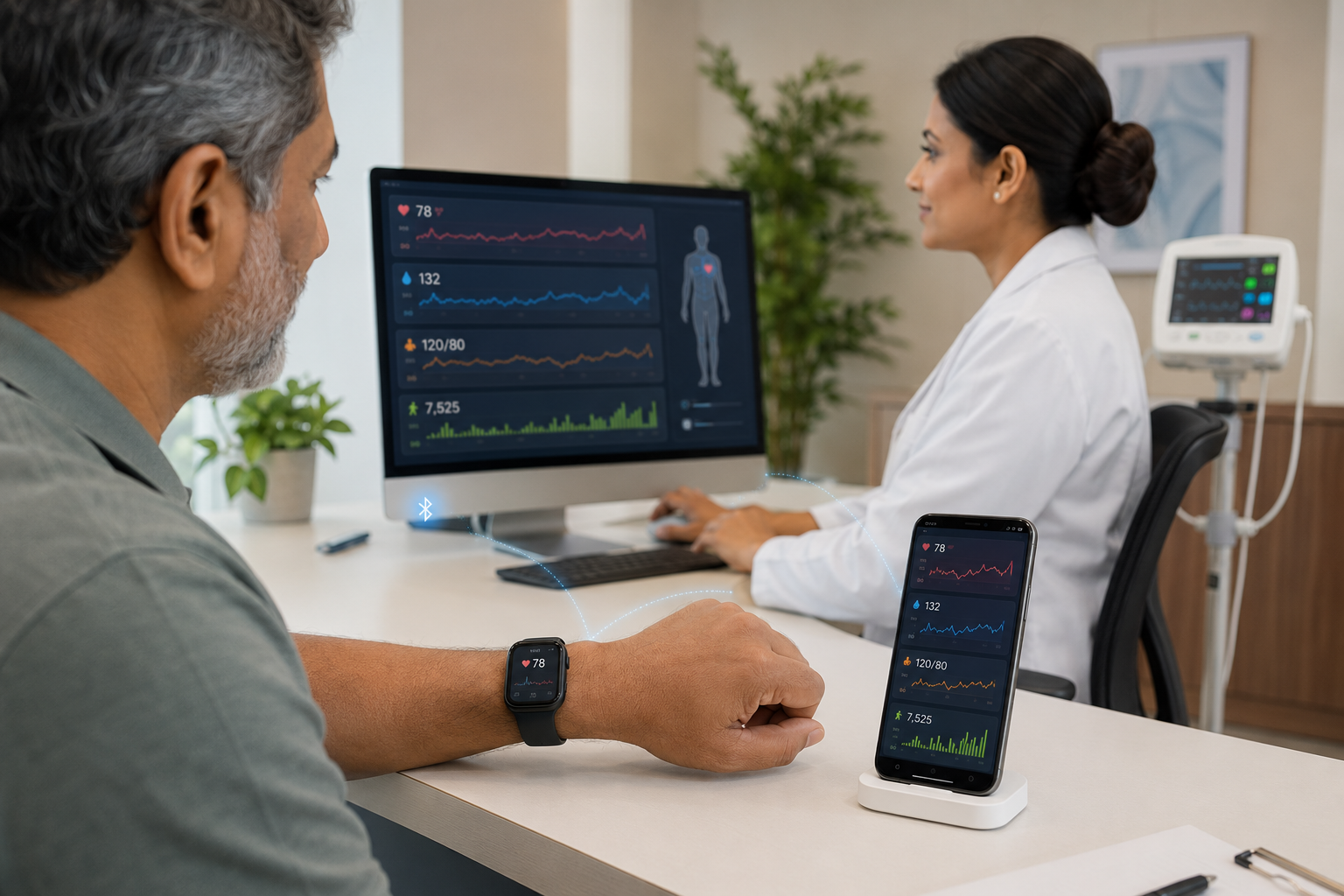


A patient with type 2 diabetes walks into your clinic, their fasting glucose looks fine, and they leave with a clean report for another month. What that single number hides is the three evenings last week when their levels spiked after dinner. This is the blind spot every lifestyle disease clinic lives with. Care happens in fifteen-minute appointments, but the disease happens every hour in between. BLE wearables for remote patient monitoring close that gap, letting clinics see what is happening with a patient continuously rather than in monthly snapshots. For clinics managing diabetes, hypertension, and cardiac risk, a continuous patient monitoring system is becoming less of a luxury and more of an expectation.
This article walks through how these wearables make that continuous view possible, what they can realistically track for different conditions, where they are accurate and where they are not, and how a clinic can actually build one. BLE earns its place here for a simple reason: it uses very little power, so devices run for long stretches without charging, which is what makes always-on monitoring practical in the first place.
Why Continuous Monitoring Matters for Lifestyle Disease Clinics
Chronic conditions do not behave politely between visits. Blood pressure rises with stress at work, glucose swings with meals and sleep, and a patient's honest self-report is often softened by the time they reach your consulting room. A reading taken in the clinic is a single frame from a film you never get to watch.
Continuous data changes that. When a clinic can see trends rather than isolated numbers, it can adjust medication earlier, catch a deterioration before it becomes an emergency, and have conversations grounded in evidence rather than recall. For the patient, it means fewer surprises. For the clinic, it means better outcomes and a clearer reason for patients to stay enrolled in a long-term program. Effective lifestyle disease management depends on this kind of visibility, because these conditions are managed over years, not cured in a visit. A clinic that can show a patient their own data, and act on it quickly, earns trust that a once-a-month appointment never will.
How BLE-Connected Wearables Enable Continuous Monitoring
What BLE Is and Why It Suits Wearables
Bluetooth Low Energy, or BLE, is a wireless standard built for exactly this kind of job. Unlike classic Bluetooth, which was designed to stream continuous data like audio, BLE is designed to send small packets of information at intervals while drawing very little power. According to the Bluetooth SIG, the organization that maintains the standard, this low-energy design lets devices run for long stretches on a small battery, which is what makes always-on wearables practical in the first place. That matters in healthcare, because a monitoring band that needs charging twice a day will not be worn consistently, and inconsistent data is close to useless. The role of Bluetooth Low Energy in healthcare is essentially to act as the quiet, efficient courier between a patient's body and their clinic. It is one corner of the wider Internet of Medical Things (IoMT), the network of connected devices now used across patient care.
The Data Flow, From Wearable to Clinic Dashboard
The way these wearables enable continuous patient monitoring in clinics comes down to a simple chain:
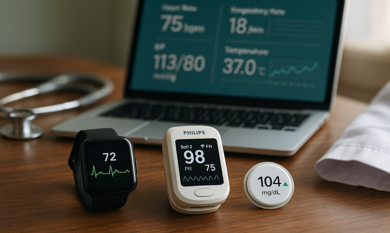
- The wearable's sensors capture readings such as heart rate, blood oxygen, or activity, and some devices pair with cuffs or glucose sensors for fuller wearable vital signs monitoring across glucose, BP, and heart rate.
- BLE syncs those readings to a nearby phone app or a small in-clinic gateway, without the patient doing anything manual.
- The app or gateway forwards the data securely to a cloud platform.
- The clinic views it on a dashboard that turns raw numbers into readable trends and charts.
- The system flags readings that cross preset thresholds, so staff are alerted to the patients who need attention.
What Lifestyle Disease Clinics Can Monitor With BLE Wearables
The value of all this depends on matching the right vitals to the conditions your clinic actually treats. A diabetes program needs different data from a cardiac-risk program. The strongest setups, like the connected healthcare solutions Theta Technolabs builds, are configured around the conditions a clinic manages rather than around a single device. Here is how common lifestyle conditions map to what BLE wearables can track.
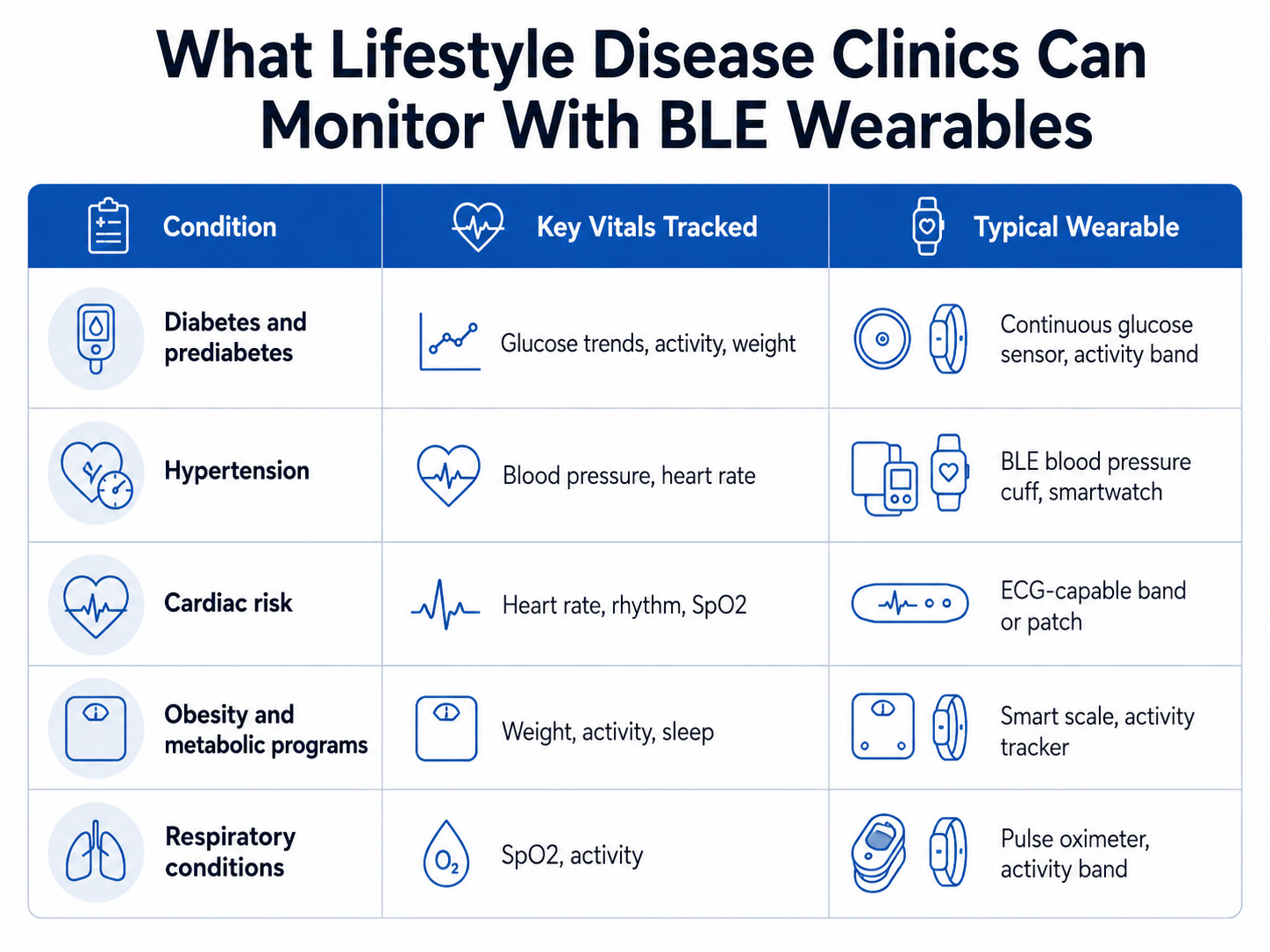
For example, a metabolic clinic running a custom BLE smart scale and activity tracker can spot a patient whose weight is climbing while their daily step count drops, and reach out for a check-in before the next scheduled visit instead of waiting to discover the change a month later.
Grouping monitoring this way keeps a remote patient monitoring solution for clinics focused on clinical value instead of collecting data nobody ever uses.
Accuracy, Security, and Compliance Clinics Should Check
Consumer vs Medical-Grade Accuracy
It is worth being honest about what these devices can and cannot do. Everyday smartwatches and bands are generally reliable for tracking trends. They are good at showing whether a patient's resting heart rate is drifting upward over weeks, or whether their activity has dropped. They are not a substitute for a diagnostic device. When a clinical decision depends on an exact figure, such as titrating insulin or confirming an arrhythmia, a medically certified or regulatory-cleared device is the right tool. A sensible clinic setup often uses both, consumer wearables for continuous trend monitoring and certified devices where precision drives the decision. Promising clinical-grade accuracy from a fitness band would be misleading, and patients and regulators alike see through it.
Data Security and India's DPDP Context
Patient data is sensitive, and Indian clinics handle it under the Digital Personal Data Protection Act, not the American HIPAA framework most international articles reference. Good practice, and the direction of the law, points to a few non-negotiables:
- Encrypting data both while it travels over BLE and while it is stored
- Using secure device pairing so readings cannot be intercepted
- Collecting clear patient consent for what is monitored and why
- Restricting access so only authorized clinic staff see patient records
No technology vendor can hand a clinic guaranteed compliance, but a well-built system makes meeting these obligations far easier than a patchwork of disconnected apps.
Fitting BLE Monitoring Into Your Clinic Workflow
Technology only helps if it fits how a clinic already runs. The clinics that succeed with continuous monitoring tend to keep the workflow simple:
- Onboard the patient in the clinic, fitting and pairing the device and showing them it needs no daily effort
- Decide who owns the dashboard, usually a nurse or care coordinator rather than the consulting doctor
- Set alert thresholds per patient, so staff are notified only about readings that genuinely matter
- Build a short routine, such as a daily dashboard review, instead of watching data all day
- Use the data in consultations, showing patients their own trends to drive better conversations
Done this way, monitoring adds very little to the daily workload and often reduces it, because problems surface early instead of arriving as emergencies. The goal is not more data, it is fewer surprises and better-spent appointment time.
Build vs Buy, and What a BLE Monitoring System Involves
Once a clinic sees the value, the practical question is whether to buy a ready-made platform or commission a custom one.
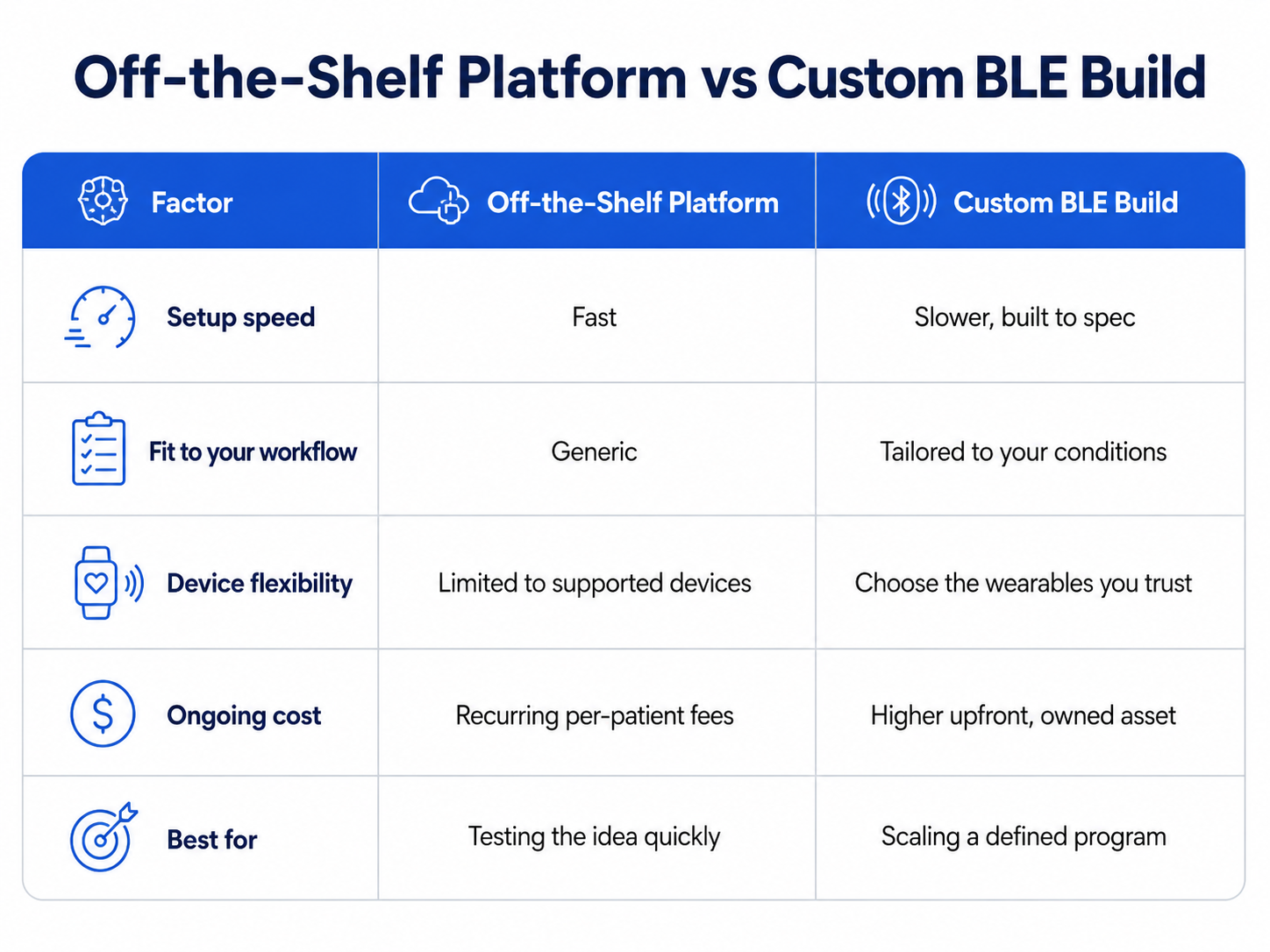
A custom build, the kind delivered through IoT and BLE development services, typically covers device integration, a patient app, a clinic dashboard, and the alerting logic. The remote patient monitoring app development cost depends mostly on a handful of factors:
- How many device types and vitals you need to integrate
- Whether you need integration with existing clinic or records software
- The complexity of dashboards, reporting, and alerts
- Your security and data-handling requirements
There is no honest flat price for this, because a single-condition pilot and a multi-clinic platform are very different projects.
BLE Patient Monitoring for Clinics in Hyderabad
Hyderabad is well placed for this shift. The city has a deep healthcare and life-sciences base, and a growing appetite among clinics to offer more than episodic care. For a lifestyle disease clinic here, continuous monitoring is a genuine way to stand out, improve patient retention, and show measurable outcomes in a competitive market. Building it well, though, takes a partner who understands both the technology and the clinical context. Theta Technolabs provides IoT and BLE solutions in Hyderabad for healthcare providers, from device integration to secure dashboards built around how your clinic actually works. If you are weighing continuous monitoring for your patients, a short conversation about your specific programs is the best place to start. Reach the team at sales@thetatechnolabs.com to talk through what a fit-for-purpose system would look like.
Frequently Asked Questions
1. Can consumer fitness wearables be used for clinical patient monitoring, or do clinics need medical-grade devices?
Consumer wearables work well for tracking trends over time, such as resting heart rate or activity levels. For decisions that depend on an exact reading, like adjusting insulin or confirming an arrhythmia, a certified medical device is appropriate. Many clinics use both together.
2. How is patient data from BLE wearables protected in India?
Indian clinics handle patient data under the Digital Personal Data Protection Act. In practice that means encrypting data in transit and at rest, securing device pairing, taking informed patient consent, and restricting access to authorized staff. A well-designed system builds these safeguards in from the start.
3. What is the difference between BLE and Wi-Fi for remote patient monitoring?
BLE uses far less power, so wearables last much longer between charges, which is essential for continuous use. Wi-Fi moves larger amounts of data faster but drains batteries quickly. For small, frequent health readings, BLE is the better fit.
4. How long does it take to build a BLE-based remote monitoring system for a clinic? It depends on scope. A single-condition pilot with one or two device types is far quicker than a multi-clinic platform with records integration. The number of devices, integrations, and reporting needs are the main drivers of timeline.
5. Do patients need technical skills to use BLE monitoring wearables?
No. Once the device is set up and paired during onboarding, BLE syncs automatically in the background. Most patients only need to wear or use the device as instructed, with no daily technical steps.






.png)


.png)



















.avif)
.avif)
.avif)
















_How%20IoT%20Can%20Reduce%20Energy%20Costs%20in%20Smart%20Factories_Q4_25.avif)
_How%20AI%20Development%20Companies%20in%20Ahmedabad%20are%20Transforming%20the%20Shopping%20Experience_Q4_25.avif)
_Node.js%20and%20Blockchain_%20A%20Perfect%20Pair%20for%20Fintech%20Innovation%20in%20Dubai_Q3_24.avif)
_Choosing%20the%20Right%20Computer%20Vision%20Development%20Partner%20in%20Ahmedabad%20for%20Construction_Q3_24.avif)
_The%20Transformative%20Role%20of%20Open%20Banking%20APIs%20in%20Fintech%20for%202024_Q3_24.avif)
_Explore%20the%20Best%20Cross-Platform%20App%20Development%20Frameworks%20of%202024_Q3_24.avif)


_Integrating%20IoT%20with%20Mobile%20Apps%20for%20Advanced%20Renewable%20Energy%20Solutions_Q2_24.avif)
_Top%20Benefits%20of%20Cloud%20Computing%20for%20All%20Business%20Sectors_Q2_24.avif)