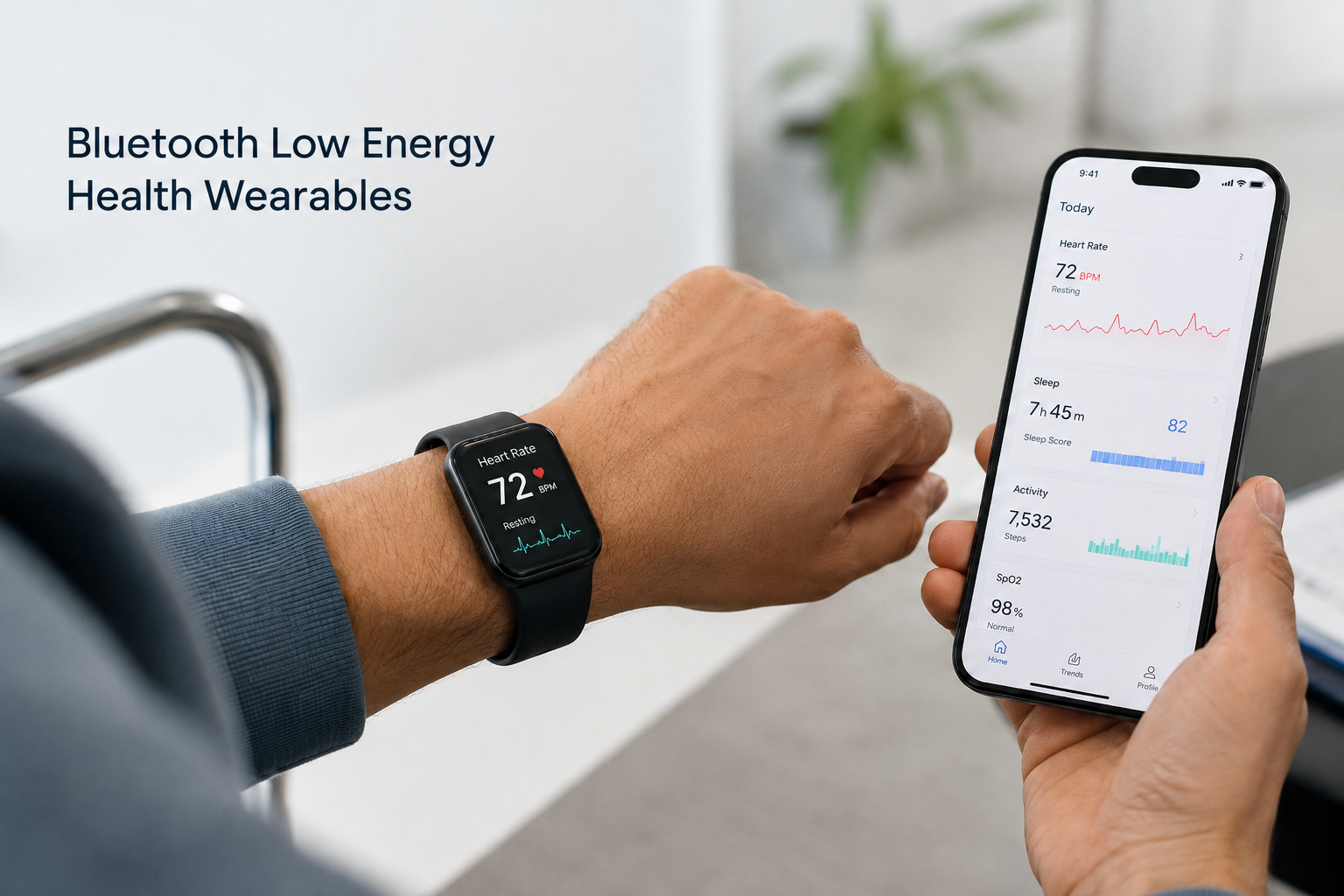


A product team in Pune sits down to scope a wearable that tracks a patient's vitals around the clock. Within an hour they hit the same wall every connected health device runs into. Continuous monitoring needs a connection that never switches off, but a connection that never switches off flattens a tiny battery before the day is over. What makes modern Bluetooth Low Energy health wearables work is a radio that stays asleep most of the time and only wakes to send each reading. This piece walks through how that works, where the engineering actually gets hard, how to keep patient data lawful in India, and when BLE is the right foundation for a continuous health monitoring wearable.
Why Battery Life Is the Real Bottleneck in Continuous Monitoring
Many always-on wearable projects run into trouble on power, not sensors, which often draw relatively little on their own. A large share of the energy budget goes on moving that data off the device, again and again, every few seconds, for days. Each time the radio wakes up and transmits, it spends power a small battery can barely spare.
This is why wearable battery life is the constraint that decides whether a product is viable, not a detail you tune at the end. A device that needs charging twice a day is not really always-on, because the moments it spends off the wrist are often the moments a missed reading matters most. For continuous monitoring to mean anything, the device has to run for days on a battery the size of a button. The rest of the design has to work around that. Choose the wrong connectivity early and you cannot win that power back later, however much you optimise.
How Bluetooth Low Energy Keeps Wearables Running for Days
BLE works well for health wearables because it is built to stay idle. Instead of holding an open connection, the device sleeps and wakes for very short, scheduled moments to exchange small packets, then drops straight back to sleep.
Two design choices do most of the work.
Connection intervals and sleep modes
- The wearable and the phone agree on how often they talk. Longer intervals mean the radio wakes less often, which stretches battery life.
- Between those moments the device sits in a deep sleep state, drawing a tiny fraction of its active current.
On-device processing to cut transmission
- Rather than streaming raw sensor output, the wearable can filter, average, or flag data on board and send only what matters.
- Less BLE data transmission means fewer radio wake-ups, and that is one of the biggest levers on battery drain.
This is the difference between real low power wearable design and just bolting a radio onto a sensor. According to the Bluetooth SIG, the body that maintains the specification, Bluetooth Low Energy is built for short bursts of data with very low idle power, the opposite of classic Bluetooth's always-connected streaming model. That distinction is a big part of why a glucose patch or an ECG band can run for days where a streaming device would last hours.
How BLE Enables Always-On Health Monitoring in the Background
Battery efficiency gets you a device that can run for days. It does not, on its own, get you data that reliably arrives. That second problem is where most teams underestimate the work.
Syncing when the app is closed or the phone is locked
A patient is not going to keep your app open all day, so the readings have to move on their own. Background data syncing is what carries sensor data from the wrist to the phone and on to the cloud without anyone tapping a screen.
The flow looks simple on paper.
- The sensor captures a reading on the wearable.
- The wearable hands it to the paired phone over BLE during a scheduled connection.
- The companion app stores and forwards it to the cloud.
- The patient or clinician sees it in near real time.
Why OS power management makes this an engineering problem
The catch is that phones fight you on step three. To protect their own battery, mobile operating systems throttle background activity, limit how often an app can scan, and put idle apps to sleep. Left unhandled, this is where readings quietly go missing, and silent data loss in a health product is worse than an obvious failure because no one notices until it matters. Getting reliable background sync working within those limits is real mobile app development work, not a checkbox, because it lives half in the firmware and half in the app. A wearable that syncs perfectly on the bench and drops data in a user's pocket has not actually solved the problem.
Where Wellness Tracking Ends and Clinical Monitoring Begins
Not every wearable carries the same weight. A consumer band that estimates steps and sleep can be off now and then without consequence. A device a clinician uses to guide treatment cannot. Blurring those two is how projects end up under-scoped.
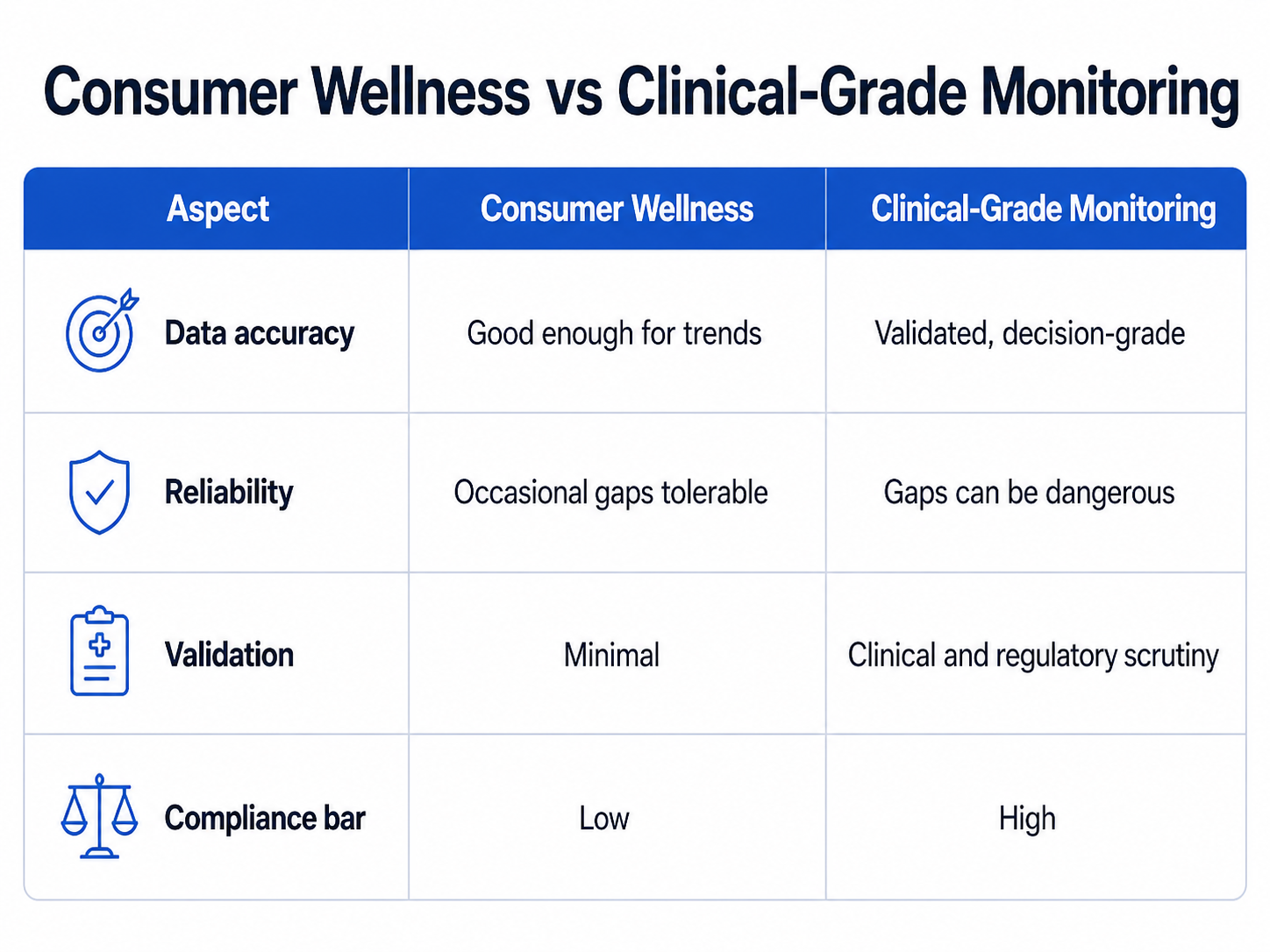
Working out which of the two you are building is a decision you make at the start, before you pick the hardware. It changes your accuracy targets, your testing, and your obligations. Teams building serious digital healthcare solutions need to be honest early about whether they are making a wellness gadget or a monitoring tool a doctor will trust, because the engineering and the cost follow directly from that answer.
Keeping Patient Data Compliant Under the DPDP Act
A wearable that handles a person's health readings is dealing with some of the most sensitive data there is. For a device built and run for the Indian market, the law that governs that data is the Digital Personal Data Protection Act, not HIPAA, which is a United States framework.
In practice, a few things shape the design from the outset. You need clear consent for collecting health data. You can use it only for the purpose the person agreed to. And you have to store and move it securely. The Act covers all personal data under one uniform framework rather than a separate sensitive-data category, so these duties apply to health readings like any other personal data. None of this is something you bolt on after launch. Consent flows, data handling, and storage all have to be designed in. No development partner can promise a regulator's approval, and anyone who does is overpromising. What good engineering can do is build the wearable so careful, lawful data handling is there from day one, not patched in later.
Choosing BLE for Your Always-On Health Wearable
BLE is not the right answer for every device, and a good build starts by being clear about that.
Use BLE when:
- You are sending small, periodic readings rather than continuous high-bandwidth streams.
- Long battery life on a small device is a hard requirement.
- The wearable pairs with a nearby phone or gateway.
Look elsewhere when:
- You need to stream high-rate raw signals continuously, where the data volume outgrows what BLE is meant to carry.
For most always-on Bluetooth Low Energy health wearables, the kind sending small regular vitals over a multi-day battery, this is the natural foundation. Building a low power health wearable with BLE then comes down to four parts working as one system, the firmware on the device, the companion app, the background sync layer, and lawful data handling. Getting all four to work together reliably is what BLE wearable development really involves. It is also why teams scoping a serious BLE wearable development company in Pune tend to look for a partner who has shipped the firmware and the app side together. Theta Technolabs handles that full stack, BLE firmware integration, the iOS and Android companion app, cross-platform builds in Flutter or KMM, and the cloud backend that stores and forwards the synced data securely. Our BLE application development work sits across exactly that span, and you can scope a build with the team at sales@thetatechnolabs.com.
Frequently Asked Questions
Can a BLE health wearable run continuously without daily charging?
Yes. BLE sleeps between short, scheduled connection moments and wakes only briefly to send small packets. That low idle draw is what makes multi-day battery life on a small wearable realistic rather than a marketing claim.
How does a BLE wearable send data when the app is closed or the phone is locked?
Through background sync handled by the companion app. It is engineered to work within the phone's power-saving limits so readings still travel from the wearable to the cloud even when no one is actively using the app.
Is BLE reliable enough for clinical monitoring or only fitness tracking?
BLE supports both. The difference is the bar. Clinical-grade monitoring demands far higher accuracy, validation, and reliability than consumer wellness tracking, and that shapes the entire build.
Does an Indian health wearable need to follow HIPAA or DPDP?
A wearable built for the Indian market follows the DPDP Act, which covers health readings as personal data under a single uniform framework rather than a separate sensitive-data tier. HIPAA is a United States law that applies to health data tied to the US healthcare system, so it would not govern a wearable built and operated for users in India, where the DPDP Act applies instead.


.png)


.png)



















.avif)
.avif)
.avif)












_How%20IoT%20Can%20Reduce%20Energy%20Costs%20in%20Smart%20Factories_Q4_25.avif)
_How%20AI%20Development%20Companies%20in%20Ahmedabad%20are%20Transforming%20the%20Shopping%20Experience_Q4_25.avif)
_Node.js%20and%20Blockchain_%20A%20Perfect%20Pair%20for%20Fintech%20Innovation%20in%20Dubai_Q3_24.avif)
_Choosing%20the%20Right%20Computer%20Vision%20Development%20Partner%20in%20Ahmedabad%20for%20Construction_Q3_24.avif)
_The%20Transformative%20Role%20of%20Open%20Banking%20APIs%20in%20Fintech%20for%202024_Q3_24.avif)
_Explore%20the%20Best%20Cross-Platform%20App%20Development%20Frameworks%20of%202024_Q3_24.avif)


_Integrating%20IoT%20with%20Mobile%20Apps%20for%20Advanced%20Renewable%20Energy%20Solutions_Q2_24.avif)
_Top%20Benefits%20of%20Cloud%20Computing%20for%20All%20Business%20Sectors_Q2_24.avif)
_Understanding%20the%20Impact%20of%20AI%20and%20Machine%20Learning%20on%20Fintech%20Web%20Apps%20in%20Dubai_Q2_24.avif)

_Smart%20Manufacturing%20in%20Dubai_%20How%20AI%20is%20Driving%20Efficiency%20and%20Innovation_Q1_In_24.avif)
_Automated%20Checkout%20Systems.avif)
_Smart%20Solutions%20for%20Healthcare_%20How%20IoT%20Development%20is%20Reshaping%20Dubai%20Hospitals_Q1_In_24.avif)
_Computer%20Vision-enabled%20Web%20and%20Mobile%20Interfaces%20for%20Mall%20Management%20in%20Dubai_Q1_In_24.avif)