

For decades, safety on construction sites has relied on manual supervision. Site engineers walk the floors. Safety officers conduct scheduled inspections. CCTV cameras record everything, but mostly for review after something goes wrong.
Now, construction leaders are asking a different question.
What if your existing cameras could think?
What if they could spot risk before an accident happens?
This is where computer vision construction safety monitoring moves from being an experimental idea to a serious boardroom discussion. Visual AI is becoming the digital safety net that watches continuously, even when humans are stretched thin across large sites.
For firms looking to bridge the gap between traditional safety practices and modern automation, 2026 represents a turning point. The potential for AI-based site safety monitoring is no longer theoretical. It is practical, measurable, and increasingly aligned with new smart city safety standards.
The Problem vs. The Solution: Manual Oversight Meets Visual Intelligence
The Reality of Manual Safety Monitoring
Manual safety processes have clear limits. Even the most experienced site supervisor cannot be everywhere at once. Large construction projects operate across multiple zones, shifts, and subcontractors. Human monitoring is periodic by nature, not continuous.
Some common challenges include:
- Unsafe behavior happening between inspections
- Missed PPE violations during peak activity hours
- Delayed response to hazardous zone breaches
- Incident investigations that rely on incomplete footage
Traditional site surveillance records events. It does not prevent them.
The Shift Toward Automated Awareness
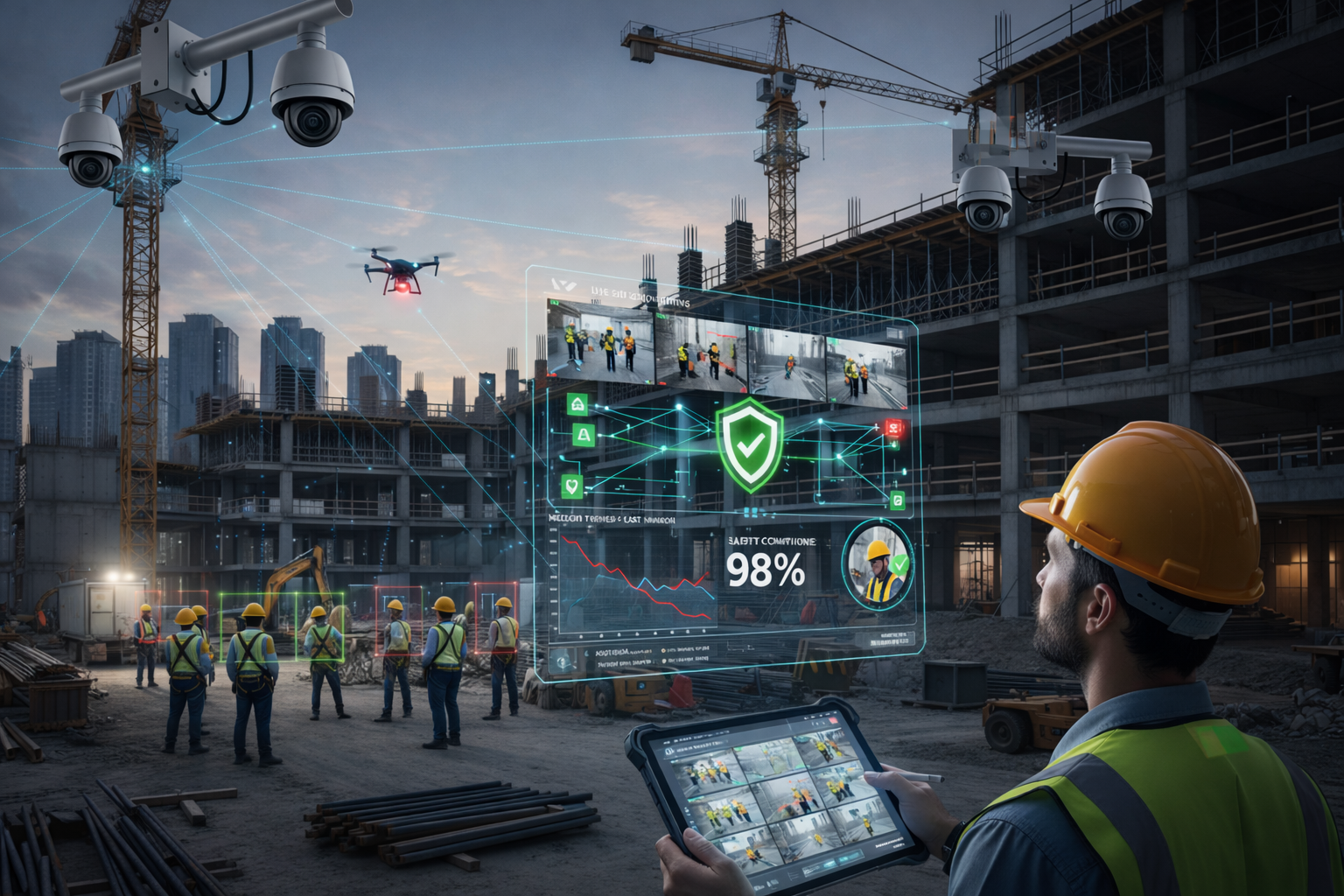
This is where automated hazard detection systems change the equation. Instead of passively recording, computer vision models analyze live video feeds. They identify unsafe patterns in real time.
Imagine the impact if a system could automatically detect:
- Workers entering restricted zones
- Missing helmets or safety vests
- Unsafe proximity between workers and heavy machinery
- Congestion in high risk areas
This is the foundation of AI-based site safety monitoring, where cameras act as an always-on safety observer rather than a silent witness.
Implementation Roadmap: How Construction Firms Can Start in 2026
Step 1: Integrating Computer Vision into Existing CCTV
One of the biggest misconceptions is that visual AI requires a complete infrastructure overhaul. In reality, most firms already have the hardest part in place: cameras.
For firms considering computer vision construction safety monitoring, the first step is integrating AI models with existing CCTV systems. The video feeds remain the same. What changes is how the footage is processed.
Instead of being stored and forgotten, footage is analyzed in real time through computer vision algorithms trained for construction environments.
This approach keeps costs controlled and avoids operational disruption.
Step 2: Moving from Passive Recording to Active Alerting
Traditional CCTV answers questions after an incident. Visual AI answers questions before one occurs.
The transition from passive recording to active alerting is where real value appears.
With active alerting:
- Safety officers receive instant notifications
- Supervisors can intervene before a situation escalates
- Risk patterns are flagged early, not discovered late
This shift supports real accident prevention, not just compliance documentation.
Step 3: Defining What the System Should Watch For
Not every site has the same risks. A high rise residential build has different hazards than an infrastructure project.
Effective automated hazard detection systems are configured based on site context. Common detection use cases include:
- PPE compliance monitoring
- Restricted zone intrusion detection
- Unsafe worker postures at height
- Equipment and worker proximity risks
As infrastructure projects in Pune scale toward 2026, the need for configurable and scalable safety technology is becoming a primary discussion point among developers managing dense, multi-tower environments. For many firms, partnering with a specialized AI development company in Pune has become the standard approach to ensuring these models are accurately tuned to local site conditions and regional safety norms.
The Proof: A Realistic Mid Build Safety Transformation
The Scenario
Consider a mid sized residential construction project with multiple floors under active development. The site already had standard CCTV coverage but relied heavily on manual inspections.
Near misses were frequent, especially during concrete pours and material movement phases.
Midway through the project, the developer introduced computer vision construction safety monitoring on critical zones only.
Before Computer Vision
- Safety checks conducted three times daily
- Near misses documented manually
- Delayed response to unsafe behavior
- Limited data for safety reviews
After Computer Vision Deployment
- Real time alerts for PPE violations
- Automatic detection of unsafe zone entry
- Visual logs for daily safety briefings
Within three months, the project recorded:
- 35 percent reduction in near miss incidents
- Faster corrective actions by site supervisors
- Clear visual evidence for compliance reporting
This scenario reflects how AI-based site safety monitoring supports human teams rather than replacing them.
Benefits That Matter in 2026
Lower Insurance Exposure
Insurers increasingly look at proactive risk management. Sites using automated hazard detection systems can demonstrate reduced incident probability, which supports insurance premium negotiations.
Faster Compliance and Audits
Instead of compiling manual reports, visual data provides timestamped evidence of safety enforcement. Audits become smoother and less disruptive.
Smarter Safety Meetings
Data driven insights change safety discussions. Instead of general reminders, teams review actual site behavior patterns and focus on real risks.
Stronger Worker Trust
When implemented transparently, computer vision enhances worker safety without constant human policing. It creates a shared safety responsibility
Conclusion: Building Safer Sites with Visual Intelligence
Looking ahead, the long term value of computer vision development services lies in prevention, not reaction. For construction firms entering 2026, visual AI offers a practical path toward safer, more predictable operations.
Computer vision construction safety monitoring turns cameras into active safety partners. It supports worker safety, strengthens site surveillance, and contributes directly to accident prevention outcomes.
Theta Technolabs specializes in Web, Mobile and Cloud solutions that help construction firms turn these what if scenarios into working, production ready systems built for real job sites.
Take the First Step Toward Smarter Safety
If you are evaluating how AI-based site safety monitoring could fit into your construction operations, now is the right time to explore a practical roadmap with Theta Technolabs.
Start the conversation to understand how automated hazard detection systems can integrate with your existing infrastructure and safety goals.
Contact: sales@thetatechnolabs.com
Frequently Asked Questions
Is computer vision expensive to implement?
Costs vary by site size and use cases. However, integrating AI with existing cameras significantly lowers entry barriers compared to full hardware replacements.
Will workers feel constantly monitored?
Clear communication is essential. When positioned as a safety tool rather than surveillance, worker acceptance improves. Privacy zones and non facial detection models are commonly used.
Does it require internet connectivity at all times?
Most systems operate on hybrid architectures. Critical alerts can run locally, while reporting dashboards sync via cloud when connectivity is available.
How accurate are these systems in real construction environments?
Accuracy depends on model training and site configuration. When tuned correctly, detection reliability improves over time through continuous learning.
Can this scale across multiple sites?
Yes. Cloud based platforms allow centralized monitoring across projects while maintaining site specific rules.