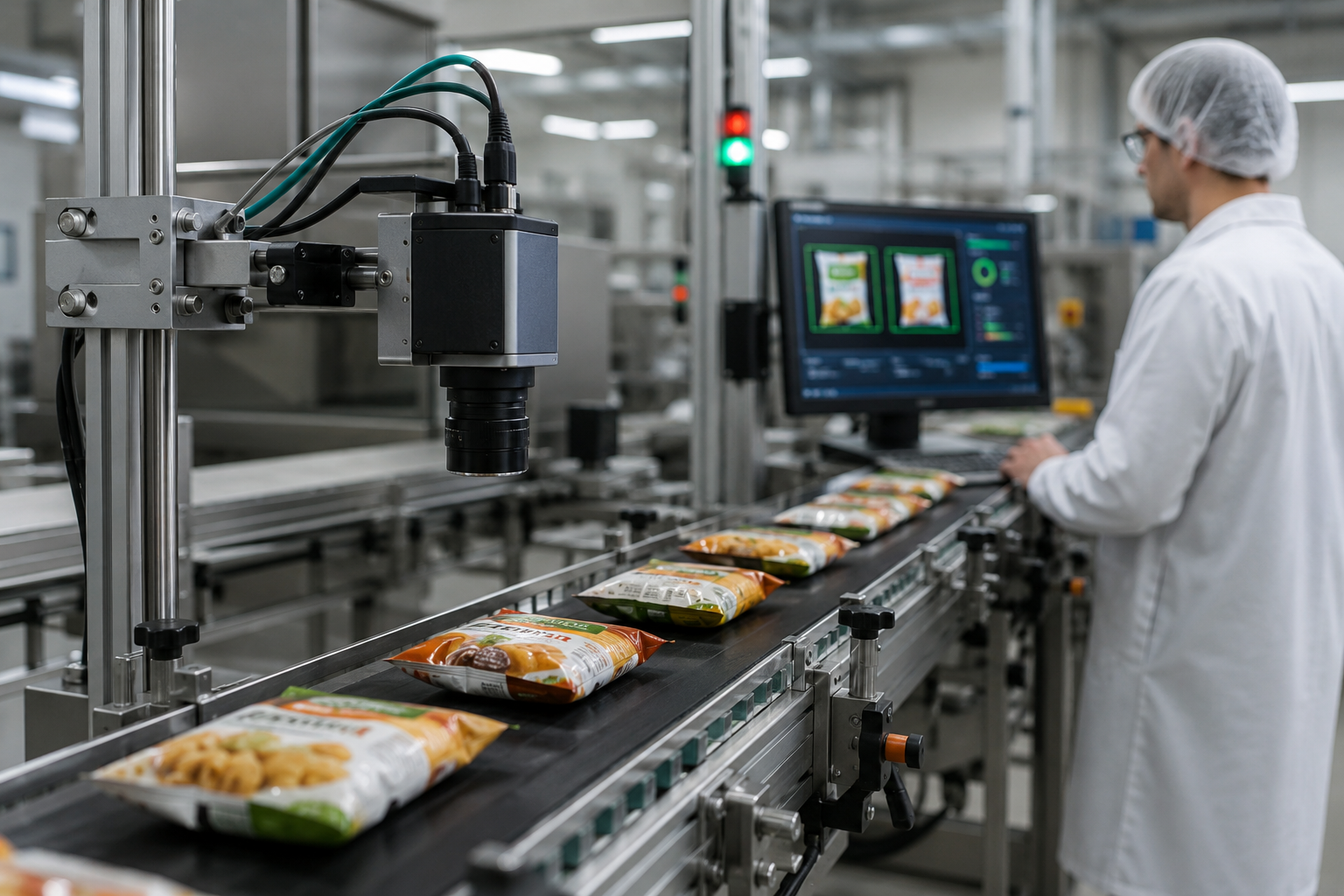


Food packaging companies work under constant pressure to maintain speed, quality, and consistency. In fast-moving production lines, even a small sealing issue, label error, damaged pack, or missing code can quickly turn into a large quality problem.
For food and FMCG packaging companies in Pune, this becomes even more important because production demand is increasing, and manual inspection alone may not be enough to check every pack with the same accuracy. This is where computer vision for food packaging inspection can support quality teams.
By using cameras, AI models, and real-time visual checks, computer vision helps identify visible packaging defects earlier, reduce inspection gaps, and improve quality control across high-volume packaging lines.
In this blog, we will explain how computer vision works in food packaging, what defects it can detect, and how companies can use it to reduce high-volume packaging defects in a practical way.
Why High-Volume Defects Are a Serious Problem in Food Packaging
When defects go unnoticed on a fast-moving packaging line, the consequences build up quickly. Rejected batches mean material waste and rework costs. Delayed dispatches affect supply timelines. Customer complaints about damaged packs or missing labels can damage brand trust, especially in a competitive FMCG market.
Why do high-volume defects happen? High-speed packaging lines produce defects mainly because human inspectors cannot keep pace with the volume. Manual visual checks are inconsistent, fatigue-prone, and limited by how much an inspector can observe in real time. AI defect detection in food packaging addresses exactly this gap by bringing consistent, automated visual checks to every unit on the line, not just random samples.
For example, a snack packaging line may face repeated label smudging during high-speed production. A computer vision setup can help identify the issue earlier, show which line or printer station is causing the defect, and alert the quality team before the same issue spreads across a larger batch.
Common Packaging Defects Computer Vision Can Detect
Vision-based inspection is designed for visible, surface-level defects. It is not a substitute for internal quality checks, but it is very effective at catching what the eye would normally catch during a manual audit.
Common defects that a computer vision system can help detect include:
- Visible sealing issues such as folded seals, open seals, misaligned seals, or damaged sealing areas
- Missing labels or incorrect labels on packs
- Misaligned labels that do not sit within the intended area
- Print smudges or faded text on packaging surfaces
- Missing or incorrect batch codes
- Missing or unreadable expiry dates
- Incorrect barcode or QR code placement
- Damaged or crushed cartons
- Visible contamination on the outer packaging surface
FMCG packaging defect detection at this level helps quality teams catch issues before they move downstream to packing, dispatch, or the retail shelf. It is worth noting that internal product quality issues, such as contamination inside sealed pouches, require additional sensor technology beyond cameras alone.
How Computer Vision Works on a Food Packaging Line
The process is more straightforward than it might seem. Here is how a typical automated packaging inspection system operates on a production line:
- Image capture. Industrial cameras are positioned at key inspection points along the packaging line, such as after sealing, after labeling, and before final carton packing.
- AI model analysis. Each image is processed by a trained computer vision model that checks visible packaging elements against a set of defined quality standards.
- Defect pattern matching. The system is trained using labeled examples of good and defective packs. In some cases, anomaly detection models can also learn from good packs and flag anything that looks different from the approved standard.
- Defect classification. Detected issues are classified by type, such as label defect, seal issue, or code error, so quality teams can act on the right information.
- Real-time packaging defect detection. With edge computing devices placed near the production line, the system can process images quickly and send near real-time alerts to quality teams.
- Flagging and review. Packs flagged as defective are either held for manual review or directed to a rejection lane, depending on how the system is configured.
- Quality team notification. Supervisors and quality managers receive alerts on dashboards or mobile apps so they can investigate and take corrective action quickly.
Figure: Computer vision workflow for food packaging inspection, from image capture to AI defect detection, pack rejection, and quality dashboard reporting.
The key advantage is consistency. Unlike manual inspection, an AI model applies the same criteria to every single pack, regardless of shift timing, fatigue, or lighting variation.
Role of Defect Classification and Automated Rejection
Detection is only the first step. What a production team does with that information matters just as much.
Modern vision-based inspection systems can classify defects as minor or major, helping quality teams prioritize their response. A missing expiry date is typically treated as a critical issue, while a slightly misaligned label might be classified as a minor defect depending on the brand's quality standards.
Beyond individual packs, the system can track repeat defect patterns over time. If a particular sealing station is consistently producing poor seals, the line-wise defect report will make that pattern visible before it becomes a larger problem.
The support for automated rejection of faulty packs allows production teams to configure a physical rejection mechanism, such as a diverter or air jet, that removes flagged packs from the line. It is important to understand that this supports rejection decisions based on detected defects, but human supervisors still play an important role in reviewing exceptions, setting defect thresholds, and making process improvement decisions.
Why Pune-Based Food Packaging Companies Should Consider Computer Vision
Pune has grown into one of India's stronger manufacturing and industrial hubs, with a significant presence of food processing, FMCG, and packaging companies. The city's infrastructure and talent availability make it well-placed to adopt AI-based inspection systems. Similar adoption potential exists in Mumbai, Ahmedabad, Bengaluru, Chennai, Hyderabad, and Delhi NCR, where food and FMCG packaging is a significant part of the manufacturing activity.
For companies evaluating a technology partner, working with a computer vision development company in Pune that understands packaging workflows, camera placement, AI model training, dashboard development, and integration with existing production systems can make implementation significantly smoother than working with a generic software vendor.
Local implementation expertise matters because packaging lines vary. Line speeds, product types, lighting conditions, and defect priorities differ from one facility to another. A solution designed around your specific line performs better than an off-the-shelf product that requires heavy customization.
Business Benefits of Computer Vision Quality Inspection
When companies shift from manual visual checks to computer vision quality inspection, the business benefits are practical and measurable over time:
- Faster defect identification helps prevent faulty packs from progressing through the line
- Better inspection consistency removes the variability that comes with manual checking
- Reduced manual inspection pressure allows quality staff to focus on review and improvement rather than repetitive checking
- Lower rework and material waste as defects are caught earlier in the process
- Improved quality reporting with digital records of every inspection decision
- Better traceability for investigations, audits, and customer queries
- Faster quality decisions for line supervisors backed by real-time data
- Better customer confidence when outgoing packs consistently meet visible quality standards
Technology Stack Behind AI Visual Inspection for Manufacturing
AI visual inspection for manufacturing is not a single product. It is a combination of hardware, software, and integration components working together. A typical system includes:
- Industrial cameras suited to the line speed and inspection distance
- Proper lighting setup to ensure consistent image capture across shifts
- Edge computing devices that process images locally for low-latency response
- Computer vision models trained on annotated images of defective and acceptable packs
- Defect classification models that categorize detected issues by type and severity
- A cloud or on-premises dashboard for quality reporting and trend analysis
- Integration with ERP or MES systems for seamless production data flow
- Real-time alert mechanisms that notify quality teams immediately
- Data storage and reporting tools for audit trails and continuous improvement
- Area-scan or line-scan industrial cameras based on product speed and inspection angle
- Synchronized LED lighting to reduce shadows and reflection on shiny packaging
- Edge AI hardware or industrial PCs for faster local processing
- Camera trigger sensors to capture images at the right moment
What to Check Before Implementing a Computer Vision System
Before investing in any automated inspection solution, decision-makers should work through a practical checklist:
- What specific defects need to be detected on your line?
- What is the current line speed in units per minute?
- Where should cameras be installed for maximum coverage?
- What are the existing lighting conditions at those points?
- How much defect image data is available for model training?
- Will the system run on edge devices, cloud infrastructure, or a hybrid setup?
- How will physically rejected packs be handled and tracked?
- Who will review exceptions and edge cases that the system flags?
- How will inspection reports be used by quality managers and production supervisors?
Getting clear answers to these questions before implementation helps set realistic expectations and leads to a better-designed system.
How Theta Technolabs Can Help Food Packaging Companies
Theta Technolabs works with manufacturing and packaging companies to build practical AI and vision-based inspection solutions tailored to their production environment. The focus is on building systems that are usable by quality teams, not just technically impressive on paper.
Services that support food packaging quality automation include custom computer vision model development, AI defect detection solutions, web-based quality dashboards, mobile monitoring applications for supervisors, cloud reporting for multi-site operations, and integration with existing production management systems.
The approach is to understand the specific defects, line configuration, and reporting needs of each client before building anything. That means companies get a system that fits their workflow rather than one that creates more complexity.
Frequently Asked Questions
How does computer vision reduce defects in food packaging?
Computer vision systems capture and analyze images of every pack on the line in real time. By comparing each image against trained defect patterns, the system can identify visible quality issues much faster and more consistently than manual inspection, helping quality teams catch and address problems earlier.
Can computer vision detect label and sealing defects?
Yes. Vision-based inspection systems can be trained to detect a wide range of label defects, including missing labels, wrong labels, misaligned placement, and print smudges, as well as visible sealing issues such as poor seal formation or open seals on pouches and trays.
Is computer vision useful for FMCG packaging companies?
Absolutely. FMCG packaging lines typically operate at high speeds with large volumes, making manual inspection difficult to sustain consistently. A vision-based system is well-suited to this environment because it can be configured to inspect each pack moving through the line, instead of depending only on random sampling.
Does computer vision replace manual quality inspection?
Not entirely. Computer vision supports quality teams by handling repetitive visual checks at scale. Human review remains important for handling exceptions, investigating repeat defect patterns, making process improvement decisions, and managing the overall quality system.
Can the system be customized for different packaging lines?
Yes. A well-built vision system is trained and configured for the specific products, defect types, line speeds, and camera positions of each facility. Customization is a standard part of implementation, not an optional extra.
Conclusion
High-speed packaging lines need quality control that can keep pace with production. Manual inspection alone struggles to maintain consistency across thousands of units per shift. Computer vision helps food and FMCG packaging companies detect visible defects earlier, reduce rework and material waste, and give quality teams better data to work with.
For companies in Pune, Mumbai, Ahmedabad, Bengaluru, and other major Indian manufacturing cities, AI-based inspection is becoming a practical investment rather than a distant technology. If you are looking for a capable ai development company in pune that also brings expertise in web, mobile, and cloud, Theta Technolabs is worth a conversation.
Ready to Explore Computer Vision for Your Packaging Line?
Theta Technolabs builds custom computer vision inspection systems for food packaging and FMCG manufacturing companies. From defect detection models and web dashboards to mobile monitoring apps and cloud reporting, the team handles the full solution from design to deployment.
Whether you are looking to reduce manual inspection pressure, improve quality reporting, or integrate AI-based checks into your existing production system, reach out to discuss what is possible for your facility.
Email us at: sales@thetatechnolabs.com


.png)





.png)






























.avif)
.avif)
.avif)



















_How%20IoT%20Can%20Reduce%20Energy%20Costs%20in%20Smart%20Factories_Q4_25.avif)
_How%20AI%20Development%20Companies%20in%20Ahmedabad%20are%20Transforming%20the%20Shopping%20Experience_Q4_25.avif)
_Node.js%20and%20Blockchain_%20A%20Perfect%20Pair%20for%20Fintech%20Innovation%20in%20Dubai_Q3_24.avif)
_Choosing%20the%20Right%20Computer%20Vision%20Development%20Partner%20in%20Ahmedabad%20for%20Construction_Q3_24.avif)
_The%20Transformative%20Role%20of%20Open%20Banking%20APIs%20in%20Fintech%20for%202024_Q3_24.avif)
_Explore%20the%20Best%20Cross-Platform%20App%20Development%20Frameworks%20of%202024_Q3_24.avif)


_Integrating%20IoT%20with%20Mobile%20Apps%20for%20Advanced%20Renewable%20Energy%20Solutions_Q2_24.avif)
_Top%20Benefits%20of%20Cloud%20Computing%20for%20All%20Business%20Sectors_Q2_24.avif)

_Understanding%20the%20Impact%20of%20AI%20and%20Machine%20Learning%20on%20Fintech%20Web%20Apps%20in%20Dubai_Q2_24.avif)


_Smart%20Manufacturing%20in%20Dubai_%20How%20AI%20is%20Driving%20Efficiency%20and%20Innovation_Q1_In_24.avif)
_Automated%20Checkout%20Systems.avif)
_Smart%20Solutions%20for%20Healthcare_%20How%20IoT%20Development%20is%20Reshaping%20Dubai%20Hospitals_Q1_In_24.avif)
_Computer%20Vision-enabled%20Web%20and%20Mobile%20Interfaces%20for%20Mall%20Management%20in%20Dubai_Q1_In_24.avif)