

Biopharma products such as vaccines, biologics, insulin, lab samples, clinical trial materials, and specialty medicines require precise temperature conditions throughout their journey. Even brief exposure to unsafe temperatures during storage, transport, or handover can affect product quality. The World Health Organization notes that time and temperature-sensitive pharmaceutical products need careful handling throughout the supply chain.
IoT cold chain monitoring, connected sensor networks, and BLE technology give teams the tools to track conditions in real time. Real-time cold chain monitoring replaces manual processes with live data, helping biopharma logistics teams respond quickly and maintain better supply chain visibility.
Why Cold Chain Monitoring Matters in Biopharma Logistics
Cold chain monitoring covers every stage from manufacturing to warehousing, transport, and delivery. Any break in this chain puts product integrity at risk.
According to the CDC, the cold chain is a temperature-controlled supply chain that keeps vaccines and sensitive biological products within safe ranges from manufacture to point of use. This standard applies across pharmaceutical cold chain management.
Strong real-time cold chain monitoring supports:
- Protecting product quality during storage and transport
- Helping teams respond faster to unsafe conditions
- Supporting digital records for quality and audit checks
- Improving visibility across warehouses, vehicles, and handover points
Common Cold Chain Challenges for Biopharma Companies
Biopharma and pharma logistics teams face real challenges when managing temperature-sensitive shipments across complex networks.
Common issues include:
- Temperature fluctuations during road, air, and sea transport
- Delayed detection of unsafe storage or handling conditions
- Manual temperature checks that are error-prone and time-consuming
- Poor shipment visibility at loading, transit, and unloading points
- Last-mile delivery risks where monitoring is often absent
- Missing audit records that create documentation gaps
During air or deep-sea transport, some devices may store sensor data locally and sync it once the shipment reaches a connected gateway, airport, port, or logistics facility. This helps teams maintain condition history even when live connectivity is limited.
During air or deep-sea transport, some devices may store sensor data locally and sync it once the shipment reaches a connected airport, port, warehouse, or logistics facility.
What Are Connected Sensor Networks in Cold Chain Monitoring?
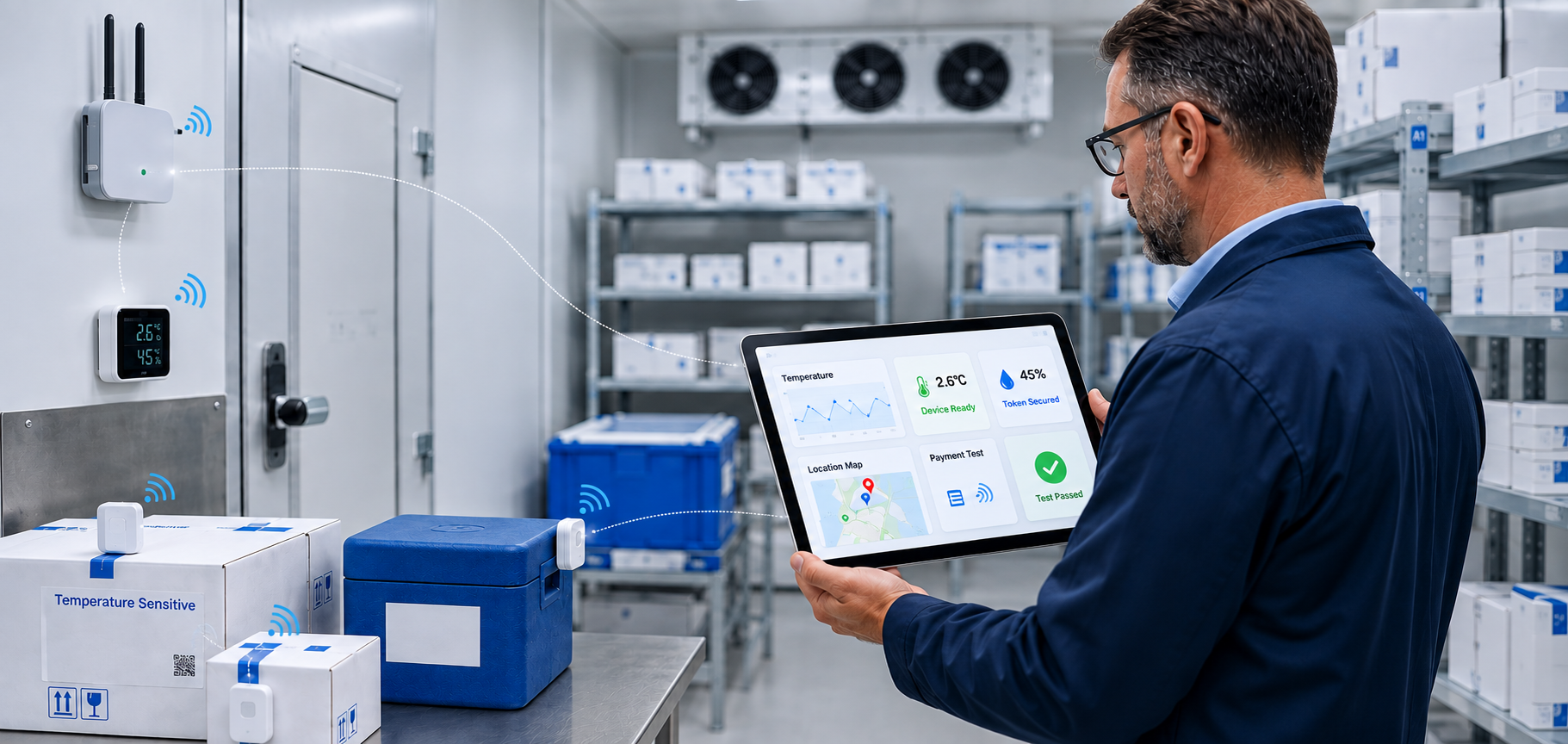
Connected sensor networks are groups of smart sensors placed across packages, pallets, cold rooms, warehouses, vehicles, and handover points. Each sensor collects live condition data and sends it to a central platform through wireless communication.
These networks work as a system. If one sensor reports an unusual reading, the platform detects it and triggers an alert. IoT cold chain monitoring depends on these networks to gather reliable data from multiple locations simultaneously.
IoT sensors for cold chain logistics can track temperature, humidity, door opening events, movement, battery status, and shipment location where network connectivity is available, making monitoring more practical and scalable.
How IoT Enables Real-Time Cold Chain Visibility
IoT enables real-time cold chain visibility by connecting sensors, gateways, cloud platforms, dashboards, and alerts into one monitoring system.
Sensors collect live data from wherever they are placed. Gateways or BLE devices pick up this data and forward it to a cloud platform, which processes and stores it. Teams view conditions on a live dashboard and receive instant alerts by SMS, email, or mobile app when a reading crosses the safe range.
IoT cold chain monitoring allows managers to track active shipments and storage areas from a single interface, with live or synced shipment updates depending on network availability.
For longer routes, the system may also use cellular connectivity such as LTE-M, NB-IoT, or GPS-enabled gateways, while BLE is more useful for short-range tracking inside cold rooms, warehouses, and handover points.
Where BLE Helps in Cold Chain Monitoring
BLE, or Bluetooth Low Energy, is a short-range wireless technology that transfers data using very little power. BLE sensors for cold chain monitoring are useful where sensors need to communicate over short distances without draining batteries quickly.
BLE works well in cold rooms, warehouses, packaging stations, handover points, and last-mile delivery. BLE sensors do not usually send data directly to the cloud. They first share nearby temperature and condition data with a BLE gateway or mobile device. The gateway then sends this data to the cloud platform through Wi-Fi, cellular connectivity, or another internet connection.
Because BLE uses low power, sensors operate for extended periods with minimal maintenance, making it well-suited for connected sensor networks where battery replacement is not always practical.
Step-by-Step Workflow of an IoT Cold Chain Monitoring System
- Sensors are placed inside packages, cold rooms, containers, or vehicles.
- Sensors collect temperature, humidity, movement, and location data, and store readings when live connectivity is limited.
- BLE or gateway devices transmit this data to the cloud platform.
- The cloud platform stores and processes the data in real time.
- Live dashboards display current conditions for operations and logistics teams.
- Automated alerts are sent when conditions cross the defined safe range.
- Teams take corrective action based on live data.
- All readings, alerts, and reports are saved for quality review and audit purposes.
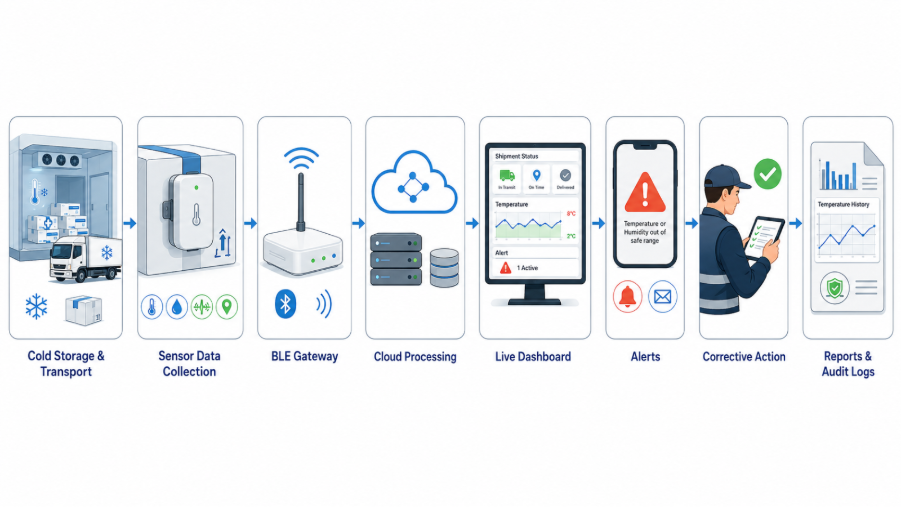
Figure: IoT cold chain monitoring workflow for biopharma logistics
Key Features Biopharma Companies Should Look For
When evaluating a cold chain monitoring platform, look for features that support visibility, compliance documentation, and daily operations.
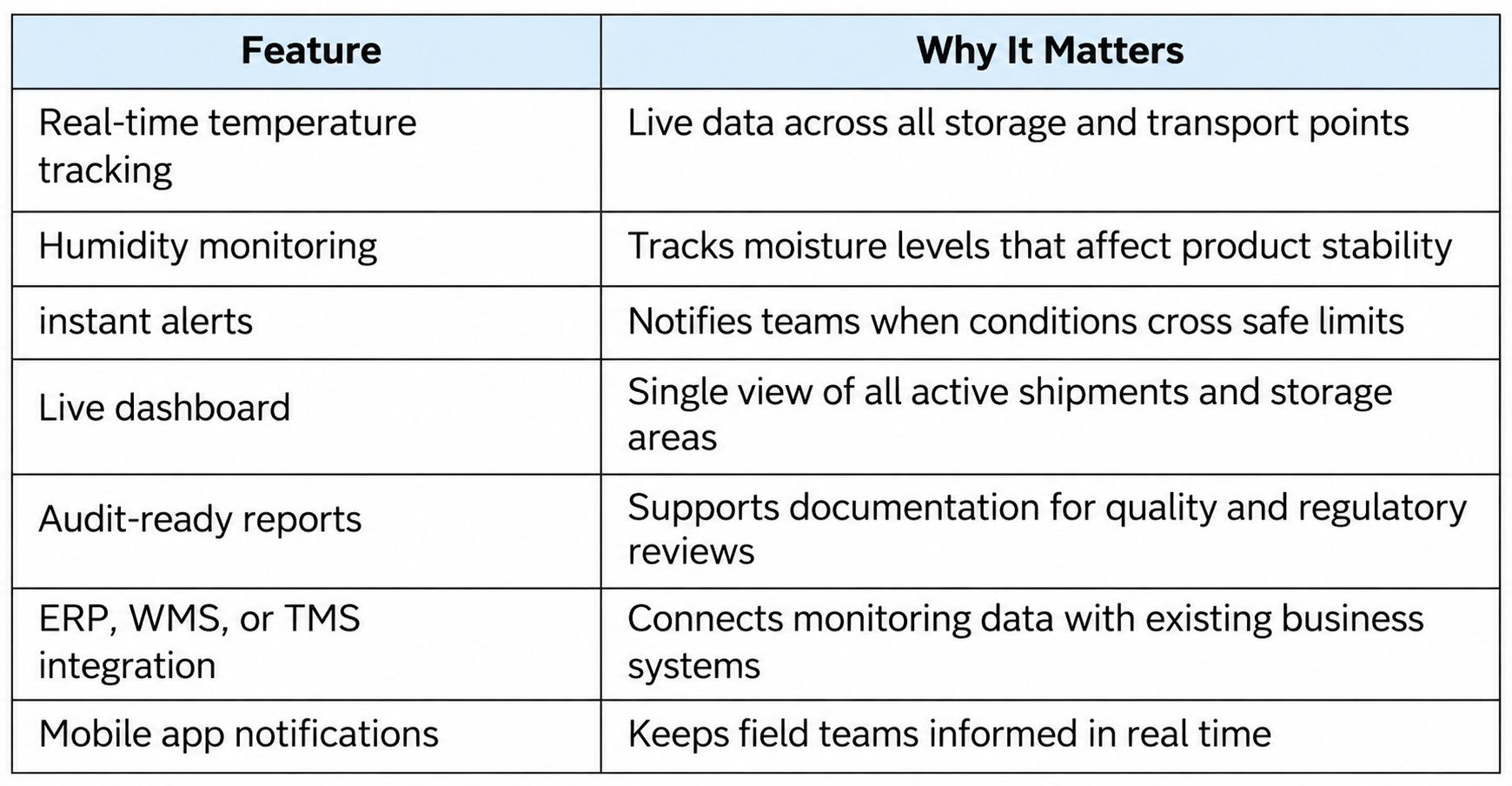
These features support reliable pharmaceutical cold chain management and help teams act on live data.
Imagine a refrigerated vehicle carrying insulin from a Dubai-based distribution center to a clinic. During traffic, the cooling unit begins to lose efficiency, and the temperature starts moving outside the set range. With a connected IoT platform, the logistics team receives an instant alert, checks the dashboard, and guides the driver to take corrective action before the shipment reaches the delivery point. This type of setup helps teams respond earlier instead of discovering the issue only after delivery.
Compliance and Data Records for Safer Biopharma Logistics
A key benefit of IoT cold chain monitoring is the automatic creation of digital records. Every temperature reading, alert, and access event is logged without manual data entry.
This supports compliance documentation. It does not guarantee compliance on its own, but it gives quality teams a structured record for audits, regulatory inspections, and client reviews.
Key records an IoT platform maintains include digital temperature logs, deviation records, alert histories with timestamps, corrective action notes, and shipment condition reports from origin to destination.
For biopharma logistics teams managing temperature monitoring in pharma logistics across multiple sites, these records reduce audit preparation time and help close documentation gaps.
Why Dubai-Based Biopharma Logistics Need Smarter Monitoring
Dubai is a significant hub for healthcare, pharmaceutical distribution, air cargo, and regional logistics. The Dubai Healthcare City Authority supports one of the largest regulated healthcare ecosystems in the Middle East, bringing together hospitals, clinics, pharmaceutical companies, and service providers in a structured environment.
For biopharma logistics companies in Dubai, cold chain monitoring solutions in Dubai must cover operations spanning airports, cold storage facilities, free zones, distribution centers, and last-mile delivery.
Companies managing temperature-sensitive healthcare shipments can improve visibility with advanced transport and logistics solutions that support tracking, monitoring, and better operational control. IoT solutions for biopharma companies in Dubai help teams respond faster when conditions change.
When to Choose a Custom IoT Cold Chain Monitoring Platform
A custom platform becomes useful when a company needs more than basic tracking.
Custom development makes sense when a company needs:
- Monitoring across multiple warehouse and storage locations
- Support for different sensor hardware types
- Custom alert rules based on product or route requirements
- Integration with ERP, WMS, or TMS systems
- Role-based dashboards and client-specific reports
- Cloud-based analytics and Dubai-specific documentation formats
IoT solutions for biopharma companies in Dubai benefit from custom platforms when operations span multiple partners and compliance requirements. Custom development gives better control over dashboards, alerts, and integrations, and allows the platform to scale as connected sensor networks expand.
In practical IoT projects, these platforms are usually configured around the client’s product type, storage condition, alert rules, sensor hardware, and reporting workflow.
Frequently Asked Questions
What is real-time cold chain monitoring in biopharma logistics?
Real-time cold chain monitoring in biopharma logistics is the continuous tracking of temperature, humidity, and location for pharmaceutical products. It gives teams live data to act quickly when conditions change.
How does IoT help in cold chain monitoring?
IoT cold chain monitoring connects sensors to cloud platforms through gateways. Teams view live data on dashboards and receive instant alerts when readings go outside safe ranges.
What are connected sensor networks in cold chain monitoring?
Connected sensor networks are groups of smart sensors placed across packages, vehicles, cold rooms, and warehouses. They transmit condition data to a central platform, giving teams a continuous stream of live information.
How do BLE sensors support cold chain monitoring?
BLE sensors for cold chain monitoring use low-power wireless technology to send temperature and humidity data to nearby gateways. They work well in cold rooms, warehouses, and transport checkpoints.
Why is cold chain monitoring important for biopharma companies in Dubai?
Dubai-based biopharma companies manage shipments that move through airports, cold storage facilities, and healthcare delivery points. Cold chain monitoring solutions in Dubai help teams maintain visibility and respond faster to deviations.
What features should an IoT cold chain monitoring platform include?
A platform built on IoT sensors for cold chain logistics should include real-time temperature tracking, humidity monitoring, instant alerts, audit-ready reports, mobile notifications, ERP integration, and cloud data storage.
Conclusion
IoT cold chain monitoring, BLE sensors, and connected sensor networks give biopharma logistics teams a practical way to track temperature, humidity, location, and shipment conditions in real time. Instead of relying on manual checks, teams gain live data, instant alerts, and a complete digital record from storage to delivery.
For businesses planning connected monitoring systems, Theta Technolabs brings strong experience as an IoT and BLE development company in Dubai, helping biopharma logistics teams build secure and scalable cold chain monitoring platforms.
Ready to Build a Smarter Cold Chain Monitoring System?
Looking to build a custom IoT cold chain monitoring platform for your biopharma logistics operations? Theta Technolabs can help you design and develop secure, scalable, and connected solutions with BLE sensor integration, real-time dashboards, cloud data storage, and mobile app alerts.
Whether you need monitoring for cold rooms, refrigerated transport, or end-to-end shipment tracking, our team brings practical experience in IoT, BLE, web, mobile, and cloud services.
Contact sales@thetatechnolabs.com to discuss your project requirements.


_Smart%20Solutions%20for%20Healthcare_%20How%20IoT%20Development%20is%20Reshaping%20Dubai%20Hospitals_Q1_In_24.avif)
_Computer%20Vision-enabled%20Web%20and%20Mobile%20Interfaces%20for%20Mall%20Management%20in%20Dubai_Q1_In_24.avif)