


In a multi-specialty clinic, creating a referral does not complete the coordination work. The receiving department needs the right information, someone must arrange the next step, and the referring clinician needs visibility into the outcome.
Better patient referral management starts with shared referral records, clear routing rules, named owners and visible follow-up. AI can support information handling, while qualified professionals remain responsible for clinical decisions.
For teams improving patient referral management in Bengaluru, this guide explains how to connect intake, department matching, scheduling and closure without losing oversight between departments.
Why Referrals Become Difficult to Manage as Clinics Grow
Consider a clinic where clinical notes sit in an electronic record, appointments in a scheduling tool, and referral updates in messages. Each team may complete its own task without seeing what happens next.
A request marked “sent” might still be waiting for acceptance. An appointment might be cancelled without the referring team knowing.
The practical question in healthcare referral management is therefore not just where a request went, but who owns the next action. Useful patient referral tracking should make unanswered requests, missing information and incomplete follow-up visible in a shared work queue.
Before changing software, follow a referral through each department. Note where staff re-enter information, chase updates or depend on an individual remembering to call the patient.
Build One Clear Referral Workflow from Request to Closure
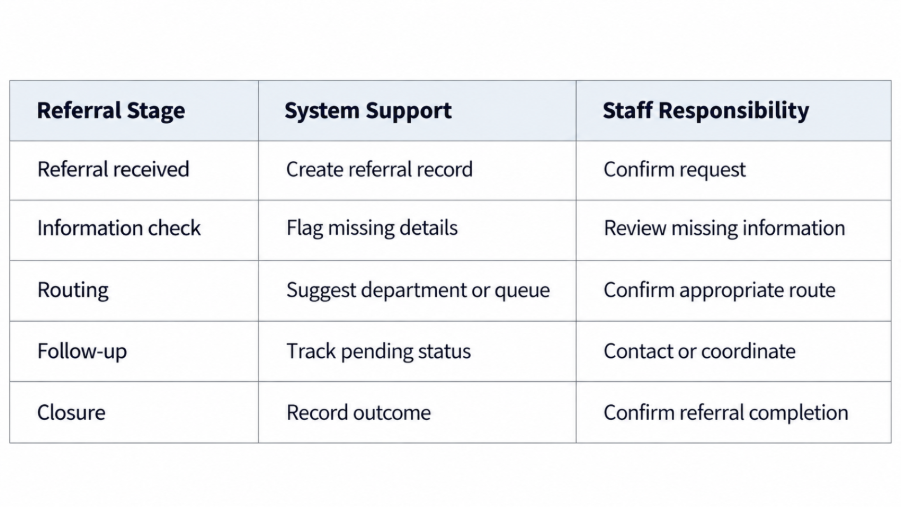
Define the multi-specialty clinic referral workflow before choosing features. A patient referral management system should support the following steps.
1. Capture the Referral in One Place
Record the referring clinician, requested specialty, referral reason, clinician-assigned urgency and relevant reports. Confirm patient identity before linking records, and retain the original referral information.
2. Check Whether Required Information Is Present
Flag missing fields or attachments for staff review. Never fill clinical gaps by guessing. Clinician-marked urgent referrals need an escalation route that does not wait for routine paperwork.
3. Match the Referral with the Appropriate Department
Apply approved specialty and department rules first. Then check provider availability, appointment type, location and patient preferences. An available appointment in an unsuitable specialty is not an acceptable substitute.
4. Assign Ownership and Track the Status
Give each referral a responsible team, current status, next action and update history. When a department returns a request, record why and assign follow-up responsibility.
5. Close the Referral Loop
Treat booking as a milestone, not completion. Track attendance and the return of specialist feedback for the referring clinician’s review. Record cancellations, declined appointments and unsuccessful contact attempts separately from completed care.
Use common status definitions across departments, so “reviewed” does not mean “appointment booked” to one team and “consultation completed” to another.
Where AI Can Help Without Taking Over Clinical Decisions
Design AI-powered patient referral management around administrative support, not autonomous diagnosis or decisions about clinical urgency.
Extract and Organise Referral Information
For unstructured notes, consider natural language processing to suggest fields such as the requested specialty and referral reason. Keep suggestions alongside their source text so staff can check omissions or incorrect interpretation.
Test abbreviations, mixed-language notes and copied text before enabling extraction in routine use. When confidence is low or records conflict, the system should request review rather than produce a definitive answer.
Suggest the Appropriate Referral Queue
For patient routing in healthcare, combine extracted information with an approved specialty directory. Show why a queue was suggested. Ambiguous requests should reach a reviewer rather than receive an unsupported specialty assignment.
Identify Referrals That Need Attention
Use defined rules to flag ageing requests, missing documents and returned referrals. These checks do not necessarily need AI. Reserve AI for tasks where interpreting varied text adds value over straightforward rules.
When assessing an AI development company in Bengaluru, ask how routing suggestions will be tested against clinician-reviewed examples and how staff can correct them during everyday use.
Automate the Administrative Work Around the Referral
Use referral workflow automation for predictable coordination tasks. When selecting referral management software for clinics, prioritise:
- Notifications when a department receives or returns a referral.
- Reminders for missing information, appointment confirmation and follow-up.
- Escalation when a clinic-defined response period expires.
Set notification rules around actual referral status. Stop outdated booking reminders after cancellation, and avoid duplicate messages from separate systems. Choose communication channels with the patient and record contact attempts so departments do not repeatedly send the same request.
An alert also needs a responsible recipient and an agreed response. Otherwise, automation creates another queue that nobody owns. Preserve clinician-assigned urgency rather than treating the oldest request as automatically the most clinically urgent.
Connect Referral Management with the Systems the Clinic Already Uses
Start with the clinic’s electronic medical record or electronic health record system, scheduling tools and patient communications. Decide which system owns appointment availability, referral status and clinical documentation.
When engaging a healthcare software development company, review supported interfaces before deciding whether to extend existing software or build a connected module.
Test patient matching, duplicate referrals, cancelled appointments and failed updates. A failed connection should produce a visible exception, not an assumed success.
Keep a stable referral identifier across connected systems and preserve the original clinical record. Staff should be able to tell when information was last synchronised and whether an update still needs checking.
A shared referral view need not centralise every medical record. The ABDM Health Data Management Policy describes interoperability between independent health-information systems within a federated architecture.
Protect Patient Information Throughout the Referral Process
The ABDM Health Data Management Policy emphasises privacy by design and consent-based information sharing within its digital-health ecosystem. Its scope concerns participating entities, so it should not be presented as a complete compliance checklist for every clinic.
Translate those principles into practical controls: limit access according to responsibilities, share only necessary information, protect stored and transmitted data, and maintain access and change logs. The policy addresses restricted access, security safeguards and audit trails.
Keep sensitive details out of routine notifications. Do not send identifiable referral notes to unapproved AI tools. Before deployment, review applicable obligations, consent requirements, retention arrangements and any external AI processing with the clinic’s privacy and security advisers.
What a Better Referral Workflow Looks Like in Practice
Consider a hypothetical Bengaluru clinic where a general physician has already decided that a patient needs a routine endocrinology consultation.
- The clinician creates the referral with the reason and relevant records. The system flags a missing attachment for staff attention.
- After verification, the system suggests the endocrinology queue using approved rules. Staff confirm the receiving department and coordinate an available appointment with the patient.
- The referring team sees the updated status. A cancellation returns the request to an owned follow-up queue rather than silently ending the process.
- After consultation, specialist feedback returns for the referring clinician’s review. Staff confirm the documented closure conditions.
The workflow organises an existing clinical decision. It does not make that decision independently.
Choosing the Right Approach for a Bengaluru Multi-Specialty Clinic
Start with a limited referral pathway. Map its owners, required information and exceptions before adding AI development services.
Test incomplete requests, unavailable specialists and missed appointments. Track time to first response, unresolved referrals, returned requests and staff corrections, without assuming predetermined improvements. Compare suggested queues with routes approved by clinic staff. Log overrides and review recurring errors before enabling broader use.
AI-driven digital healthcare solutions include scheduling automation and care-coordination capabilities, but clinic-specific referral rules still need careful definition.
Extend an existing module where it meets the need. Consider custom development when supported configuration and integrations cannot deliver the required workflow.
Frequently Asked Questions
What is a patient referral management system?
It is software for recording, assigning and tracking referrals from creation to a documented outcome. A useful system also identifies the responsible team, outstanding information and next action.
How can multi-specialty clinics track internal referrals?
Use a shared referral record linked to the patient, clear departmental ownership and agreed status updates. Keep returned requests, cancellations and pending follow-up visible to both referring and receiving teams.
Can AI help route patients to the right department?
AI can assist with extracting referral information and suggesting queues under approved rules. Clinical interpretation, urgency and ambiguous cases should remain with appropriately qualified professionals, with administrative coordination handled by authorised staff.
What is the difference between referral tracking and an EHR?
An EHR holds broader clinical records. Referral tracking focuses on assignment, progress and follow-through between care teams. The referral workflow may sit within an EHR or in a connected module.
Conclusion
Improving referrals starts with clear ownership, reliable information and visible follow-up. AI should support those foundations, not obscure responsibility. Where simple routing rules are sufficient, there is no reason to add unnecessary AI complexity.
Our approach is to map the referral journey, define review rules, connect supported systems and test before expanding. Python, spaCy and REST APIs from our AI development stack can support workflow logic, text processing and system integration.
For clinic-specific referral workflow requirements, contact Theta Technolabs at sales@thetatechnolabs.com.



_Understanding%20the%20Impact%20of%20AI%20and%20Machine%20Learning%20on%20Fintech%20Web%20Apps%20in%20Dubai_Q2_24.avif)


_Smart%20Manufacturing%20in%20Dubai_%20How%20AI%20is%20Driving%20Efficiency%20and%20Innovation_Q1_In_24.avif)
_Automated%20Checkout%20Systems.avif)
_Smart%20Solutions%20for%20Healthcare_%20How%20IoT%20Development%20is%20Reshaping%20Dubai%20Hospitals_Q1_In_24.avif)
_Computer%20Vision-enabled%20Web%20and%20Mobile%20Interfaces%20for%20Mall%20Management%20in%20Dubai_Q1_In_24.avif)