


A packaging line scheduled for longer shifts before Diwali has little room for an unexpected conveyor or compressor problem. Yet a machine that runs normally during a light production day may behave differently when its load increases. Changing current or vibration warrants investigation, not automatic failure predictions.
IoT-based machine health monitoring gives maintenance teams a structured way to check equipment conditions before busier schedules begin. Effective Diwali production peak preparation involves choosing critical assets, collecting reliable readings, comparing similar operating conditions and planning inspections while maintenance windows are still available. The objective is informed readiness, not guaranteed predictions.
Identify Machines That Need Checks Before Peak Production
Prioritise equipment that affects the whole line
Begin with the production schedule and an asset list. A packaging line may depend on a conveyor drive, air compressor and sealing equipment; if one essential machine becomes unavailable, the remaining equipment may not keep producing. The same reasoning applies to pumps, mixers, presses and other machinery in different factories.
Pre-festival equipment maintenance should first address machines with significant production dependencies, recurring warnings or known servicing needs. Examine past work orders and the availability of qualified technicians and replacement parts. Use inspection evidence rather than machine age alone.
For manufacturing downtime prevention, connecting equipment records with production plans is often as useful as adding another sensor. Existing manufacturing software systems can provide asset identifiers, work order history and scheduled availability that the monitoring dashboard should reference.
Agree on a readiness checklist
List which assets need baseline checks, which inspections are due and which repairs must be completed before extended shifts. Give each task an owner and a review date. Warnings should support existing maintenance procedures. Before the production schedule changes, the team can review unresolved equipment alerts in a short readiness meeting. For each machine, record whether it is cleared for its planned duty or needs further assessment.
Install Sensors for Relevant Machine Conditions
Match sensors to actual failure concerns
Vibration monitoring sensors can help track changes in rotating equipment when appropriately installed. Industrial equipment temperature monitoring may reveal changes in relevant bearings, motors or process components. Electrical current can indicate altered load; pressure readings may be appropriate for compressors and fluid systems.
Readings are not interchangeable: rising current may simply reflect greater production load. Choose measurements based on the asset's construction, operating conditions, known failure modes and manufacturer guidance. Where machines already expose trustworthy condition data through approved interfaces, assess that information before adding duplicate hardware.
Install and connect the devices safely
A connected sensor network requires dependable mounting, power and communication. Sensor position affects vibration measurements; a loosely mounted device may report the movement of its housing instead of the machine component. Appropriate sampling depends on whether the goal is a slow temperature trend or analysis of faster vibration behaviour.
A gateway can collect supported machine readings and forward them to a central application. In industrial IoT monitoring projects, engineers should document the network path, device identity, measurement frequency and status of each connection. Installation and electrical work must follow site safety requirements and be completed by authorised personnel.
Build Load-Aware Machine Health Baselines
Compare machines at similar speeds and loads
Machine condition monitoring becomes misleading when a reading is judged without its operating context. A motor at half production load may draw different current and show a different vibration profile from the same motor operating near its normal upper workload. Record operating mode, load and speed before setting alerts.
A practical baseline consists of trustworthy observations collected while the machine is known to be operating acceptably. Separate idle, startup and steady-production periods where necessary. Do not use a single average to represent operating modes that behave differently. After maintenance or an approved process change, review whether the previous baseline remains appropriate.
Give each measurement a clear history
A real-time machine health dashboard should show machine name, sensor, unit, observation time, operating mode and recent trends. Store raw readings or suitable validated summaries so technicians can compare conditions before and after an inspection. Time alignment matters when combining motor current with vibration and production load.
If connectivity fails, mark the last reading as stale. A flat graph could mean a stable machine, a stopped machine or a disconnected sensor. The interface must distinguish those cases using machine status and data-quality information, rather than presenting an old number as live condition data.
Detect Abnormal Changes Without Assuming a Failure
Use equipment limits and trend comparisons
Machine anomaly detection can identify changes worth investigating. A condition rule might identify temperature above a documented equipment limit, while trend analysis might flag steadily increasing vibration at comparable operating loads. The same warning should include its measurement history and the conditions under which it occurred.
Threshold alerts flag boundaries; diagnosis requires further evidence. Those are separate steps. For instance, unusual vibration may be associated with mounting problems, misalignment, imbalance, load changes or sensor issues. A qualified technician must assess the actual equipment.
Apply prediction only when the evidence supports it
Predictive maintenance in manufacturing goes further by estimating future condition changes or the likelihood of a defined event. Reliable prediction requires relevant operating history, suitable failure information and evaluation on new data. If such evidence is missing, trend monitoring and condition-based inspections may be more defensible than a claimed failure date.
Predictive IoT analytics can combine multiple measurements for analysis, but the result should remain traceable to known equipment and a documented model or rule. Predictions must not override protective interlocks or manufacturer safety instructions.
Connect Machine Warnings With Maintenance Planning
Present a warning that technicians can investigate
Condition-based maintenance planning depends on knowing which asset has changed, what the relevant reading shows and whether the change is comparable with earlier conditions. An alert should include machine identity, timestamp, source signal, baseline, current operating mode and communication status. Repeated messages from one disconnected gateway should not appear as unrelated failures on every asset.
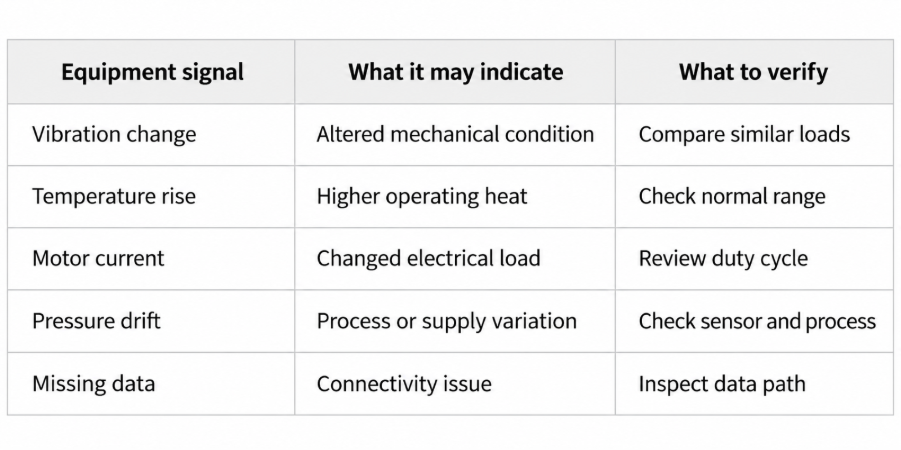
Turn the warning into a scheduled check
A maintenance planner can review the information, decide whether inspection is warranted and arrange a suitable window before Diwali shifts intensify. The work order should identify the inspection procedure, required skills, spare parts and any isolation requirements. Record inspections even after readings normalise.
If a safety-related condition is identified, follow the site's emergency and equipment procedures immediately; a future maintenance slot is not a substitute for a required protective response.
Validate Equipment Readiness Before Busy Shifts
Test the complete monitoring path
Before relying on the dashboard, check whether sensors report realistic values, alerts reach the correct personnel and equipment IDs match physical assets. Test a disconnected sensor, a stopped machine and a delayed reading. Operators should understand which screen shows confirmed operating measurements and which information is an analytical estimate.
Confirm condition through approved inspection
The NIST research on monitoring, diagnostics and prognostics in manufacturing operations describes the importance of measurement, verification and validation for equipment health technologies. Monitoring identifies conditions; diagnostics investigates causes; prognostics evaluates possible future behaviour. They should not be treated as identical capabilities.
Complete the pre-production review with maintenance records, authorised sign-off and follow-up checks for any repaired machine. A readiness dashboard supports that process but does not independently certify that machinery is safe or fit for every operating condition.
Frequently Asked Questions
Which machines should manufacturers monitor before Diwali production peaks?
Prioritise production-critical equipment such as conveyor drives, compressors, pumps and packaging machines whose interruption could affect planned output. Asset history, operating demands and existing maintenance obligations help determine where monitoring and inspection are most useful.
What IoT sensors are used for machine health monitoring?
Common options include vibration, temperature, electrical current and pressure sensors, selected according to machine type and relevant failure concerns. Proper mounting, measurement frequency, calibration and operating context affect the usefulness of each sensor.
Can IoT sensors be installed on existing manufacturing equipment?
Often, yes, if the equipment design, access and safety requirements permit installation. Existing machine interfaces may also provide usable readings. Engineers should check compatibility and use authorised installation procedures rather than assume every machine can be modified in the same way.
Does abnormal machine vibration always indicate an equipment fault?
No. Vibration can change with speed, load, mounting conditions or sensor placement. An unusual trend warrants comparison with relevant operating baselines and, where appropriate, inspection by qualified personnel before diagnosing a mechanical problem.
Can predictive machine health monitoring replace preventive maintenance?
No. Predictive monitoring can inform maintenance priorities when models and data are reliable, but scheduled inspections, safety checks and manufacturer-required servicing remain important. A prediction is not proof that equipment can safely operate without planned maintenance.
Planning Machine Maintenance Before Diwali Production Increases
Useful equipment monitoring begins before the busiest shifts. Identifying critical machines, selecting suitable sensors, testing baselines and connecting alerts to work orders give maintenance teams a clearer basis for readiness decisions. Monitoring cannot guarantee uninterrupted production.
Theta Technolabs develops connected manufacturing applications using industrial IoT integration, machine-data processing and monitoring interfaces. To discuss a custom machine health platform, contact us at sales@thetatechnolabs.com.


_Node.js%20and%20Blockchain_%20A%20Perfect%20Pair%20for%20Fintech%20Innovation%20in%20Dubai_Q3_24.avif)
_Choosing%20the%20Right%20Computer%20Vision%20Development%20Partner%20in%20Ahmedabad%20for%20Construction_Q3_24.avif)
_The%20Transformative%20Role%20of%20Open%20Banking%20APIs%20in%20Fintech%20for%202024_Q3_24.avif)
_Explore%20the%20Best%20Cross-Platform%20App%20Development%20Frameworks%20of%202024_Q3_24.avif)


_Integrating%20IoT%20with%20Mobile%20Apps%20for%20Advanced%20Renewable%20Energy%20Solutions_Q2_24.avif)
_Top%20Benefits%20of%20Cloud%20Computing%20for%20All%20Business%20Sectors_Q2_24.avif)

_Understanding%20the%20Impact%20of%20AI%20and%20Machine%20Learning%20on%20Fintech%20Web%20Apps%20in%20Dubai_Q2_24.avif)


_Smart%20Manufacturing%20in%20Dubai_%20How%20AI%20is%20Driving%20Efficiency%20and%20Innovation_Q1_In_24.avif)
_Automated%20Checkout%20Systems.avif)
_Smart%20Solutions%20for%20Healthcare_%20How%20IoT%20Development%20is%20Reshaping%20Dubai%20Hospitals_Q1_In_24.avif)
_Computer%20Vision-enabled%20Web%20and%20Mobile%20Interfaces%20for%20Mall%20Management%20in%20Dubai_Q1_In_24.avif)