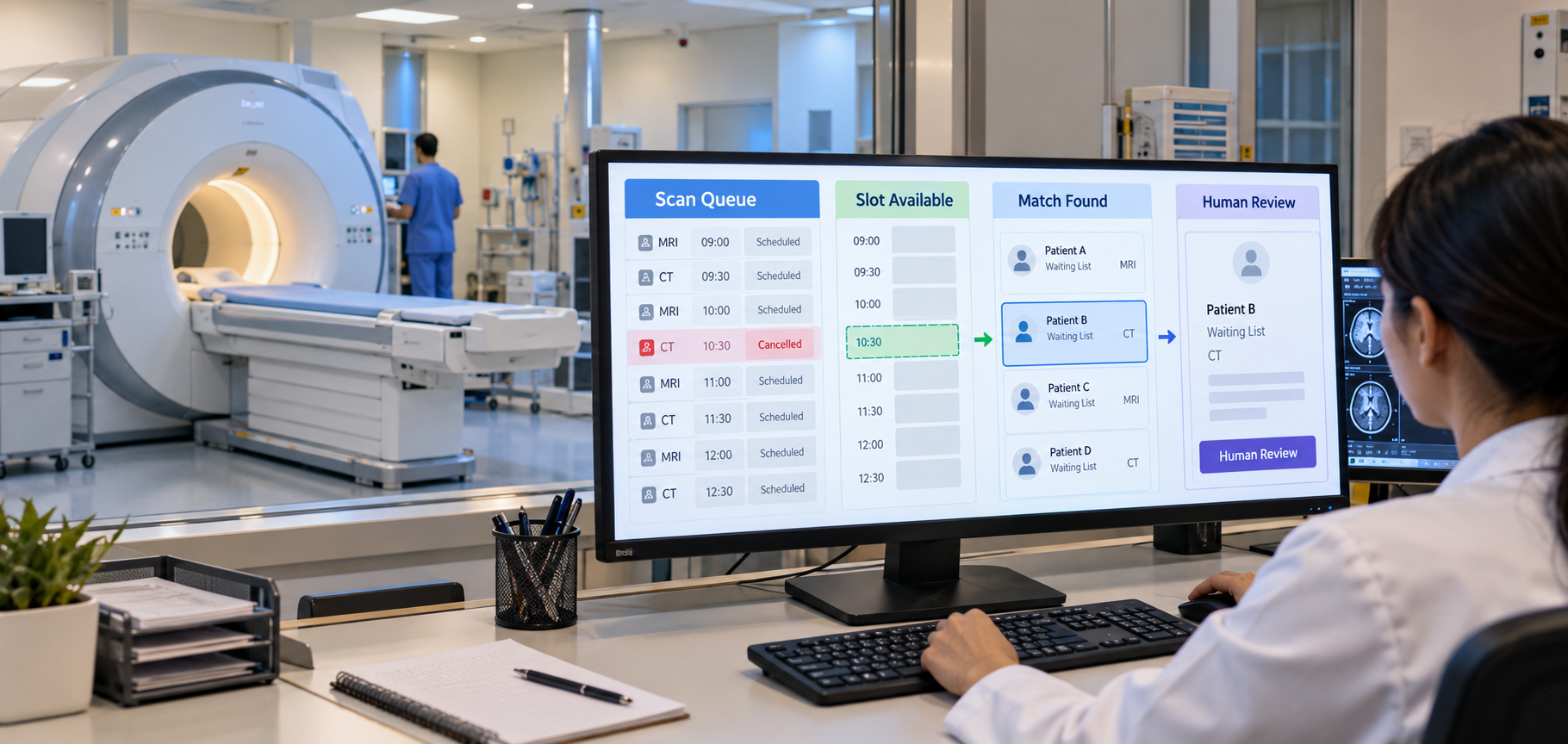


Diagnostic scan backlogs are not always caused by a lack of MRI, CT, or ultrasound equipment. Delays can also build when appointment teams must coordinate scan type, available equipment, appointment duration, preparation requirements, patient availability, cancellations, waiting lists, and staff constraints. AI scheduling for diagnostic imaging can help organize these variables and identify workable appointment options faster.
The goal is not to let software make clinical decisions. A practical diagnostic scan scheduling system should support routine booking logic, surfacesuitable options, and send unclear or safety-sensitive cases to qualified staff. This article explains where scheduling backlogs form, how AI can support the workflow, and how a diagnostic centre can connect it with existing systems.
Where Diagnostic Scan Backlogs Actually Build Up
A diagnostic imaging backlog can refer to different operational problems, and each needs a different response.
Booking Backlog
A booking backlog forms when scan requests are waiting for an appointment. Staff may still need to verify the modality, patient availability, preparation requirements, location, and suitable appointment length.
Scanner Scheduling Backlog
This occurs when a request is ready to book, but the right combination of scanner, time, location, preparation conditions, and capacity is difficult to find. This is where radiology backlog management becomes a scheduling problem rather than simply a capacity problem.
Reporting Backlog
A reporting backlog starts after the scan has taken place and is waiting for radiologist review or reporting. AI scheduling does not solve that queue directly.
For centres evaluating AI appointment scheduling for diagnostic centres, the first task is to identify which queue is causing the delay. Scheduling automation is most relevant to booking and scanner scheduling. A healthcare software development company can help connect scheduling automation with appointment booking, EHR workflows, patient management, and other administrative processes instead of creating another isolated tool.
What an AI Scheduler Needs Before It Can Recommend a Scan Slot
An AI scheduler needs reliable information about the scan request and available capacity. Without current data, even well-designed diagnostic imaging scheduling software may recommend a slot that is no longer usable.
Scan and Appointment Requirements
Inputs can include imaging modality, expected duration, location, approved preparation rules, patient availability, and scheduling priority already defined by the organisation. The system should not invent clinical eligibility rules.
Capacity and Operational Data
The scheduling layer also needs information such as scanner availability, existing bookings, cancellations, waiting queues, and site capacity.
A 2026 Frontiers review describes AI-based imaging triage systems that use hospital information, imaging requests, equipment, booking, and patient data to support prioritisation and scheduling. The review also notes limitations around evidence, integration, privacy, and broader clinical adoption. That is an important boundary for medical imaging scheduling automation: AI can support resource allocation and workflow decisions, but implementation still requires governance and human oversight.
How AI Scheduling Can Move a Scan Request Through the Queue
The practical value of radiology scheduling AI comes from moving a request through a defined operational process, not replacing staff judgment.
Capture the Scheduling Requirements
The workflow begins when a scan request enters the system. Required booking information can come from a referring workflow, patient-management system, scheduling desk, or integrated hospital system.
Identify Eligible Appointment Slots
In practice, this type of scheduling system may combine deterministic rule-based logic with machine learning. Rules can handle constraints such as modality, appointment duration, preparation requirements, and scanner availability, while predictive models may support tasks such as no-show risk estimation or waitlist prioritisation.
A rule-based scheduling engine can compare the request with available capacity, filtering slots by modality, appointment duration, location, scanner availability, preparation rules, and other approved constraints.
Rank Suitable Options
When several eligible slots exist, the system can rank them using approved operational priorities, queue conditions, and patient timing constraints. Clinical urgency should come from authorised clinical or organisational rules, not be invented by the scheduling system.
Recover Cancelled Capacity
When a slot becomes free, the scheduler can search the waitlist for requests that match its requirements. This can reduce manual queue review and help staff find a suitable replacement.
Predictive methods can also support AI no-show prediction in radiology when suitable historical data and a legitimate use case exist. Such predictions should be treated as operational signals, not facts about an individual patient.
Route Exceptions for Review
If information is missing, rules conflict, or a case falls outside the configured logic, the system should escalate it for staff review.
This workflow can support AI scheduling for diagnostic centres in Delhi as part of a wider healthcare platform. AI-driven digital healthcare solutions can connect scheduling with routine workflow automation, patient management, and other healthcare processes.
Which Decisions Can Be Automated and Which Need Human Review?
Routine imaging centre workflow automation can handle repetitive scheduling tasks when rules are clear. Clinical suitability, ambiguous cases, and safety-sensitive decisions should remain with qualified staff.
AI-Assisted Scheduling vs Human Review
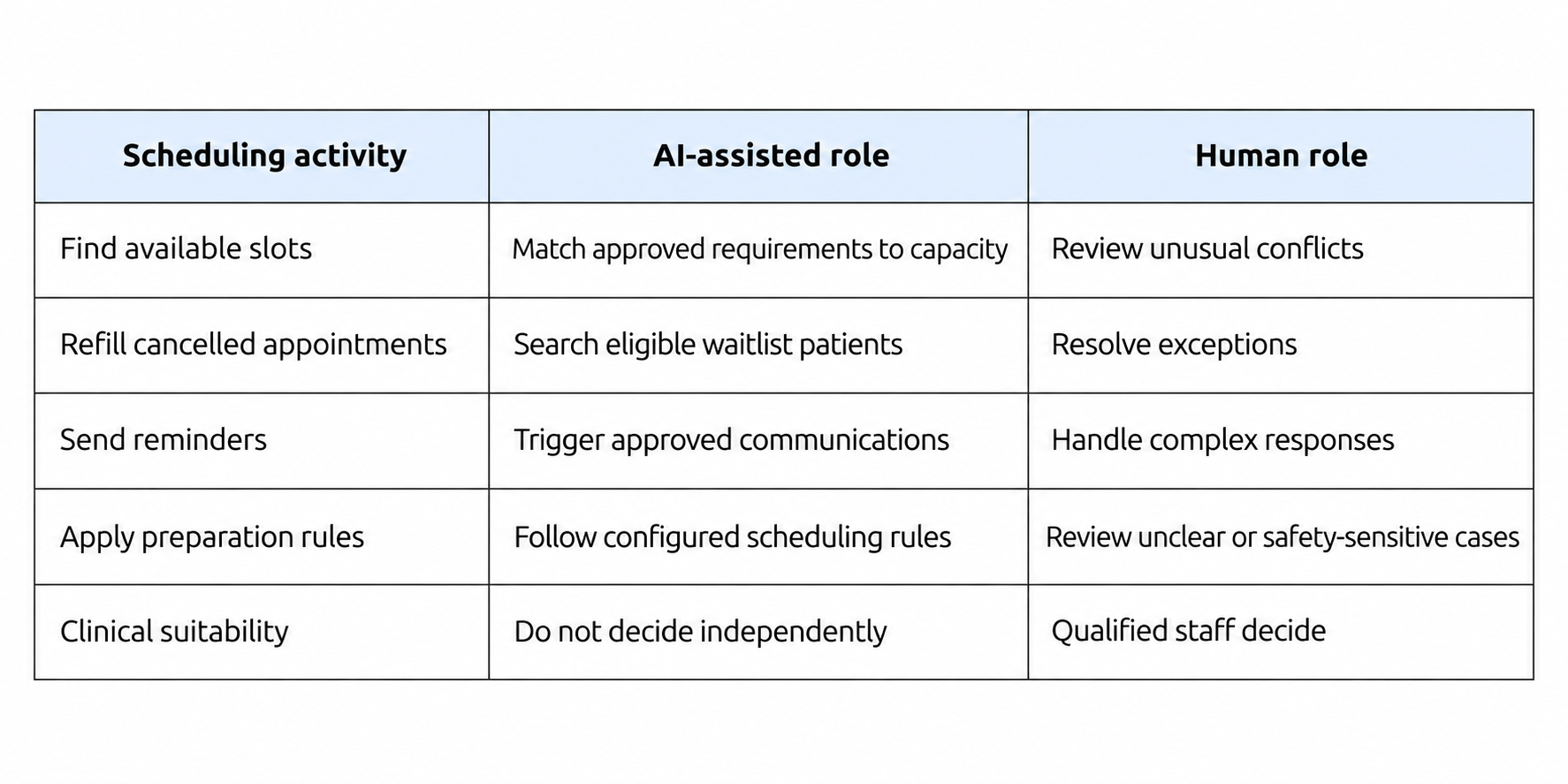
Imaging appointments may involve preparation, contraindications, sedation, contrast, implants, pregnancy-related considerations, or other conditions that should not be reduced to a generic booking rule. Automation works best when it handles defined administrative logic and clearly hands off anything outside that boundary.
Connecting AI Scheduling with RIS, PACS and Existing Healthcare Systems
A scheduling system is more useful when it works with software already used by the diagnostic centre. RIS PACS scheduling integration should therefore be planned around the actual source of booking, patient, and imaging workflow data.
A radiology information system, or RIS, may hold scheduling and radiology workflow information. A hospital information system, or EHR may contain broader patient and operational data. PACS is primarily part of the imaging environment, so it should not automatically be treated as the scheduling source.
An integration layer can exchange information required by the scheduling engine, such as appointment status, capacity, patient identifiers, and workflow events. Depending on the existing healthcare environment, integrations may use REST APIs alongside healthcare interoperability standards such as HL7 or FHIR. Because scheduling workflows can involve personal and health-related information, diagnostic centres should also apply appropriate access controls, data protection measures, and privacy requirements relevant to their operations in India. Current data matters because stale availability can lead to unsuitable slot suggestions.
For organisations considering a custom implementation, an AI development company in Delhi can combine rule-based scheduling logic, machine learning, predictive analytics, cloud infrastructure, and integrations using REST APIs, HL7, or FHIR where appropriate to the diagnostic centre's existing systems.
A Practical Delhi Diagnostic Centre Scenario
Consider a diagnostic centre in Delhi managing MRI and CT requests in a waiting queue. Some requests need longer appointment blocks, some have preparation requirements, and patients have different timing constraints. A cancellation opens a scanner slot, but staff still need to identify who can use it.
In a manual process, the team may review requests individually. With an AI-assisted scheduler, the cancellation can trigger a search of the queue. The system can filter requests against approved slot requirements and surface patients whose scheduling conditions fit the opening. Staff can then confirm the booking or review exceptions.
The system does not decide what scan a patient needs. It helps match an already authorised request with usable operational capacity.
What Delhi Diagnostic Centres Should Plan Before Implementation
Before investing in AI development services in Delhi, a diagnostic centre should define the scheduling problem precisely.
Define the Backlog
Separate requests waiting for appointments from scans waiting for reporting. If the main constraint is reporting capacity, appointment automation alone will not resolve it.
Document Scheduling Rules
Record the operational rules staff use for modality, duration, preparation, location, timing, and escalation. Automation should follow approved rules rather than assumptions.
Check Where the Required Data Lives
Identify which systems store scanner calendars, appointment status, patient requests, cancellations, and waitlists.
Set Human-Review Boundaries
Define which actions the system may complete, which it may recommend, and which cases always require staff review.
Start With a Narrow Workflow
A centre can begin with a well-defined process such as cancelled-slot recovery or a specific imaging appointment queue. This makes it easier to test data, workflow, and escalation rules before expanding.
Frequently Asked Questions
How can AI help reduce diagnostic scan backlogs?
AI can support scheduling-related backlog reduction by matching authorised scan requests with suitable capacity, monitoring waiting queues, identifying replacement candidates for cancelled slots, and reducing repetitive manual searching. It does not remove the need for adequate scanners, staff, or clinical review.
Can AI schedule MRI and CT scans automatically?
It can automate routine booking actions when required information and approved rules are clear. Cases involving clinical suitability, unclear preparation requirements, safety concerns, or conflicting information should be escalated to qualified staff.
Can AI help fill cancelled imaging appointments?
Yes. An AI-assisted scheduler can compare a newly available slot with waiting requests and surface candidates whose modality, duration, timing, location, and other approved requirements fit the opening.
How does AI scheduling integrate with RIS and hospital systems?
Integration depends on where the organisation stores patient, radiology, and scheduling data. The scheduling engine can exchange relevant information with RIS, HIS, EHR, and other systems through supported interfaces such as REST APIs, HL7, or FHIR, depending on the existing healthcare environment.
Can AI predict imaging appointment no-shows?
Predictive systems can estimate no-show risk when appropriate historical scheduling data is available. The output should be treated as a planning signal, not a certainty, and should not be used in ways that unfairly restrict patient access.
Reducing the Scheduling Bottleneck Without Removing Human Control
Diagnostic centres can reduce scheduling friction by identifying where the queue forms, making appointment rules explicit, keeping capacity information current, and using AI where the workflow is suitable for automation. Clinical and exceptional decisions should remain under human control.
Theta Technolabs can develop these scheduling workflows using rule-based logic, machine learning technologies such as Python and Scikit-Learn, and appropriate system integrations to connect with existing healthcare platforms.
For project discussions, contact us at sales@thetatechnolabs.com.


_Automated%20Checkout%20Systems.avif)
_Smart%20Solutions%20for%20Healthcare_%20How%20IoT%20Development%20is%20Reshaping%20Dubai%20Hospitals_Q1_In_24.avif)
_Computer%20Vision-enabled%20Web%20and%20Mobile%20Interfaces%20for%20Mall%20Management%20in%20Dubai_Q1_In_24.avif)