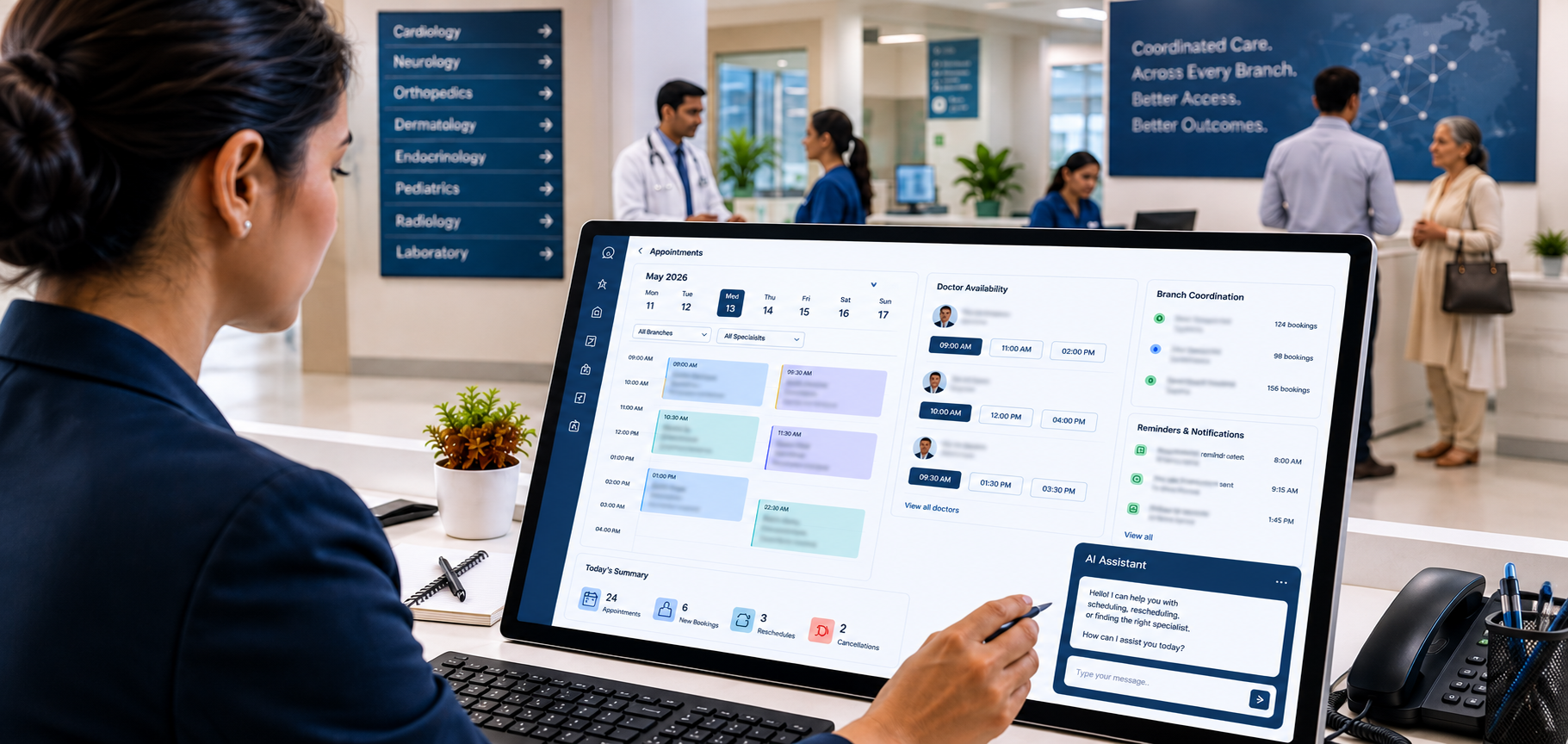


Running a hospital chain means coordinating hundreds of appointment requests every day across multiple departments, specialists, and branches. Each department carries its own schedules, patient volumes, and care workflows, and managing all of this without a structured system creates consistent pressure on reception teams, call centers, and operations staff. For hospital chains, the main value is not just faster booking. The bigger benefit is consistent appointment control across departments, doctors, branches, reminders, follow-ups, and patient communication.
Common challenges hospital chains face:
- Long waiting times even for routine specialist consultations
- Call center overload from basic scheduling queries
- Manual errors leading to double bookings or missed slots
- Patients unsure which specialist fits their concern
- Inconsistent follow-up coordination across departments
- Poor appointment visibility between multiple branch locations
Hospitals are increasingly turning to intelligent chatbots for hospitals and appointment automation tools to address these challenges systematically. AI-driven appointment systems help hospital chains manage specialist booking, doctor availability, branch-wise scheduling, reminders, rescheduling, follow-ups, and patient communication through intelligent chatbot-based workflows.
What Is an AI-Driven Appointment System for Hospitals?
This technology automates the appointment process from end to end. It handles booking, doctor availability checks, patient communication, reminders, rescheduling, follow-ups, and feedback collection without requiring manual effort at every step.
Such a system connects across:
- Hospital website chatbot for 24/7 assistance
- Mobile app for on-the-go booking
- WhatsApp chatbot for conversational scheduling
- Call center workflow automation
- Hospital Information System for real-time scheduling data
- Cloud dashboard for operations and management teams
The goal is not to replace hospital staff. It is to remove repetitive administrative tasks so your team can focus their time on situations that genuinely require human judgment and direct patient care.
The Complete Appointment Lifecycle in a Hospital Chain
Appointment management is more than booking and confirming a slot. A complete patient appointment lifecycle management covers every interaction from the first inquiry through post-consultation follow-up.
A well-designed hospital appointment management system should cover:
- Patient inquiry and first point of contact
- Department or symptom-based selection guidance
- Specialist recommendation based on patient inputs
- Real-time doctor availability check across branches
- Appointment booking and slot confirmation
- Confirmation messages via SMS, email, or WhatsApp
- Reminder notifications before the scheduled visit
- Rescheduling support when patient plans change
- Consultation day coordination and queue updates
- Follow-up appointment booking after the visit
- Patient feedback collection post consultation
- Reporting and analytics for operations teams
Each of these steps is an opportunity to either improve or weaken the patient's experience with your hospital.
Figure: AI-driven appointment lifecycle workflow for hospital chains, from patient inquiry to follow-up and analytics dashboard.
Where Manual Scheduling Fails in Specialist Care
Manual scheduling works for small clinics. For hospital chains managing dozens of specialists across several branches, the process develops consistent failure points.
Patients frequently do not know which specialist fits their concern. Reception teams manually check schedules and suggest a doctor based on partial information, restarting the process when that doctor is unavailable. Call centers get overloaded with routine questions about availability, timing, and documents. Doctors face no-shows because reminder communication is inconsistent. Research on patient no-shows shows that missed appointments can reduce healthcare resource utilization and increase waiting time for other patients. Read more
Follow-up appointments go untracked, creating gaps in care continuity. Multi-branch coordination happens manually over phone calls between admin teams. When booking becomes frustrating, patients often choose another hospital. That is a direct business cost.
How Intelligent Chatbots Simplify Appointment Booking
Intelligent chatbots for hospitals allow patients to schedule appointments at any time without waiting on hold or visiting the hospital in person just to secure a slot.
A healthcare chatbot for appointment booking can:
- Provide round-the-clock appointment assistance without adding staff
- Communicate in multiple languages to serve diverse patient groups
- Guide patients to the right department based on their symptoms
- Show live doctor availability and confirm appointments instantly
- Answer common questions about doctors, required documents, visiting hours, and insurance
- Send automated reminders via WhatsApp, SMS, or email
- Allow rescheduling or cancellation within the same chat interface
- Reduce the volume of routine calls reaching your call center
It is important to be clear here. Chatbots handle administrative and scheduling workflows. They do not replace doctors, offer clinical guidance, or make medical decisions. Those responsibilities remain entirely with qualified healthcare professionals.
AI Specialist Matching: Helping Patients Reach the Right Doctor
Many patients visiting a hospital website do not know which specialist suits their concern. Someone with recurring joint pain may not immediately connect it to orthopaedics. Someone with persistent vision changes may not know they need an ophthalmologist.
An AI specialist matching system addresses this by asking patients structured questions about their symptoms. Based on those inputs, it suggests a relevant department or specialist category and shows available slots. This reduces misdirected bookings and helps patients reach the right team faster.
One important note: AI provides guidance based on basic inputs only. Final clinical decisions should always be made by qualified healthcare professionals.
Managing Appointments Across Multiple Hospital Branches
Hospital chains face scheduling complexity that single-facility hospitals simply do not encounter. Multi-branch hospital appointment scheduling requires systems that work across all locations simultaneously and give operations teams a unified, real-time view.
A centralized system can display branch-wise doctor availability in real time. It can suggest the nearest available specialist based on patient location. It can allow patients to choose between branches based on convenience. It can give operations teams one dashboard covering all branch appointments. It can distribute patient load more evenly across facilities. It can also eliminate manual coordination between branch administration teams.
Without centralized management, branches operate in silos. A patient who cannot get a slot at one branch may not know another branch has availability nearby.
Reducing No-Shows, Delays, and Waiting Time with AI
Missed appointments waste doctor time, disrupt daily schedules, and break patient care continuity. AI appointment scheduling for healthcare addresses this through consistent, proactive patient communication.
Practical ways to reduce patient no-shows with AI include SMS reminders sent days and hours before the appointment. They also include WhatsApp messages with one-click rescheduling links, email confirmations with pre-visit preparation instructions, mobile app push notifications for upcoming consultations, real-time queue updates so patients can plan their arrival, smart alerts when consultations run behind schedule, and automated follow-up reminders after the visit.
Consistent, multi-channel communication cannot guarantee zero no-shows, but it meaningfully improves appointment adherence and reduces avoidable gaps in specialist schedules.
Key Features of a Hospital Appointment System for Chains
When evaluating solutions, these features should be on your checklist:
- AI chatbot across website, mobile app, and WhatsApp
- Real-time doctor availability and schedule management
- Department and specialist selection logic
- Patient profile and appointment history management
- Multi-branch scheduling with a centralized dashboard
- Automated reminders and pre-visit instruction delivery
- Rescheduling and cancellation management
- Follow-up booking linked to consultation outcomes
- HIS, EHR, or EMR integration
- CRM integration for patient communication tracking
- Analytics and reporting for management
- Role-based access control for different staff levels
- Multi-language support and patient feedback collection
A strong hospital appointment management system brings all of these capabilities together in one integrated workflow.
Technology and Integration: Connecting with Existing Hospital Systems
A well-built appointment solution should integrate with your current hospital infrastructure rather than require rebuilding it entirely. Modern AI appointment scheduling for healthcare can connect with your hospital website, mobile app, WhatsApp Business, Hospital Information System, EHR or EMR platforms, CRM systems, payment gateways, and cloud reporting dashboards.
For hospitals exploring this area, working with a team that specializes in chatbots and conversational AI services ensures the chatbot layer is designed around real healthcare workflows and not generic automation logic.
Integration should be phased. Start with the systems that deliver the most immediate operational value, validate results, then expand from there.
Compliance, Data Privacy, and Patient Trust
Patient data is sensitive, and hospitals carry real responsibility around how it is managed. Any appointment system in a healthcare setting must treat data privacy as a foundational requirement.
A responsible system should include:
- Encrypted data transfer at every stage
- Consent-based patient communication flows
- Role-based access so only authorized staff can view patient information
- Audit logs for transparency and accountability
- Human review protocols for complex situations
- Design aligned with applicable healthcare data protection standards
Before committing to any partner, hospitals should ask direct questions about security architecture and access controls.
Business Benefits for Hospital Chains
A thoughtfully implemented AI appointment system delivers practical operational improvements over time:
- Reduced call center workload from routine scheduling queries
- Faster appointment booking with fewer manual steps
- Better specialist utilization across departments
- Fewer missed and forgotten appointments
- Improved follow-up management supporting patient retention
- Higher patient satisfaction from smoother booking experiences
- Greater operational visibility across branches
- Better patient load distribution between hospital locations
Example Scenario: A Patient Books a Specialist Appointment
A patient in Hyderabad experiences recurring knee pain and visits the hospital website at 10 PM. The healthcare chatbot for appointment booking asks structured questions and, based on the inputs, suggests an orthopaedic consultation. It shows available orthopaedic specialists across branches, with location options and open slots.
The patient selects a convenient time and receives an instant WhatsApp confirmation. Pre-visit instructions arrive the following morning. A reminder is sent the day before. After the consultation, the chatbot follows up and offers to help schedule a follow-up visit as the treating doctor recommended.
That is the complete journey, guided from first contact through post-consultation support.
Why Hyderabad Hospital Chains Should Prioritize Appointment Automation
Hyderabad's healthcare sector is growing rapidly. The city serves patients from Telangana, Andhra Pradesh, and neighboring states, and patient expectations around digital access are rising steadily.
Healthcare appointment automation in Hyderabad is becoming a competitive necessity for hospital chains managing high patient volumes. Hospitals that offer smooth digital booking, intelligent reminders, and centralized multi-branch scheduling are better positioned to grow without proportionally increasing administrative costs.
How to Choose the Right Development Partner
The development partner you choose matters as much as the technology itself. Before committing, verify that your partner:
- Understands real hospital workflows, not just general software development
- Has experience building custom healthcare chatbots
- Can develop across web, mobile, and WhatsApp channels
- Has worked with cloud infrastructure for scalable healthcare applications
- Has integration experience with HIS, EHR, and CRM platforms
- Has a clear approach to data security and access control
- Provides post-launch support and system improvements
- Can build analytics and reporting features for operations teams
The Future of Specialist Appointment Management
Appointment management is moving toward more predictive and personalized experiences.
Directions worth planning for include predictive demand forecasting using historical scheduling patterns, smart queue management to reduce in-clinic waiting times, personalized patient journeys based on health history, voice-based appointment booking through smart devices and apps, AI-assisted follow-up suggestions tied to consultation outcomes, and integrated patient engagement platforms combining appointments, records, and communication.
Frequently Asked Questions
1. What is an AI-driven appointment system for hospitals?
An AI-driven appointment system helps hospitals automate booking, doctor availability checks, reminders, rescheduling, follow-ups, and patient communication. It supports hospital teams by reducing repetitive manual scheduling work.
2. How do intelligent chatbots help with hospital appointment booking?
Intelligent chatbots help patients book appointments through a website, mobile app, or WhatsApp. They can guide patients to the right department, show available slots, send reminders, and support easy rescheduling.
3. Can AI reduce patient no-shows in hospital chains?
AI can help reduce no-shows through timely SMS, WhatsApp, email, and app reminders. It cannot guarantee zero missed appointments, but it improves communication and appointment adherence.
4. Is an AI appointment system useful for multi-branch hospitals?
Yes, it helps multi-branch hospitals manage doctor availability, branch-wise appointments, patient load, and follow-ups from one centralized system. This improves visibility and coordination across locations.
5. Can AI chatbots replace hospital staff or doctors?
No. AI chatbots support administrative and scheduling workflows only. Medical decisions, diagnosis, and treatment should always remain with qualified healthcare professionals.
Conclusion
Managing specialist appointments across a hospital chain is complex, but it does not need to be chaotic. An AI-driven appointment system helps bring structure and consistency to the entire patient journey, from the first inquiry through post-consultation follow-up. It reduces manual workload, improves branch coordination, lowers missed appointment rates, and creates a measurably better experience for patients at every touchpoint.
If your hospital chain is ready to explore this, working with an experienced AI development company in Hyderabad like Theta Technolabs can help you build a solution tailored to your specific operational needs and patient growth goals.
Take the Next Step with Theta Technolabs
Theta Technolabs helps healthcare businesses build intelligent chatbot-based appointment systems, patient-facing web platforms, mobile apps, and cloud-based healthcare solutions designed around real hospital operations.
If you are exploring appointment automation for your hospital chain, our team is ready to understand your requirements and discuss the right solution.


_Smart%20Solutions%20for%20Healthcare_%20How%20IoT%20Development%20is%20Reshaping%20Dubai%20Hospitals_Q1_In_24.avif)
_Computer%20Vision-enabled%20Web%20and%20Mobile%20Interfaces%20for%20Mall%20Management%20in%20Dubai_Q1_In_24.avif)