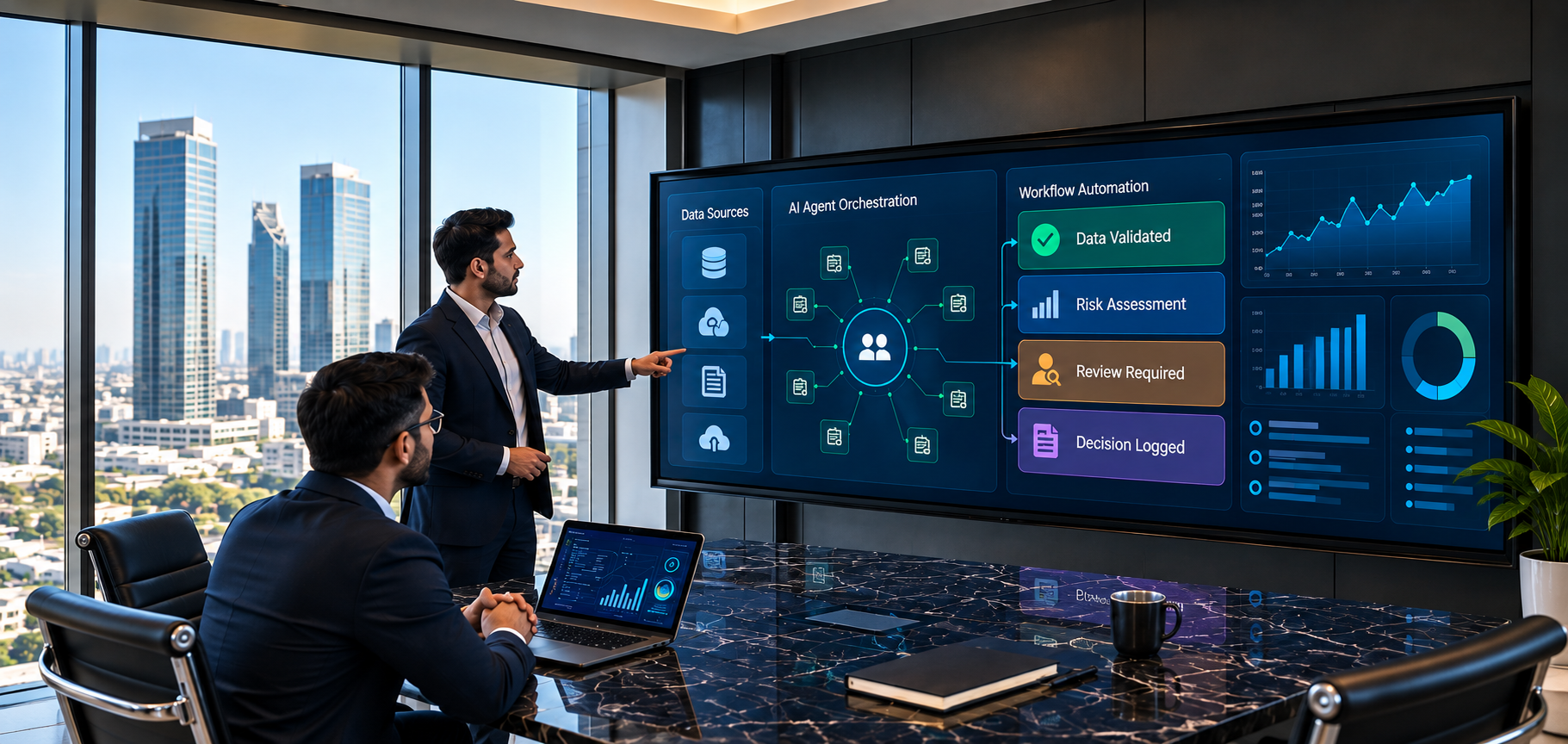


Businesses are no longer asking only whether AI can answer questions. They are now asking whether AI can complete real work across departments.
In many enterprises, daily operations still depend on manual approvals, repeated follow-ups, disconnected tools, spreadsheets, emails, and slow reporting cycles. A simple client onboarding task may involve sales, finance, legal, operations, and support teams. When every step needs manual coordination, decisions become slower and teams spend too much time on repetitive work.
This is where the idea of the Agentic Enterprise is becoming important. With Agentic AI and autonomous workflows, businesses can move toward systems where AI agents understand a goal, plan steps, coordinate tasks, work with enterprise tools, and support teams with better execution. For Dubai enterprises that are focused on digital transformation, speed, and scalability, this shift can become a major business advantage in 2026.
What Is an Agentic Enterprise?
An Agentic Enterprise is a business environment where AI agents do more than generate answers or summaries. These agents can understand business goals, break them into smaller tasks, use connected tools, and support workflow execution with human oversight.
In simple words, it means moving from AI as an assistant to AI as an active workflow partner.
An Agentic Enterprise may include:
- AI agents that understand business goals
- Autonomous workflows that reduce repeated manual coordination
- Systems that connect with CRM, ERP, email, dashboards, and internal tools
- Human approval points for sensitive actions
- Monitoring layers to track performance and reduce risk
This does not mean AI replaces every employee or takes over all business decisions. A responsible Agentic Enterprise uses Agentic AI to support teams, reduce repetitive effort, and improve workflow visibility while keeping humans involved in important decisions.
Why 2026 Is Becoming Important for Autonomous Workflows
The year 2026 is important because enterprise AI is moving from experimentation to deeper workflow adoption. Many companies have already tested chatbots, copilots, and AI assistants. The next step is to use task-specific AI agents that can support real business processes.
According to Gartner, 40% of enterprise applications are expected to include task-specific AI agents by the end of 2026, compared with less than 5% in 2025. This shows how quickly enterprise applications may shift from basic AI features to agent-based systems that support business execution. Read more
For Dubai businesses, this matters because the local market is highly competitive and digitally ambitious. Companies in finance, retail, logistics, real estate, healthcare, hospitality, and professional services need faster decisions, better customer experiences, and more scalable operations. AI workflow automation in Dubai can help enterprises reduce delays and improve how teams work across departments.
How Multi-Agent Systems Work Inside an Enterprise
Multi-Agent Systems are a key part of the Agentic Enterprise model. Instead of depending on one AI tool to do everything, a multi-agent system uses different agents for different roles.
A simple enterprise setup may include:
- Manager Agent: Receives the business goal, breaks it into tasks, assigns work, monitors progress, and escalates issues.
- Document Agent: Reviews, organizes, or extracts information from documents.
- CRM Agent: Updates customer records or checks client details.
- Email Agent: Drafts updates, sends reminders, or prepares communication.
- Finance Agent: Supports invoice checks, billing steps, or approval tracking.
- Reporting Agent: Creates summaries, dashboards, and workflow status updates.
The Manager Agent acts like the coordinator. It does not blindly complete every task. It follows rules, checks progress, and sends sensitive actions to human users for approval. This makes Multi-Agent Systems useful for AI agents for business automation where multiple steps, tools, and teams are involved.
Example: How a Manager Agent Handles a Business Goal
To understand autonomous workflows better, take a simple example: “Onboard this new enterprise client.”
In a traditional workflow, this may require multiple emails, manual reminders, CRM updates, internal approvals, and follow-up meetings. In an Agentic Enterprise model, the process can be coordinated more smoothly.
- The Manager Agent receives the goal to onboard a new client.
- It identifies required steps such as document collection, CRM entry, billing setup, and welcome communication.
- The Document Agent checks whether required files are available.
- The CRM Agent updates client information in the system.
- The Email Agent prepares onboarding messages and reminders.
- The Finance Agent supports billing setup or invoice approval tracking.
- The Reporting Agent shares progress with the internal team.
- A human manager reviews sensitive steps before final approval.
This kind of setup does not remove human responsibility. It reduces repetitive coordination and gives teams more time to focus on client experience, relationship building, and strategic decisions.
Agentic AI vs Traditional Automation
Agentic AI is not the same as every other automation tool. Each technology has a role, but they work differently.
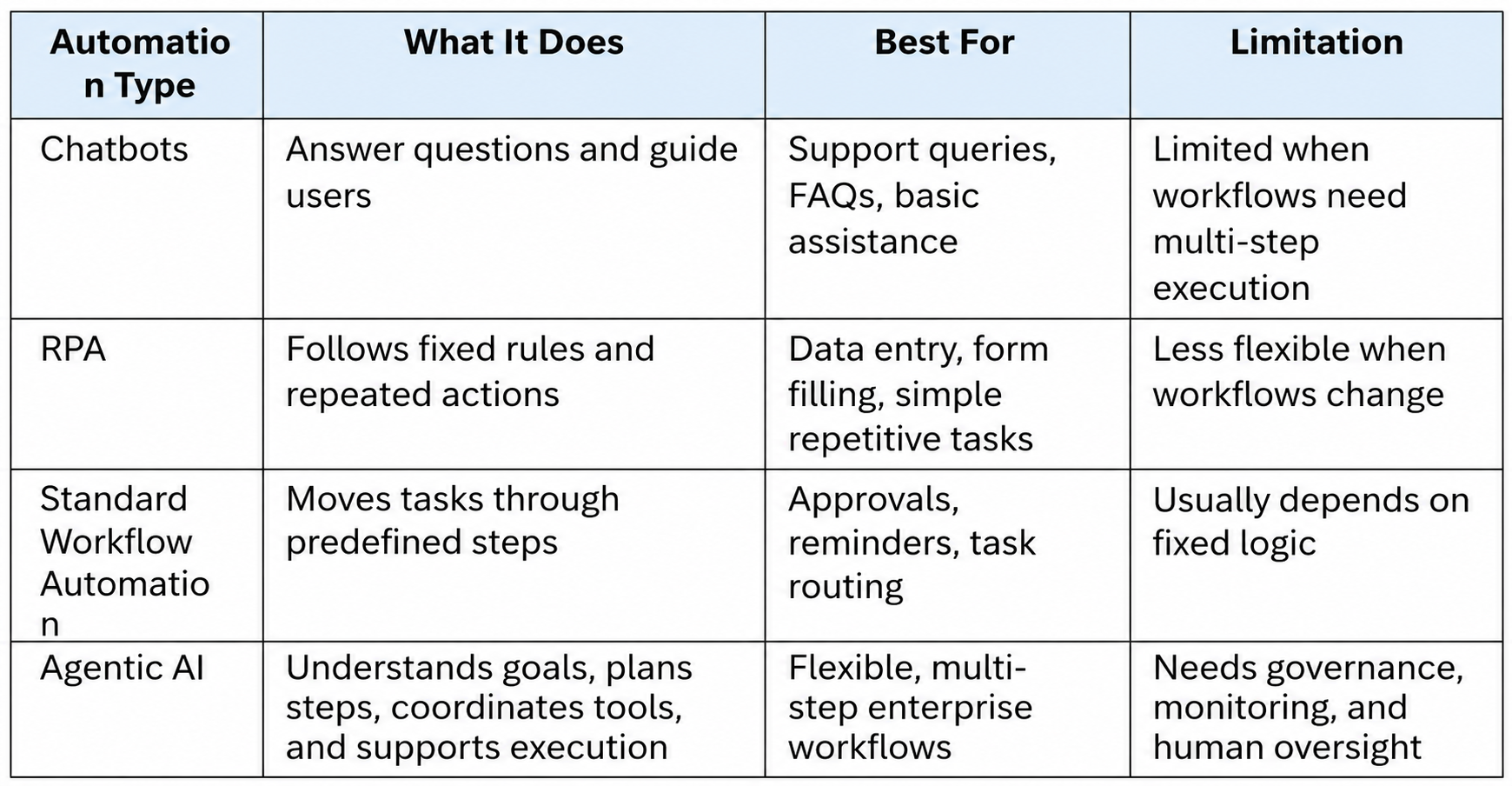
The value of Agentic AI is that it can support more flexible enterprise AI automation. It can work across tools, adapt to context, and help teams complete workflows with better coordination.
Key Use Cases for Dubai Enterprises
Dubai enterprises can apply Agentic AI across many departments, especially where teams handle repetitive tasks, multiple systems, and time-sensitive decisions.
- HR onboarding: AI agents can support document checks, welcome emails, internal task creation, and onboarding reminders.
- Customer support: Agents can summarize issues, route tickets, suggest responses, and update customer records.
- Sales follow-ups: AI agents can track leads, prepare follow-up drafts, update CRM fields, and remind sales teams about next steps.
- Finance approvals: Agents can support invoice checks, approval routing, payment reminders, and billing updates.
- Document workflows: AI agents can extract information, classify documents, and flag missing details.
- Internal reporting: Agents can collect data from different tools and prepare status summaries for leadership.
- Operations coordination: Agents can help teams track tasks, delays, approvals, and pending actions.
When these workflows need mobile access, approvals, alerts, or team updates, working with a mobile app development company in Dubai can help businesses create mobile-friendly workflow experiences for employees and managers.
Business Benefits of Autonomous Workflows
The business value of autonomous workflows comes from reducing manual effort and improving how teams coordinate work. These systems are especially useful when processes involve repeated steps, multiple tools, and frequent follow-ups.
Agentic Enterprise systems can help businesses:
- Complete routine workflows faster
- Reduce repeated manual coordination
- Improve visibility across teams
- Support better internal reporting
- Scale operations without adding unnecessary process complexity
- Improve employee productivity
- Reduce delays in approvals and task handovers
- Create more consistent customer and internal experiences
These benefits depend on proper implementation. Results may vary based on workflow quality, data availability, system integration, user adoption, and governance. That is why enterprises should start with practical use cases instead of trying to automate everything at once.
Technology Stack Behind Agentic Enterprise Systems
An Agentic Enterprise system needs more than a large language model. It requires a reliable technology stack that can connect agents with business tools, data sources, and monitoring systems.
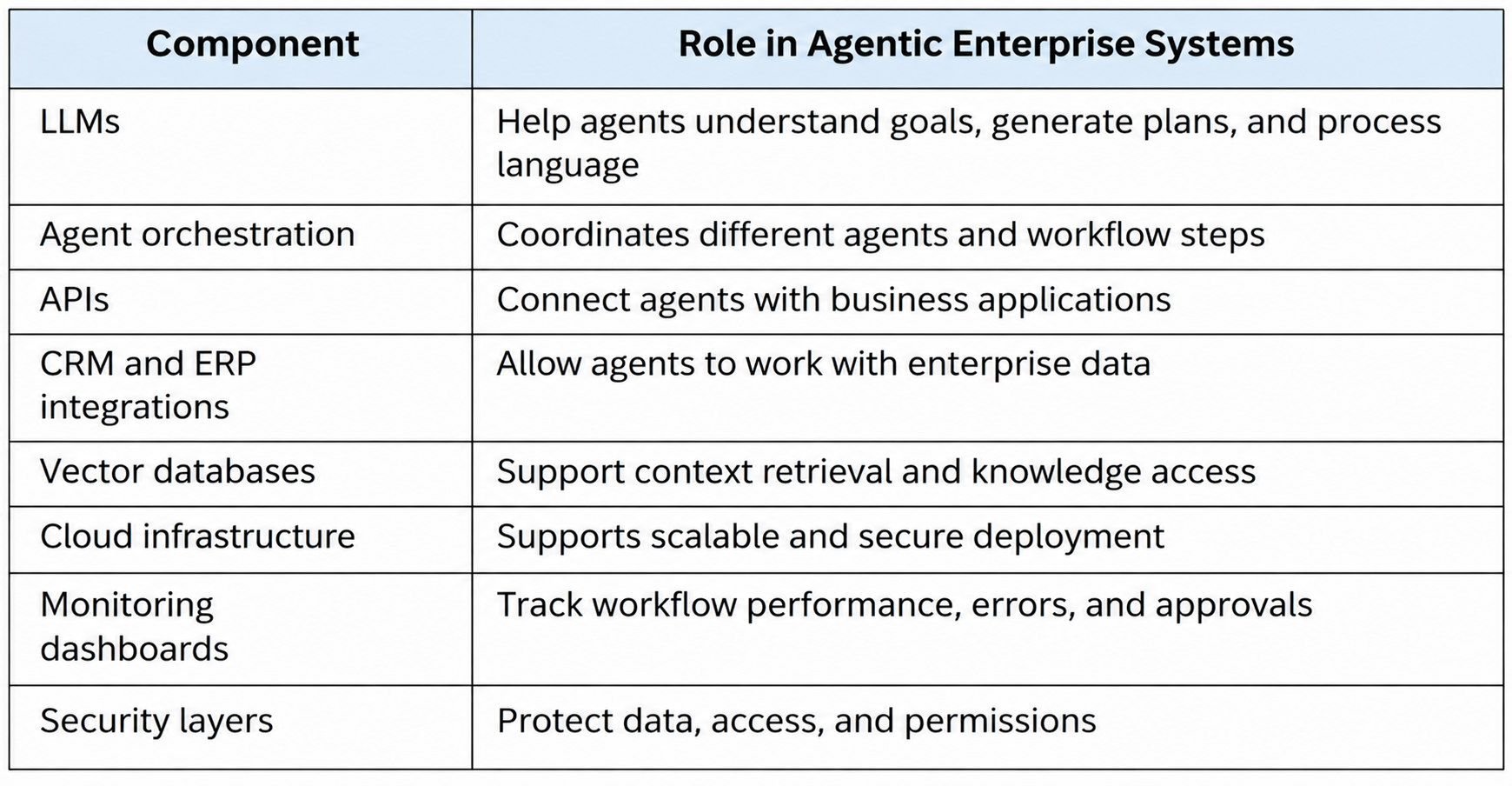
Many Agentic AI systems also need dashboards, admin panels, and reporting portals. In such cases, support from a web app development company in Dubai can help businesses create web-based interfaces to monitor workflows and manage AI-driven operations.
Governance and Security Checklist
Autonomous AI systems should not run without clear controls. Since AI agents may interact with business data, internal tools, and customer information, governance is an important part of responsible adoption.
Enterprises should consider:
- Role-based access control
- Clear permission limits for each agent
- Human approval for sensitive actions
- Audit logs for workflow tracking
- Data privacy controls
- Monitoring dashboards
- Escalation rules for unclear cases
- Prompt injection protection
- Secure API connections
- Regular review of agent behavior
The main goal is to define what agents can do, what they cannot do, and when humans must step in. This is especially important for finance, legal, compliance, HR, and customer-facing workflows.
Implementation Roadmap for Enterprises
A practical Agentic AI roadmap should begin with one clear business problem. Enterprises should avoid starting with a large, unclear automation project.
The following roadmap shows a simple step-by-step approach enterprises can follow to plan, test, and scale Agentic AI workflows responsibly.
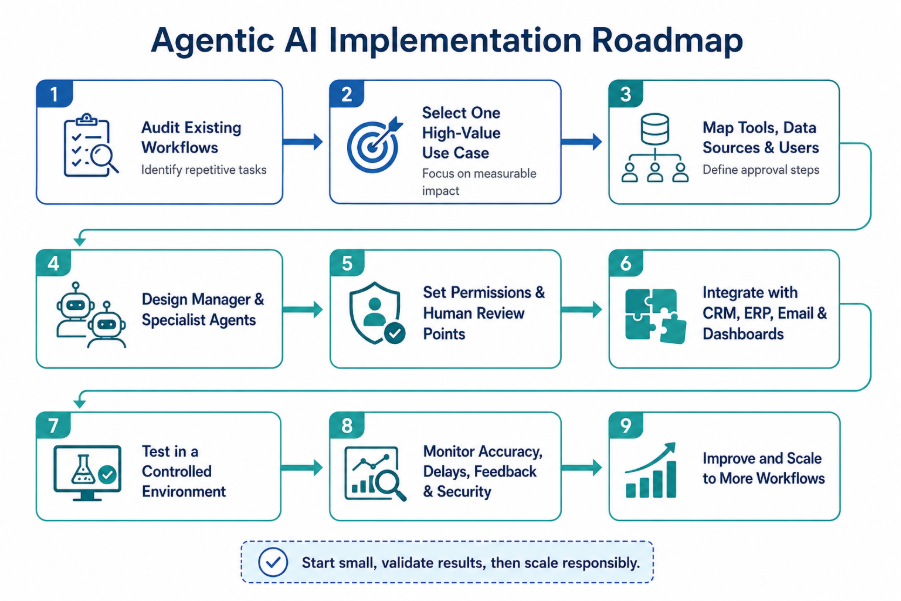
Figure: Agentic AI Implementation Roadmap for Enterprise Workflows
This roadmap keeps the implementation practical by starting with workflow discovery, moving into agent design and integration, and then scaling only after testing, monitoring, and validation.
A simple roadmap includes:
- Audit existing workflows and identify repetitive tasks.
- Select one high-value use case with measurable business impact.
- Map tools, data sources, users, and approval steps.
- Design the Manager Agent and specialist agents.
- Define permissions, restrictions, and human review points.
- Integrate agents with CRM, ERP, email, dashboards, or internal systems.
- Test the workflow in a controlled environment.
- Monitor accuracy, delays, user feedback, and security issues.
- Improve the system before expanding to more workflows.
This step-by-step approach makes custom AI agent development safer, more practical, and easier for business teams to adopt.
Why Choose Theta Technolabs for Agentic AI Solutions
Building an Agentic Enterprise system requires business understanding, AI development experience, integration planning, and secure deployment. As an AI development company in Dubai, Theta Technolabs helps businesses design Agentic AI workflows that connect with real enterprise needs instead of creating isolated AI experiments.
Our team supports LLM integration, workflow automation, CRM and ERP integrations, monitoring dashboards, secure APIs, and scalable enterprise AI deployment.
Conclusion
The rise of the Agentic Enterprise shows how business AI is moving beyond simple assistance. In 2026, more enterprises will look for autonomous workflows that can support real tasks, reduce manual coordination, and improve decision-making across departments.
For Dubai businesses, this shift creates an opportunity to prepare early. The right approach is not to automate everything at once, but to identify practical workflows, build secure systems, add governance, and scale step by step. With the right strategy, Agentic AI solutions in Dubai can help enterprises work faster, improve visibility, and build more scalable operations.
Start Your Agentic AI Journey
Looking to explore Agentic AI for enterprise automation?
Theta Technolabs can help you plan, design, and develop custom AI agent workflows supported by web, mobile, and cloud solutions. Connect with our team at sales@thetatechnolabs.com to discuss your business use case and explore how Agentic AI can support your enterprise workflows.
Frequently Asked Questions
What is the difference between Agentic AI and normal AI automation?
Normal AI automation usually follows fixed rules or responds to specific inputs. Agentic AI can understand a goal, plan steps, coordinate tools, and support multi-step workflows. It is more flexible, but it still needs governance, monitoring, and human oversight for sensitive decisions.
How can Multi-Agent Systems help enterprise operations?
Multi-Agent Systems divide work between a Manager Agent and specialist agents. For example, one agent may handle documents, another may update CRM records, and another may prepare reports. This helps businesses coordinate tasks across departments with better visibility and fewer manual follow-ups.
Are autonomous workflows safe for business use?
Autonomous workflows can be useful when they are designed with proper controls. Businesses should use role-based access, audit logs, approval steps, data privacy measures, monitoring, and clear permission limits. Sensitive actions should always include human review.
Why should Dubai enterprises explore Agentic AI in 2026?
Dubai enterprises are under pressure to move faster, improve customer experience, and scale operations efficiently. Agentic AI can support repetitive workflows, faster decisions, and better operational visibility when implemented with the right strategy, secure integrations, and governance.


_Smart%20Solutions%20for%20Healthcare_%20How%20IoT%20Development%20is%20Reshaping%20Dubai%20Hospitals_Q1_In_24.avif)
_Computer%20Vision-enabled%20Web%20and%20Mobile%20Interfaces%20for%20Mall%20Management%20in%20Dubai_Q1_In_24.avif)