

Healthcare depends heavily on accurate and timely clinical documentation. Every patient visit generates records filled with diagnoses, lab results, prescriptions, and physician notes. Managing this volume of information is overwhelming, and traditional manual summarization methods consume valuable physician time. A single error in an electronic health record (EHR) can lead to compliance issues, treatment delays, or even patient harm.
Large Language Models (LLMs) are transforming this space by automating health record summarization. With advanced natural language processing capabilities, LLMs can process vast amounts of medical text, generate concise summaries, and assist healthcare providers in delivering efficient, accurate care. This blog explores why LLMs matter in health record summarization, the challenges they solve, and how healthcare providers can maximize their potential.
Pain Points in Health Record Management
Despite advances in digital healthcare systems, many providers continue to struggle with record-keeping:
- Time-Consuming Documentation: Physicians often spend 30–40% of their working hours documenting patient encounters, leaving less time for direct care.
- Error Risks: Manual entry increases the likelihood of inaccuracies, from incomplete diagnoses to misinterpreted lab results.
- Physician Burnout: Administrative burdens are a leading factor in burnout. Repetitive record-keeping takes focus away from patient engagement.
- Scattered Data: Patient records are often siloed across departments, making it difficult to create unified, actionable summaries.
These inefficiencies reduce operational productivity and affect patient outcomes. Healthcare organizations need smarter, automated methods to manage clinical documentation effectively.
LLM Solutions
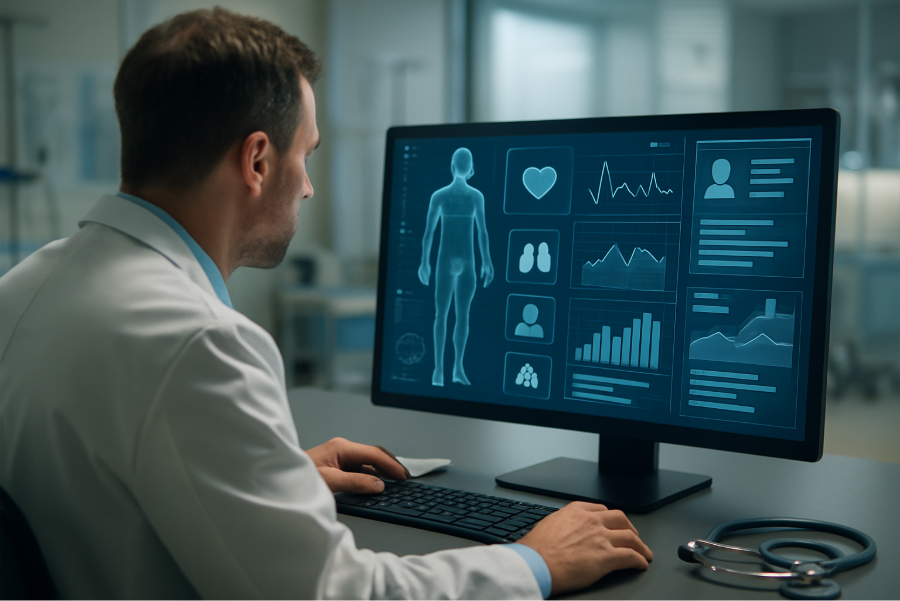
LLMs excel at processing unstructured medical data and transforming it into usable insights. Here’s how they improve health record summarization:
- AI Health Record Summarization: LLMs can condense multiple pages of patient notes into concise, accurate summaries without losing critical details.
- LLM Medical Text Summarization: By identifying patterns in clinical narratives, these models highlight diagnoses, treatment plans, and follow-ups in seconds.
- AI for Clinical Documentation: Intelligent automation reduces the need for physicians to write exhaustive notes, allowing them to verify rather than manually generate documentation.
- LLM Healthcare Applications: From discharge summaries to medical research reviews, LLM-powered tools increase efficiency across healthcare workflows.
- AI in Electronic Health Records: With contextual understanding, LLMs extract structured data from unstructured inputs, making EHRs more searchable and reliable.
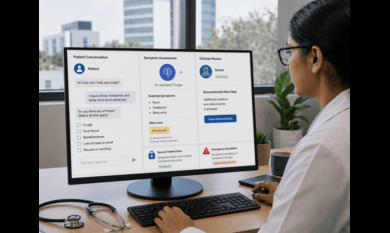
In practice, this means a physician reviewing a 10-page chart could receive a concise, AI-generated summary highlighting key medications, lab results, and next steps.
Tech Stack & Architecture
Building LLM-powered health record summarization systems typically involves:
- Core Models: GPT-based LLMs fine-tuned for medical data.
- NLP Pipelines: Pre-processing modules to handle medical abbreviations and domain-specific terminologies.
- Cloud Infrastructure: Scalable platforms such as AWS or Azure that allow integration with hospital information systems.
- APIs and Custom Integrations: Provided by a software development company in Ahmedabad to connect LLM tools with existing EHR platforms.
- Data Storage & Retrieval Systems: Secure databases that enable real-time access while meeting compliance needs.
A machine learning company Ahmedabad can design tailored solutions using this stack, ensuring seamless integration with healthcare workflows.
Compliance & Security
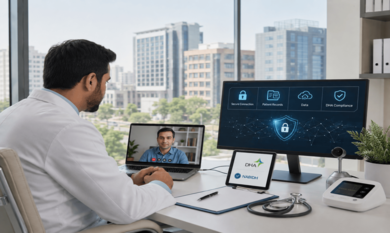
Healthcare organizations must meet strict data privacy standards when adopting AI-powered summarization. Solutions must ensure:
- HIPAA Compliance (US): Protection of sensitive health information from unauthorized access.
- GDPR Adherence (EU): Transparency in how patient data is processed and stored.
- Data Encryption & Access Control: End-to-end encryption for records, with role-based permissions.
- Audit Trails: Every AI-generated summary should include a log of how data was processed, ensuring accountability.
With the right safeguards, AI health record summarization can deliver efficiency without compromising patient privacy.
Applied in Healthcare
One practical example comes from Nuance Communications, a Microsoft company. Their AI-driven Dragon Ambient eXperience (DAX) uses conversational AI and large language models to capture patient-physician interactions in real time. Instead of typing notes, doctors can focus on patient conversations while the system automatically generates accurate clinical summaries. Early adopters in the United States reported up to 50% reduction in documentation time, resulting in improved patient engagement and reduced burnout. Read more
This shows how LLM-powered tools are already reshaping healthcare delivery on the ground.
Development ROI
Healthcare providers adopting LLM healthcare applications are seeing measurable results:
- Time Savings: Physicians spend up to 30–40% less time on manual documentation, freeing hours each week for patient engagement.
- Lower Costs: Hospitals report a 15–20% reduction in administrative expenses by minimizing reliance on transcription services and manual clerical staff.
- Error Reduction: AI-supported summaries reduce documentation errors, lowering misdiagnosis risks by as much as 25% in pilot projects.
- Faster Decisions: Real-time documentation empowers providers to act quickly, improving treatment response times by 20–30%.
Over time, these benefits scale across hospital networks, boosting both financial performance and patient satisfaction.
Competitive Advantage
Beyond ROI, the strategic benefits of AI health record summarization include:
- Faster Healthcare Delivery: Summaries generated within minutes reduce delays, accelerating care planning across facilities.
- Scalability: Hospitals can roll out LLM-based solutions across multiple departments, with organizations reporting up to 40% faster deployment compared to traditional upgrades.
- Better Patient Outcomes: Improved documentation accuracy has been linked to 10–15% fewer treatment delays, enhancing care quality.
- Operational Resilience: Automated systems reduce dependency on overworked staff, ensuring consistency even during peak workloads.
These advantages position LLMs as a cornerstone of future-ready healthcare systems.
Why Choose Us
At Theta Technolabs, we understand the complexities of healthcare technology. Our team builds solutions that combine Web, Mobile, and Cloud expertise with advanced AI capabilities. Whether it’s integrating LLM healthcare applications, deploying secure data pipelines, or building scalable EHR platforms, we ensure that healthcare providers achieve both compliance and efficiency.
Our proven track record as a trusted software development company in Ahmedabad makes us a partner of choice for digital healthcare innovation.
Conclusion
The growing complexity of healthcare records makes manual summarization unsustainable. LLMs bring automation, accuracy, and scalability to clinical documentation, allowing physicians to focus on patient care instead of paperwork. From reducing physician burnout to improving patient outcomes, LLMs are driving the next phase of healthcare efficiency.
As an AI development company in Ahmedabad, Theta Technolabs is equipped to help healthcare providers leverage LLM solutions for smarter, compliant, and more efficient digital health ecosystems.
Take the Next Step
If you’re ready to transform clinical documentation with AI-powered summarization, reach out to us today.
📩 Email: sales@thetatechnolabs.com
Our team at Theta Technolabs can support your journey with:
- Web Application Development to integrate EHR solutions.
- Mobile Application Development for healthcare providers and patients.
- Cloud Consulting Services to ensure scalable, secure, and compliant deployment.
Let’s build the future of healthcare documentation together.