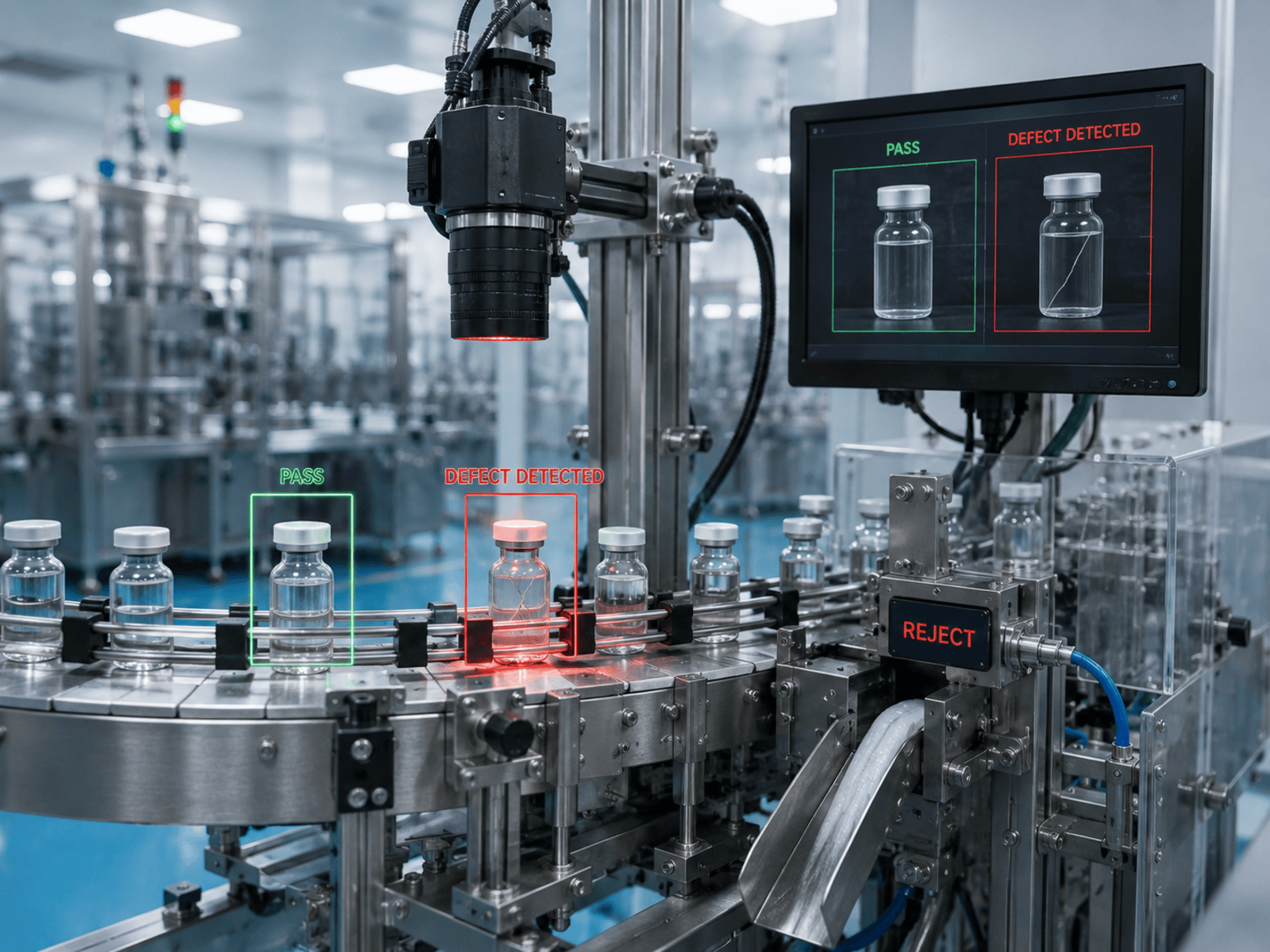


Most pharma plants running tablet or vial lines at scale run into the same wall sooner or later: human inspectors can't keep pace with the line speed, and the defects that slip through aren't small ones. A hairline crack in a vial, a chipped tablet edge, an underfilled blister pocket - these are the things that trigger batch holds, rework, and in the worst case, a recall. Computer vision for pharma quality control is the practical answer manufacturers are turning to now, and this isn't a futuristic concept - it's already running on live production lines. This blog walks through why plants across Hyderabad and other major pharma hubs feel this pressure, how a vision-based inspection system actually works on a tablet or vial line, what it changes for your batch QC process, and a realistic path to rolling it out without disrupting current operations.
Why Automated Inspection Is No Longer Optional
Walk into any mid-to-large pharma plant across Hyderabad, Baddi, Vizag, or Sikkim today, and a similar picture shows up: production lines running faster than they did a few years back, QC teams stretched across multiple products in the same shift, and export clients asking sharper questions during audits. This pattern isn't unique to one location — it's the reality across most of India's major pharma manufacturing clusters right now. Hyderabad carries extra weight here simply because of the sheer volume moving through its plants, with bulk drug and formulation lines running in parallel across a dense manufacturing base.
A few things are driving the shift toward automation across these hubs:
- Rising line speeds mean visual checks that used to be manageable at lower throughput now outpace what a manual team can consistently catch
- Multi-shift inconsistency, where pass/fail judgment can quietly differ between inspectors and shifts, becomes harder to defend during a regulatory review
- Stricter audit expectations, both from India's Central Drugs Standard Control Organisation (CDSCO) and from international buyers who expect documented, traceable inspection records
- Multi-product lines, common in mid-sized plants, where a single line handles several SKUs a week, leaving little room for inspection processes that can't adapt quickly
Put together, this is what's pushing plants toward GMP compliant visual inspection systems — not as an experiment, but as a response to how manufacturing at this scale actually runs today.
Where Manual Inspection Actually Breaks Down
It helps to be specific about what goes wrong, because "human error" on its own doesn't tell you much. In practice, manual tablet and vial visual inspection runs into a few recurring issues:
- Extended shifts on repetitive visual checks naturally wear down attention over time, and accuracy tends to dip as a result
- Pass/fail calls can vary between individual inspectors and between shifts, creating inconsistency that's difficult to justify in a deviation report
- At the speeds many lines now run, fine defects — a hairline crack in glass, foreign particulate, a partially filled blister pocket — are easy to miss with the eye alone
- Rejection records often come down to a checkbox and a short note, which isn't strong evidence during a regulatory investigation
This is where reducing manual inspection errors stops being purely a productivity conversation and becomes a compliance one.
How Computer Vision Actually Works on the Line
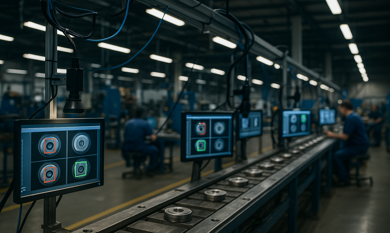
Here's the mechanics without turning it into a lecture. A vision inspection setup typically pairs high-resolution industrial cameras positioned above or alongside the conveyor with lighting tuned to the product - backlighting, for instance, works well for transparent vials since it brings out surface chips and fill-level irregularities that front lighting tends to miss. It's worth noting this standard setup has limits: catching foreign particulate inside liquid-filled vials or fine hairline cracks in glass usually needs extra handling, like a rotate-and-stop mechanism paired with specialized lighting, since a basic conveyor camera alone tends to struggle with those two defect types specifically. Each unit passing under the camera gets imaged in a fraction of a second, and that image is compared against a trained detection model that has learned what a good tablet or vial looks like versus a defective one, based on a large set of labeled reference images from the actual product line.
When the model flags something - a chip, a mislabeled pocket, an underfilled vial a reject mechanism pulls that unit off the line before it reaches packaging. This is AI defect detection in pharma manufacturing in practice, and every decision, pass or reject, gets logged with a timestamp and an image reference, which is exactly the kind of audit trail regulators and export buyers want to see. Getting this integrated properly - matched to your actual line speed and product variability - is usually where working with a team offering dedicated computer vision development services makes the difference between a system that works in a demo and one that holds up on a real production floor.
What This Actually Changes for Batch Quality Control
The value shows up in specific, trackable places rather than vague efficiency talk:
- Fewer inconsistency-driven batch holds, since pass/fail criteria stop shifting between shifts and inspectors
- Tighter deviation reports, backed by image and timestamp records instead of handwritten notes
- Shorter release cycles, since QA isn't waiting on a manual re-check of a flagged batch
- Stronger audit positioning, with a digital, image-backed inspection log standing up better than a paper logbook
An AI vision system for pharma in India still needs periodic model checks, particularly when a new SKU or packaging format is introduced — this isn't a "set it and walk away" upgrade, and treating it that way would be the wrong takeaway. But compared to a fully manual process, the gain in consistency is real and shows up within a few production cycles.
Build vs Buy: What Manufacturers Should Actually Weigh
This is the point most plant heads get stuck on, and it deserves an honest breakdown rather than a push in one direction.
Off-the-shelf vision hardware works well when:
- Your line runs one or two product types fairly consistently
- Fast deployment matters more than deep customization
- You're comfortable with vendor-managed retraining for future product changes
A tailored, integrated setup tends to fit better when:
- Your plant runs multi-product lines with frequent packaging or format changes
- You need the system built around your existing conveyor and reject mechanisms specifically
- You want retraining and updates handled without waiting on vendor turnaround
For a lot of manufacturing facilities running varied product lines, the second path tends to hold up better over time, even if the initial build takes a little longer. It's worth mapping your own product variability honestly before committing budget either way, and thinking of it as part of a broader manufacturing software solutions strategy rather than a one-off hardware purchase.
A Practical Rollout Path
Plants that get this right don't automate every line on day one. A realistic sequence looks like this:
- Pick one line to start — usually the one with the highest rejection rate or the most audit attention
- Collect real production images over a few weeks, covering both good and defective units, not staged samples
- Train the detection model on that image set and run it in parallel with existing manual inspection
- Benchmark the model's calls against your trained inspectors before letting it operate independently
- Reduce manual checks gradually, keeping periodic spot-checks rather than removing human oversight entirely
- Scale to additional lines once the integration pattern and data pipeline are proven on the first one
If you're evaluating this for a facility in Hyderabad specifically, working with a partner already familiar with the region's operational and regulatory context such as an AI development company in Hyderabad tends to shorten this runway, since local compliance nuances don't need to be explained from scratch.
Frequently Asked Questions
Is computer vision inspection accurate enough to fully replace manual QC?
Not right away, and aiming for full replacement on day one isn't realistic. The sound approach is running the vision system alongside manual inspection during validation, then reducing not eliminating manual checks once the model's accuracy holds up consistently against your trained inspectors.
Does this fit CDSCO and GMP documentation requirements?
Yes, but it takes more than just logging. The timestamped image record does strengthen your documentation position compared to a manual logbook entry, but if you're using an AI-based model rather than a simple rule-based check, it also needs to go through formal validation and change-control steps each time the model is retrained on a new SKU that part matters just as much to an auditor as the image logs do.
How long does a pilot line typically take to set up?
It depends on product complexity, but most plants spend a few weeks collecting real production images before training begins, followed by a parallel-run validation period before the system takes over inspection duties on that line.
Is this only practical for large pharma manufacturers?
No. Mid-sized manufacturers running multi-product lines are often the ones who benefit most, since a properly integrated system can be built around their specific product variability instead of a rigid setup designed for larger, more standardized operations.
Bringing This Back to Your Production Line
If your QC team is catching defects late, spending too much time on manual re-checks, or struggling to produce clean audit trails during inspections, a vision-based inspection system is worth evaluating for at least one line. Systems like this are typically built on tools such as OpenCV for image processing, deep learning frameworks like TensorFlow or PyTorch for defect classification, and edge computing setups that let inspection decisions happen in real time on the line rather than depending on a slow round-trip to the cloud.
We work with pharma manufacturers on exactly this kind of implementation from the initial line assessment to model training and integration with existing conveyor and reject systems. If you want to talk through what this would look like for your facility, reach out to us at sales@thetatechnolabs.com.









.png)





.png)































.avif)
.avif)
.avif)


















_How%20IoT%20Can%20Reduce%20Energy%20Costs%20in%20Smart%20Factories_Q4_25.avif)
_How%20AI%20Development%20Companies%20in%20Ahmedabad%20are%20Transforming%20the%20Shopping%20Experience_Q4_25.avif)
_Node.js%20and%20Blockchain_%20A%20Perfect%20Pair%20for%20Fintech%20Innovation%20in%20Dubai_Q3_24.avif)
_Choosing%20the%20Right%20Computer%20Vision%20Development%20Partner%20in%20Ahmedabad%20for%20Construction_Q3_24.avif)
_The%20Transformative%20Role%20of%20Open%20Banking%20APIs%20in%20Fintech%20for%202024_Q3_24.avif)
_Explore%20the%20Best%20Cross-Platform%20App%20Development%20Frameworks%20of%202024_Q3_24.avif)


_Integrating%20IoT%20with%20Mobile%20Apps%20for%20Advanced%20Renewable%20Energy%20Solutions_Q2_24.avif)
_Top%20Benefits%20of%20Cloud%20Computing%20for%20All%20Business%20Sectors_Q2_24.avif)

_Understanding%20the%20Impact%20of%20AI%20and%20Machine%20Learning%20on%20Fintech%20Web%20Apps%20in%20Dubai_Q2_24.avif)


_Smart%20Manufacturing%20in%20Dubai_%20How%20AI%20is%20Driving%20Efficiency%20and%20Innovation_Q1_In_24.avif)
_Automated%20Checkout%20Systems.avif)