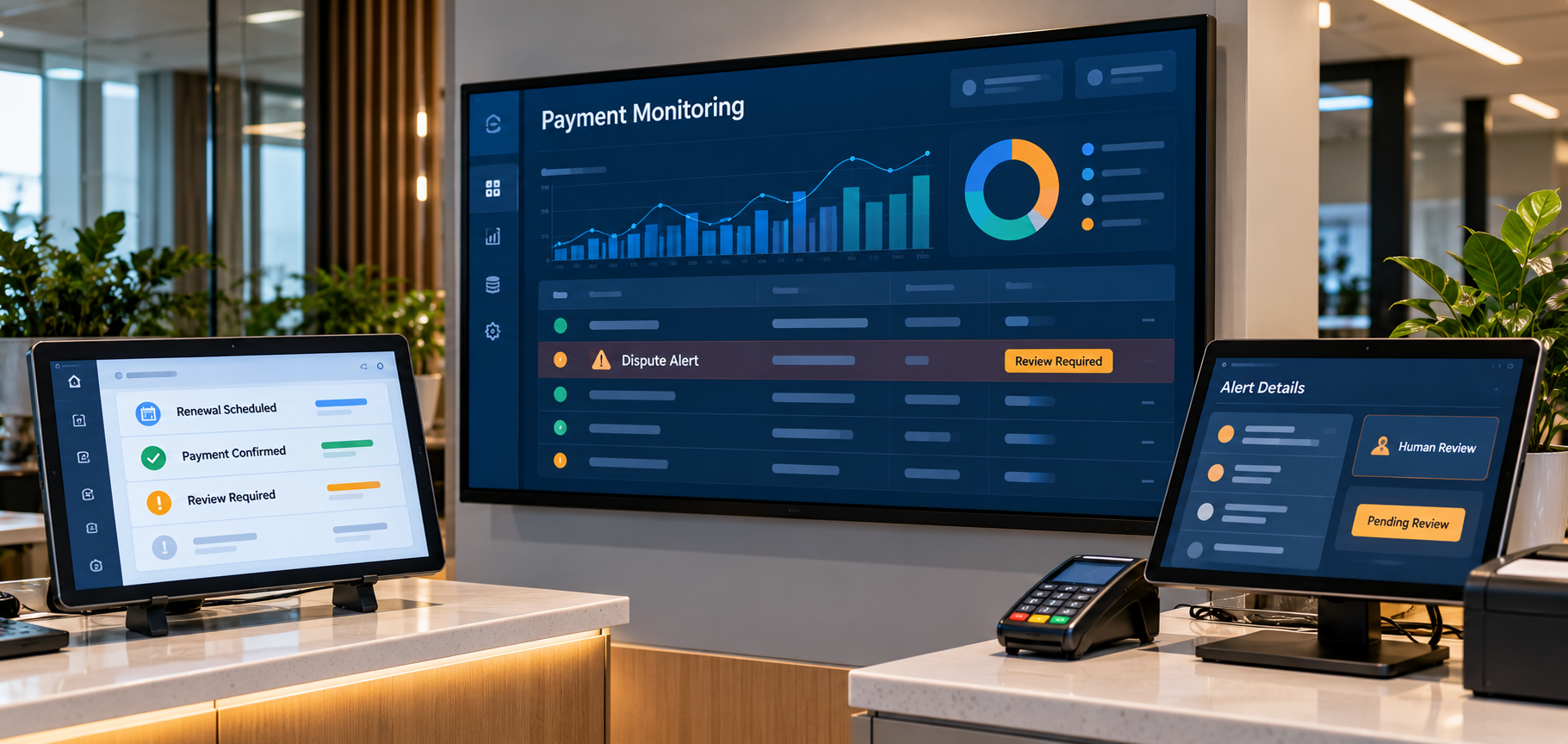


Subscription businesses rely on recurring payments, but a successful renewal does not always mean the transaction will remain undisputed. Customers might not recognise a charge, believe they cancelled, or report an unauthorised payment. For Indian SaaS providers, late investigation creates extra work and frustration.
AI-based chargeback detection helps payment teams identify warning signs using transaction history, subscription activity, and previous dispute outcomes. This guide covers useful signals, detection workflows, integration, and staff review.
Why Subscription Payments Lead to Chargebacks
Recurring billing creates more occasions for confusion or account problems than a single purchase. For subscription payment platforms, common reasons for disputes include:
- Unrecognised renewals: A customer forgets about an active subscription or does not recognise the merchant descriptor on a card statement.
- Cancellation problems: A renewal is collected even though the customer believes cancellation was completed.
- Duplicate or incorrect charges: A billing error creates more than one collection attempt or charges the wrong amount.
- Unauthorised transactions: A cardholder reports that they did not approve a payment.
- Unresolved refunds or service complaints: A customer contacts their bank after an expected refund or support response does not arrive.
These situations require different responses: an unauthorised charge warrants investigation, while a cancellation mismatch is a billing issue. Effective payment dispute management begins by recognising that difference rather than treating every disputed payment as fraud.
How AI Can Identify Possible Chargebacks Before a Dispute
AI can examine historical transactions to find patterns associated with payments that were later disputed. For example, unusual renewal attempts, repeated payment failures, and previous disputes may be useful signals when interpreted in context. A trained system can produce an estimated likelihood of a future chargeback or place a transaction in a review category.
This is predictive chargeback analytics, not proof that a customer will complain. Its usefulness depends on data quality and testing. A responsible team also compares predictive alerts against a basic rules-only approach. If a complex algorithm does not identify useful cases more reliably, adding it may create maintenance work without improving the investigation process.
Rule-based checks are also valuable. A cancelled subscription with a scheduled renewal can be flagged through a straightforward billing rule, without requiring machine learning. Combining rules with prediction can improve alert relevance. The aim of chargeback prevention is to give staff a chance to correct a genuine problem or investigate suspicious activity before it escalates, when the timing allows.
What Payment Data Does an AI Detection System Need?
Transaction and Subscription Billing Records
Relevant inputs can include payment status, recurring billing dates, renewal attempts, failed collections, refunds, customer-approved payment changes, and the recorded cancellation status. These records reveal whether a transaction follows the expected subscription journey.
For recurring payment fraud detection, transaction behaviour may help uncover suspicious activity, but it should not be used to label an ordinary billing error as fraud. An upcoming-renewal alert must use only information available before renewal.
Historical Disputes and Customer Activity
Past chargeback outcomes, dispute categories, support contact records, and permitted account activity can help identify useful patterns. Those records should be matched accurately to payment events and checked for duplicates, missing information, and inconsistent labels.
Development teams should avoid training on information generated only after a dispute was opened, since that would create misleading test results. Teams should minimise personal data and restrict access. Reliable records matter more than volume.
How an AI-Based Chargeback Detection System Works
A workflow for chargeback detection for subscription businesses combines billing data and investigation. Rules flag known inconsistencies; an AI fraud detection component can identify learned patterns.
Step 1: Collect and Prepare Payment Information
The system receives authorised events from payment processors, subscription software, and dispute records. Before analysis, it aligns event times, removes duplicate updates, and associates transactions with the correct subscription without exposing unnecessary sensitive data.
Step 2: Analyze Transactions Using Machine Learning
Historical outcomes can be used to train and evaluate a predictive algorithm. Teams providing machine learning for fraud detection can assess whether available information supports a dependable prediction or whether simpler rules are more appropriate. Testing must exclude future information from predictions.
Step 3: Flag Unusual Subscription Payments
The monitoring service evaluates incoming events and records relevant indicators, such as an unexpected retry pattern or a mismatch between billing and cancellation records. An alert should explain its reasons, not present a score as a verdict.
Step 4: Send Alerts for Human Review
Payment staff examine flagged cases, compare account and billing records, and choose an appropriate response. That may mean correcting a subscription, checking an authorisation issue, contacting the customer, or closing an alert with no action. Review outcomes help improve the system.
Integrating Chargeback Detection with Existing Payment Platforms
An Indian subscription provider may already use a payment gateway, a billing application, and a separate customer support system. A useful AI payment monitoring system connects the necessary records without assuming that all those tools must be replaced.
Connecting Payment Gateways and Billing Systems
Supported APIs and webhooks can deliver payment status changes, renewal events, refunds, and dispute notifications. Integration logic should account for delayed notifications, repeated webhook deliveries, and failed synchronisation. Keeping an auditable event history makes it easier to understand what the platform knew before a payment was collected.
Provider capabilities must be verified before promising live alerts. Teams should also define how payment events are matched to the right subscription, how unavailable gateways are handled, and how corrections appear in the dashboard. These integration decisions often determine whether an alert arrives early enough for a useful response.
Building Monitoring Dashboards and Review Workflows
A dashboard can bring together the subscription status, relevant payment history, alert reasons, and staff review outcome. Permissions should protect sensitive details.
Custom FinTech software development services can help connect these operational components, particularly when a business uses several payment or subscription systems. The workflow should remain reviewable.
What Makes Chargeback Detection Reliable and Responsible?
A detection system must be evaluated for both missed disputes and incorrect alerts. Precision describes how many flagged cases prove relevant; recall describes how many relevant historical cases the system manages to identify. Improving one measure may affect the other, so thresholds should reflect business priorities and the consequences of unnecessary intervention.
Historical records may be incomplete or reflect changing customer behaviour. Teams should test later periods and monitor deployed alert quality. Customer-impacting decisions should remain subject to appropriate review, and sensitive data needs access controls, secure storage, and defined retention practices.
Indian recurring-payment requirements also matter. The Reserve Bank of India's guidance on processing e-mandates for recurring transactions describes a pre-debit notification requirement under the e-mandate framework and a specific exception for certain auto-replenishment transactions. Operators must check applicable rules. This guidance does not require AI chargeback scoring.
Finally, card chargebacks and disputes involving UPI transactions follow different arrangements. A monitoring design should not combine them under one assumed dispute process.
Illustrative Example: Detecting a Possible Subscription Payment Dispute
Consider a hypothetical SaaS provider in India that bills customers monthly. A customer requests cancellation through its support channel, but the billing application still shows the account as active. A renewal is scheduled.
A connected monitoring system compares the cancellation record with the upcoming billing event and flags the mismatch. The payment operations team reviews the account, confirms whether cancellation was completed, and corrects the billing status if required.
This rule-based alert does not require AI. Predictive analysis may support other dispute patterns. The value comes from finding the mismatch early and giving staff information to act on it.
How Businesses Can Implement AI-Based Chargeback Detection
A sensible implementation starts with the payment problem, not with choosing an algorithm. Businesses can:
- Map existing payment, billing, cancellation, and dispute workflows.
- Audit available records, data quality, and permissions.
- Define which issues need business rules and which justify predictive analysis.
- Connect alerts to a dashboard with accountable human review.
- Pilot the workflow, check false alerts and missed cases, and improve it using recorded outcomes.
Custom AI development services in India are relevant where businesses need tailored data pipelines, predictive components, or integrations with existing operational tools. Pilots should establish usefulness before rollout.
Frequently Asked Questions
Can AI prevent every subscription payment chargeback?
No. AI can identify patterns associated with some future disputes, but customer complaints and billing issues cannot always be predicted. Clear billing practices, reliable cancellation handling, and customer support remain essential.
What data is needed to detect possible chargebacks?
Typical inputs include transaction outcomes, subscription renewal records, cancellation and refund information, and labelled historical disputes. Data availability, quality, and permitted use determine what can be analysed.
Can an existing payment platform integrate AI chargeback detection?
Often, yes, if its payment and billing providers offer suitable APIs, webhooks, or authorised data exports. The integration design depends on those capabilities and on the business's review requirements.
Conclusion
Subscription chargeback monitoring works best when payment records, clear billing rules, predictive analysis, and staff review operate together. Not every problem requires a complex algorithm, and no detection system eliminates all disputes.
For tailored FinTech monitoring, Theta Technolabs can support Python and TensorFlow development, API integration, testing, and dashboard design. Contact sales@thetatechnolabs.com to discuss an existing platform or new implementation.





















.png)




.png)





































.avif)
.avif)
.avif)
























_How%20IoT%20Can%20Reduce%20Energy%20Costs%20in%20Smart%20Factories_Q4_25.avif)
_How%20AI%20Development%20Companies%20in%20Ahmedabad%20are%20Transforming%20the%20Shopping%20Experience_Q4_25.avif)
_Node.js%20and%20Blockchain_%20A%20Perfect%20Pair%20for%20Fintech%20Innovation%20in%20Dubai_Q3_24.avif)
_Choosing%20the%20Right%20Computer%20Vision%20Development%20Partner%20in%20Ahmedabad%20for%20Construction_Q3_24.avif)
_The%20Transformative%20Role%20of%20Open%20Banking%20APIs%20in%20Fintech%20for%202024_Q3_24.avif)
_Explore%20the%20Best%20Cross-Platform%20App%20Development%20Frameworks%20of%202024_Q3_24.avif)