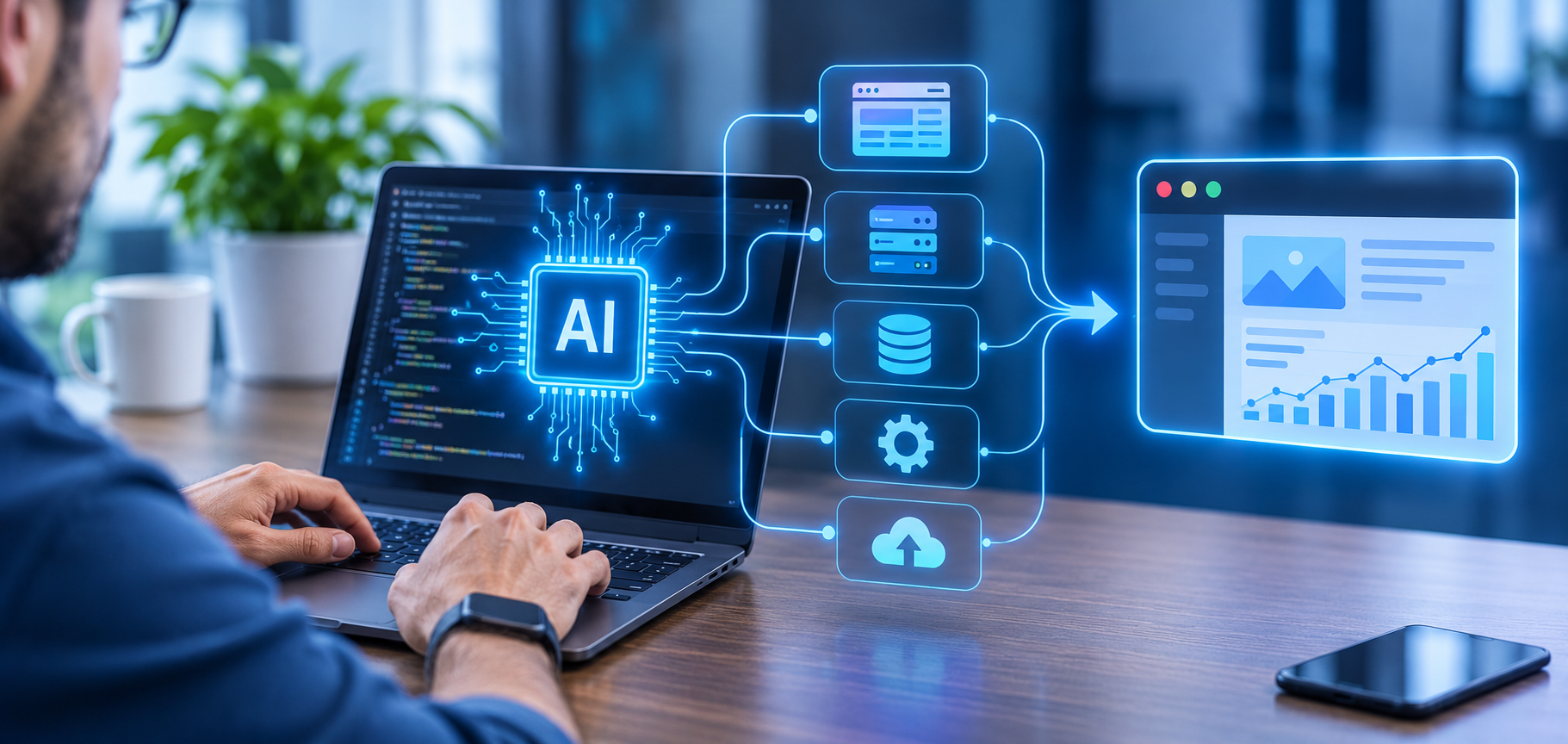


Imagine explaining your business idea in a few sentences and receiving a working web application in return. You describe the features, user roles, dashboard, and expected functionality, and an AI tool starts generating the application.
This is becoming increasingly possible with AI-powered development tools. They can generate user interfaces, write backend code, create database structures, and help developers build functional prototypes faster than traditional approaches.
However, building a web application involves more than generating code. Businesses need reliable integrations, secure data handling, customised workflows, and software that can support their operations as they grow.
So, can AI really build a complete full-stack web application from a single prompt? The answer is yes, to an extent. But creating a dependable business application still requires technical planning, development expertise, testing, and continuous improvement.
What Does Building a Full-Stack Web Application with AI Mean?
A full-stack web application includes multiple components that work together to deliver a complete digital experience.
These generally include:
- Frontend: The interface users interact with, including dashboards, forms, reports, and navigation.
- Backend: The server-side logic that manages requests, business rules, and application operations.
- Database: The system that stores and manages application data.
- APIs: Interfaces that allow the application to communicate with external platforms, devices, and services.
- Authentication and security: Features that manage user access, permissions, and data protection.
- Deployment infrastructure: The environment where the application runs and is maintained.
AI development tools can assist with generating many of these components using natural language instructions. For example, a company could prompt an AI tool to create an inventory management application with product records, stock tracking, user login, and reporting dashboards.
The tool may generate an initial working version. However, the quality of the final application depends on how well the requirements, integrations, and technical architecture are defined.
What Can AI Build from a Single Prompt?
A detailed prompt can help AI generate the initial structure of an application. Depending on the development platform and project complexity, it can assist with several important components.
1. Frontend Interfaces and User Dashboards
AI can generate interface layouts based on descriptions of the required screens and user journeys.
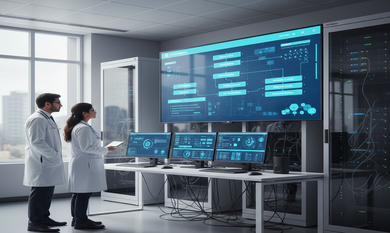
For example, a manufacturing company may need a dashboard showing production status, machine performance, inventory levels, and pending maintenance activities.
A prompt describing these requirements can help generate:
- Login and registration screens
- Admin and user dashboards
- Data entry forms
- Charts and reports
- Search and filtering options
- Responsive web layouts
Developers can then refine the design, improve navigation, and ensure the interface matches the actual workflow of the business.
2. Backend Logic and Database Structures
AI can also assist in creating backend functionality and database structures.
Consider a company that wants to develop a customer management platform. The application may need to store customer details, track enquiries, assign leads, manage follow-ups, and generate reports.
AI can help generate database tables, API endpoints, and basic business logic for these requirements. Developers still need to validate the data relationships, permissions, calculations, and performance to ensure everything works correctly.
3. API Development and Third-Party Integrations
Modern business applications rarely operate independently. They often communicate with payment gateways, CRM platforms, ERP systems, cloud services, and other business applications.
AI can help developers generate API connections and integration logic. However, the actual integration depends on the availability of APIs, documentation, authentication methods, and the requirements of each external system.
For companies using multiple software platforms, properly planned integration is essential to maintain consistent data exchange and avoid disconnected workflows.
Can AI Connect a Web Application with Existing Hardware?
This is where business-specific development becomes especially important.
Many companies depend on physical devices, sensors, machines, controllers, or connected equipment to collect operational data. They need software that can receive this information, process it, and present useful insights through a web application.
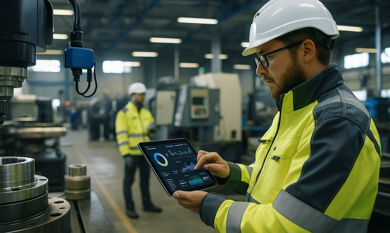
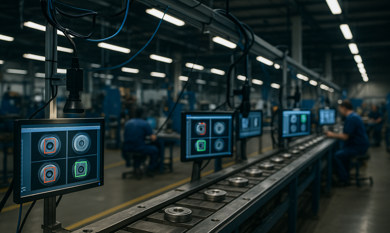
For example, a manufacturing company may want to connect its production machines to a central dashboard. The application could display machine status, production output, temperature readings, equipment alerts, and maintenance information.
AI can assist in generating parts of the application and integration code. However, hardware integration requires a clear understanding of device communication protocols, firmware, data formats, gateways, network connectivity, and real-time requirements.
A development team must ensure that the application can reliably communicate with the hardware and handle incoming data correctly.
This is particularly relevant when businesses need software and hardware integration, IoT connectivity, BLE communication, or custom monitoring platforms.
Where Does AI Need Support from Professional Developers?
AI can accelerate development, but a single prompt rarely captures every technical and operational requirement of a business application.
Some important areas still require developer involvement.
1. Understanding Business-Specific Requirements
A prompt may describe what an application should do, but it may not explain every business rule, exception, user permission, or operational dependency.
Developers need to understand the actual workflow before finalising the application architecture.
2. Security and Data Protection
Applications handling customer information, financial records, employee data, or industrial operations need appropriate security measures.
Authentication, access control, input validation, secure API communication, and database protection must be reviewed and tested before deployment.
3. Performance and Scalability
An application that works with a small amount of sample data may not perform equally well when hundreds of users access it simultaneously.
Developers need to assess database queries, server capacity, application architecture, and infrastructure requirements to support future growth.
4. Testing and Continuous Maintenance
AI-generated code also needs proper testing. Developers must identify errors, validate integrations, check different user scenarios, and resolve issues before the application is used in real business operations.
After deployment, regular updates, monitoring, and maintenance help keep the software reliable as business requirements change.
AI-Assisted Development for New and Existing Business Applications
AI is not limited to creating applications from scratch. It can also support companies that already have software but need to improve it.
For businesses planning a new application, AI can help accelerate prototyping, generate initial code, and explore different functionality options before full-scale development.
For businesses with existing applications, AI can assist with code analysis, documentation, test generation, bug identification, and selected modernisation tasks. Developers can use these capabilities to improve existing functionality without unnecessarily rebuilding the entire system.
Common business requirements include:
- Adding new modules to an existing enterprise application.
- Integrating software with machines, sensors, and connected devices.
- Connecting separate platforms through APIs.
- Improving dashboards and reporting functionality.
- Replacing manual processes with automated workflows.
- Modernising outdated applications and backend systems.
- Improving application performance, security, and scalability.
The right approach depends on the existing technology, business objectives, and the complexity of the required changes.
Choosing the Right Development Partner for AI-Powered Applications
AI tools can make development faster, but businesses still need a technology partner who understands how to convert an idea into a reliable working solution.
Companies evaluating ai software development services in hyderabad should look beyond the ability to generate code. They should consider whether the development team can understand business requirements, work with existing technologies, integrate hardware, and build applications that can evolve over time.
A capable development partner should be able to support the complete development lifecycle, including requirement analysis, architecture planning, UI/UX design, development, API integration, testing, deployment, and ongoing maintenance.
Similarly, when selecting a web app development company in India, businesses should evaluate its experience in custom application development, enterprise software, system integration, and application modernisation.
The objective should not simply be to build an application quickly. It should be to create software that solves a real business problem and remains useful as the organisation grows.
How Theta Technolabs Helps Businesses Build and Improve Web Applications
At Theta Technolabs, we combine AI-assisted development with engineering expertise to help businesses create practical software solutions.
Our approach focuses on understanding what the business needs, the systems it already uses, and the improvements required to achieve its objectives.
We support businesses across different development requirements:
Custom Web Application Development
We design and develop web applications around specific business workflows, whether the requirement involves an enterprise portal, CRM, ERP, eCommerce platform, or a custom business management system.
Explore our web app development services.
AI-Powered Software Development
We help businesses explore AI-powered solutions, automate workflows, process information, and introduce intelligent capabilities into their applications.
Our AI development services in Hyderabad support organisations looking to apply AI to real business challenges.
Software and Hardware Integration
For businesses working with connected devices, industrial equipment, or sensors, we develop software that supports device communication, data exchange, monitoring, and integration with existing systems.
Enhancement of Existing Applications
If your current software no longer meets your requirements, we can help improve its functionality, integrate new technologies, modernise components, and support future scalability.
Whether you are starting with an idea, connecting hardware to software, or upgrading an existing platform, the development approach should be aligned with your business goals.
Conclusion
AI can build a significant part of a full-stack web application from a single prompt, but a successful business solution requires more than generated code. It needs the right architecture, reliable integrations, secure data management, proper testing, and the flexibility to adapt as business requirements evolve.
For companies planning to develop new software, integrate applications with hardware, or enhance existing systems, combining AI capabilities with experienced developers can make the development process more effective.
As an experienced app development company in Hyderabad, Theta Technolabs helps businesses turn software ideas into practical, scalable applications through AI-assisted development and engineering expertise.
The goal is not just to build software faster. It is to build software that works for your business.