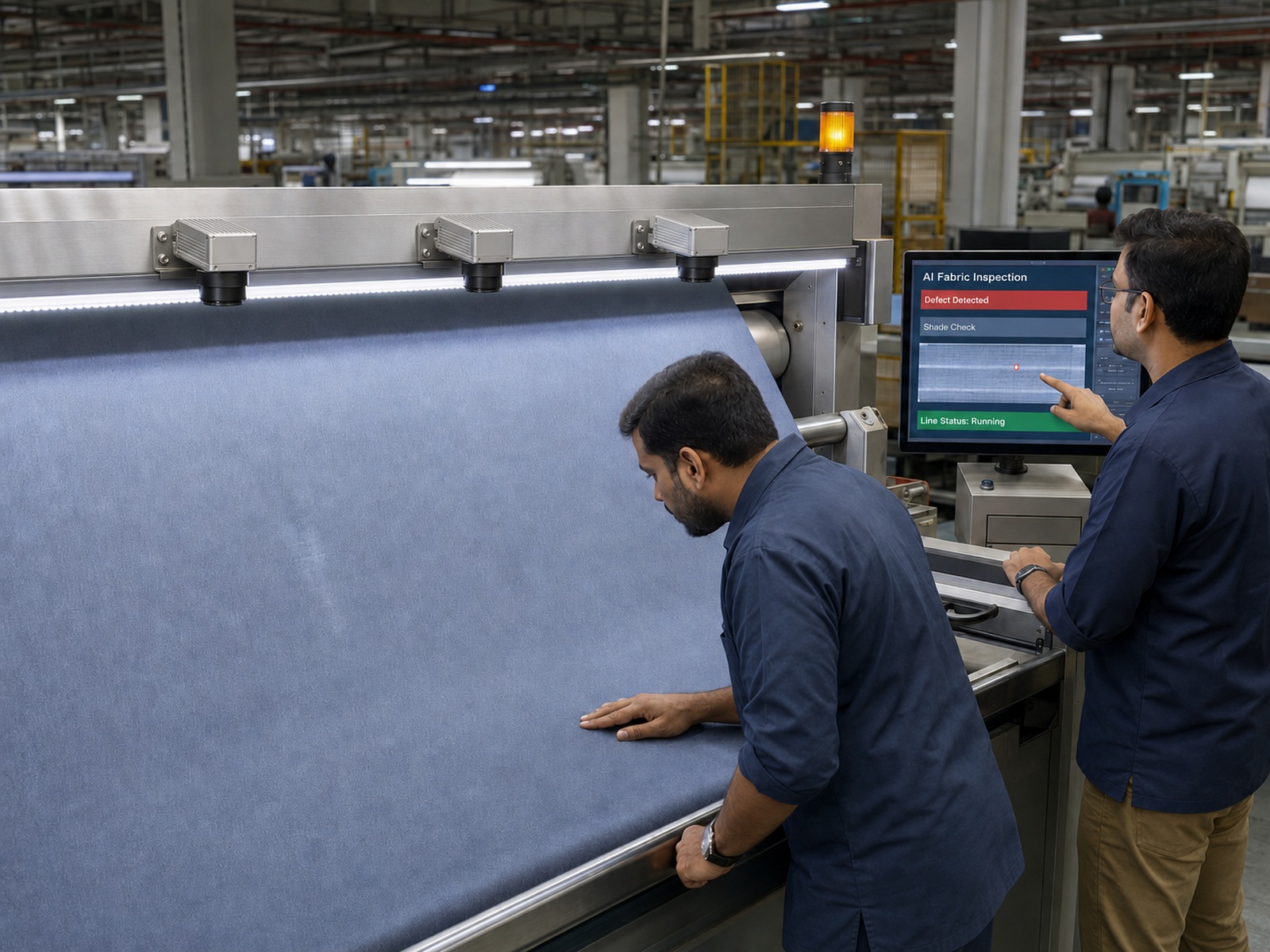


On a busy shift, a fabric inspector at a rolling table can only see so much. Rolls move quickly, the eye tires by late afternoon, and a faint colour deviation or a small broken pick can slip past and reach a buyer before anyone notices. By then it has become a rejection, a reworked lot, or wasted metres of fabric that eat into your margin. This is the everyday problem for a textile unit in Ahmedabad, where buyer quality expectations keep climbing.
AI fabric inspection offers a way to close that gap. Cameras over the line and a trained model flag suspected defects and shade deviation in the moment, so your team can act before a fault spreads. At Theta Technolabs, we build and train these systems around your own fabric types and fit them to your existing setup, rather than handing over a fixed product.
This blog walks through how it works on a live line, how it catches both physical faults and colour deviation, what it takes to train a model on your fabric, and how a mill can start with one line and scale across the plant.
Why manual fabric inspection holds mills back
Manual inspection has carried the industry for decades, and skilled inspectors are very good at their job. The problem is not effort, it is human limits. A person can only scan fabric so quickly before speed and accuracy start to trade off against each other. Concentration dips across a long shift, and two inspectors, or even the same inspector on two different days, may not judge a borderline fault the same way. Subtle issues are the hardest of all. A thin streak, a slight weave irregularity, or a shade that has drifted just enough to matter can be difficult to catch by eye, especially on dark or patterned fabric where low-contrast defects hide easily. None of this is a failure of your team. It is the ceiling of what unaided human inspection can do, and on a fast line running long hours, that ceiling gets reached often.
What AI fabric inspection actually does on a live line
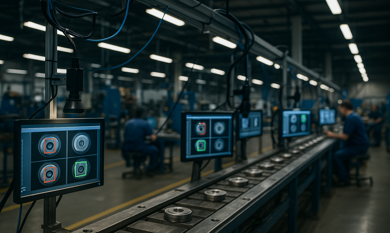
Put simply, it uses cameras mounted over the moving fabric and a trained model that flags suspected defects as the material passes, so your operator can act on them in the moment. That is the whole idea. The system watches continuously, marks what looks wrong, and leaves the final call to a person. This is where computer vision for fabric inspection earns its place, because it does not tire and it applies the same standard to the first metre and the ten-thousandth. Peer-reviewed work on AI methods in textiles points to gains in accuracy and consistency over manual checking, though results depend heavily on how the system is set up and trained. You can read a useful overview in this review of AI in textile inspection. What matters for a working mill is the real-time defect detection loop. Instead of finding a problem at the end of a roll, or after it has shipped, the system surfaces it while the fabric is still on the line, so you can stop, mark or divert before the fault multiplies. Think of it as a tireless second set of eyes that supports your inspectors rather than replacing their judgement.
Catching colour deviation, not just holes and weaving faults
Most conversations about defect detection focus on physical faults, and those matter. Holes, broken picks, weaving flaws and finishing marks are all things a vision system can be trained to spot through fabric defect detection. But for a lot of buyers, colour is where lots actually get rejected. Shade can drift from one dye batch to the next, or even within a single roll, and by the time a customer notices, the order is already at risk. Training a system for color consistency in textiles means it can compare what it sees against an approved shade and flag deviation early, while you can still correct the batch. Handled together, structural textile defect detection and shade checking give your quality team a fuller picture of a roll than a quick visual pass usually allows. For a mill selling into fashion or export channels, where a single shade complaint can put an entire consignment at risk, that colour layer is often where mills tend to see value first.
What it takes to train a model on your fabric types
Here is the part that vendors do not always say out loud. A model has to learn your fabrics before it can inspect them well. Denim behaves differently from fine cotton, and a printed fabric is a different problem again, so an automated fabric inspection system is only as reliable as the images it was trained on. In practice that means gathering examples of both good material and known defects across the fabric types you actually run, and labelling them so the model understands what a fault looks like on your product.
This is why off-the-shelf claims rarely transfer cleanly between mills, and why the early groundwork matters far more than the demo. Building and tuning that model is the work behind machine learning development services, and it is worth planning for rather than rushing. One practical note. If your floor images happen to capture staff, handle that footage in line with India's data protection expectations under the DPDP framework and keep control of who can access it. That responsibility sits with your organisation, but it is easy to plan for from the start.
Scaling from one line to the whole plant
This is the question the title promises to answer, and it is where a sensible rollout beats a big-bang install. You do not need to wire up every line on day one. Approached as a series of small steps, AI in textile manufacturing scales through repeatable setup rather than one enormous project, which keeps disruption low and lets your team learn as coverage grows. A reliable sequence looks like this:
- Start with a pilot on a single line, usually the one giving you the most quality trouble, and let it run alongside your existing inspection.
- Compare what the system flags against your QA team's own judgement, since that is how you build trust and find the misses worth correcting.
- Tune the model on the defects it got wrong, so its accuracy improves on your actual fabric.
- Extend it to the next line only once it is holding up, then repeat line by line.
- Use the growing defect logs and dashboards to trace recurring faults back upstream to the machine or process step causing them.
Handled this way, inspection stops being only a catch-net at the end and starts feeding improvements earlier in production.
Fitting inspection into your existing Ahmedabad setup
A fair worry is whether this means replacing machinery you have already paid for. Usually it does not. Vision cameras and the software behind them can often be added to your existing inspection machines and looms rather than swapped in for them, which matters for a mid-size unit watching its capital carefully. That retrofit approach is what makes stronger quality control in textile manufacturing achievable without halting a running floor. The local context helps as well. Ahmedabad remains a serious textile base, strong in denim, cotton and fabric processing, with a dense network of powerloom and processing units already running high volumes. A unit like that has exactly the conditions where automated inspection tends to pay back, plenty of throughput and real cost tied to rejection and rework. Building the software layer that ties cameras, alerts and reporting together is the kind of work covered by manufacturing software development in Ahmedabad, and having a local team close by makes setup and support a good deal simpler.
Choosing a computer vision partner
If you decide to explore this, the partner you pick matters more than any single feature. The practical side of computer vision development services done well comes down to a few things worth checking before you commit:
- They train on your fabrics rather than handing you a generic model.
- They can integrate with the machines and looms you already run.
- They support and retune the system over time instead of disappearing after go-live.
- They give you a model you can adjust as your fabric mix changes, not a black box.
Ask a prospective partner how they handle each of these points, because the answers tell you far more than any product demo.
The technology behind fabric inspection
A fabric inspection system is only as good as the tools underneath it, and the right stack is what lets a model run reliably on a live line. The core technologies our team works with for this kind of work include:
- OpenCV and YOLO for the computer vision layer that spots defects and shade deviation in fabric images as the material moves.
- TensorFlow and PyTorch for building and training the detection models on your own fabric types.
- Docker and cloud platforms like AWS for deploying the system, whether you prefer a cloud setup or one that runs close to the floor.
The point is not the tool list itself but the fit. The stack is chosen around your fabric, your line speed and how you want to run it, rather than forcing your setup to match a fixed product.
Conclusion
AI fabric inspection can help Ahmedabad textile manufacturers move from reactive quality checking to more consistent, real-time quality control. By combining computer vision, machine learning, defect detection, and colour inspection, mills can identify issues earlier while keeping their existing inspection processes and equipment in place. Starting with a single-line pilot, validating results with the QA team, and then scaling gradually provides a practical path to AI in textile manufacturing.
With the right technology partner, Theta Technolabs can help textile manufacturers build and integrate an inspection solution around their fabrics, production environment, and quality requirements.
Talk to Us
If you are weighing up where AI inspection could fit on your floor, Theta Technolabs can help you scope a pilot on a single line and plan a sensible rollout from there. To start a conversation, reach us at sales@thetatechnolabs.com.
Frequently asked questions
1. Can AI detect fabric defects more reliably than manual inspection?
It can support more consistent detection, because it does not tire and applies the same standard all shift. It works best as an assist to your inspectors, who still make the final call.
2. Do I have to replace my existing inspection machines?
Usually not. In most cases cameras and software can be fitted onto the machines and looms you already run, which keeps both cost and disruption down.
3. What data do I need to get started?
Labelled images of your own fabric, both good material and known defects, across the types you actually produce. That is what the model learns from.
4. Can it check colour consistency and not just physical faults?
Yes, if it is trained for it. A system can compare fabric against an approved shade and flag colour deviation early, alongside spotting holes and weave faults.
5. How does a mill start small and then scale up?
Begin with a pilot on one line, validate it against your QA team, tune it, then extend line by line once it is proven. That keeps the risk low.









.png)





.png)

































.avif)
.avif)
.avif)



















_How%20IoT%20Can%20Reduce%20Energy%20Costs%20in%20Smart%20Factories_Q4_25.avif)
_How%20AI%20Development%20Companies%20in%20Ahmedabad%20are%20Transforming%20the%20Shopping%20Experience_Q4_25.avif)
_Node.js%20and%20Blockchain_%20A%20Perfect%20Pair%20for%20Fintech%20Innovation%20in%20Dubai_Q3_24.avif)
_Choosing%20the%20Right%20Computer%20Vision%20Development%20Partner%20in%20Ahmedabad%20for%20Construction_Q3_24.avif)
_The%20Transformative%20Role%20of%20Open%20Banking%20APIs%20in%20Fintech%20for%202024_Q3_24.avif)
_Explore%20the%20Best%20Cross-Platform%20App%20Development%20Frameworks%20of%202024_Q3_24.avif)


_Integrating%20IoT%20with%20Mobile%20Apps%20for%20Advanced%20Renewable%20Energy%20Solutions_Q2_24.avif)
_Top%20Benefits%20of%20Cloud%20Computing%20for%20All%20Business%20Sectors_Q2_24.avif)

_Understanding%20the%20Impact%20of%20AI%20and%20Machine%20Learning%20on%20Fintech%20Web%20Apps%20in%20Dubai_Q2_24.avif)


_Smart%20Manufacturing%20in%20Dubai_%20How%20AI%20is%20Driving%20Efficiency%20and%20Innovation_Q1_In_24.avif)
_Automated%20Checkout%20Systems.avif)