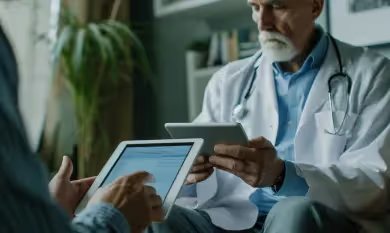


Chronic conditions don't wait for the next appointment. A patient's blood pressure can spike on a Tuesday afternoon and settle by the time they see their doctor two weeks later, and by then, the clinic has missed the window where a small adjustment could have prevented a bigger problem. For clinics managing growing numbers of diabetes and hypertension patients, that gap between visits is where things quietly go wrong.
Connected health devices close that gap. Instead of relying on a single snapshot taken once a month, clinics get a steady stream of readings that show what's actually happening in a patient's day to day life. This article looks at what these devices are, how they fit into chronic care management, where compliance comes in, and what a Dubai clinic actually needs to put this into practice.
What Are Connected Health Devices in Chronic Care Management?
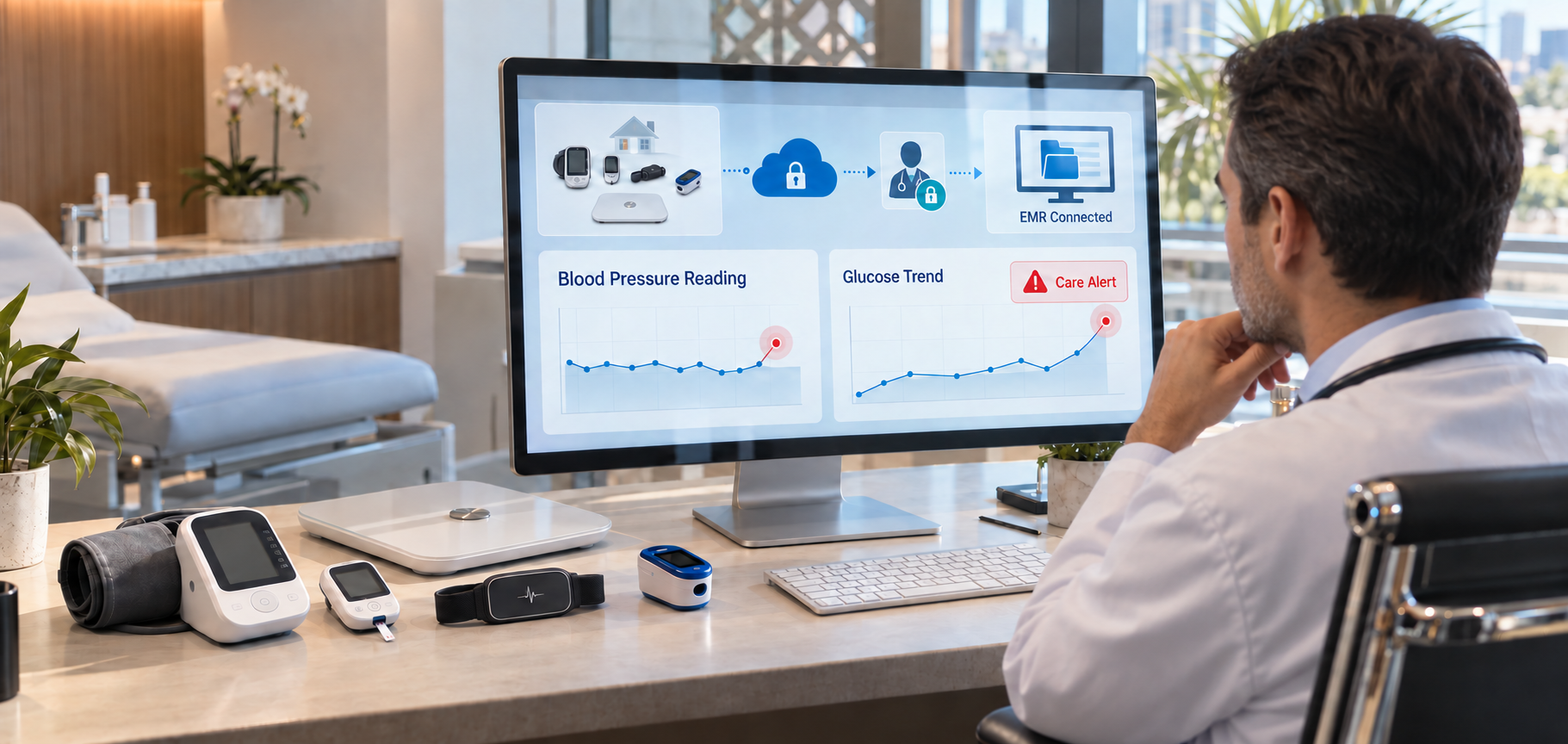
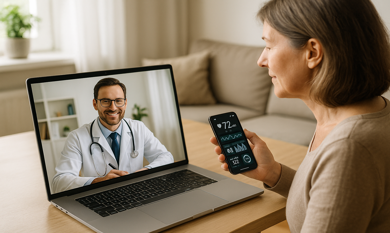
Connected health devices are medical tools, such as glucometers, blood pressure cuffs, wearable ECG monitors, pulse oximeters, and connected weighing scales, that transmit readings automatically instead of requiring a manual log or an in person visit to record them. A patient takes a reading at home, and it reaches a dashboard the care team can check, usually within seconds.
This matters for chronic care specifically because conditions like diabetes and hypertension are managed through trends, not single data points. One elevated blood pressure reading tells a doctor very little. A week of readings tells them a great deal. Dubai's own digital health direction reflects this shift. The emirate's health strategy has repeatedly pointed toward expanding remote patient monitoring Dubai clinics can use and connecting patient data across the healthcare system, rather than treating every check up as an isolated event.
How Connected Devices Support Chronic Care Management
The mechanism itself is straightforward once you break it down.
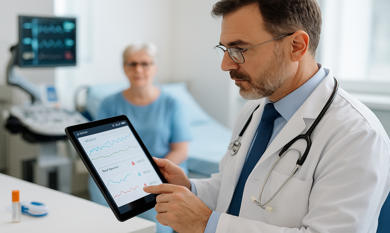
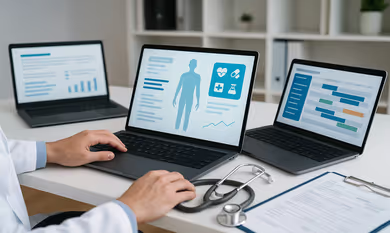
A patient uses a wearable health device, say, a Bluetooth enabled blood pressure monitor. The reading is captured and sent, either directly over cellular or through a paired gateway like a smartphone app, to a cloud platform. That platform organizes the data by patient and by trend, and it is built to flag anything outside a safe range. If a hypertension patient's readings climb steadily over three days, the system can alert the care team before it becomes a crisis visit, rather than after.
This kind of alerting works on an asynchronous basis, meaning the care team reviews and acts on flagged readings during normal working hours or on call rotations, not as an instant emergency response system. Clinics need to make this distinction clear to patients: connected devices support ongoing monitoring, but they are not a substitute for calling 998 during a sudden, life threatening event.
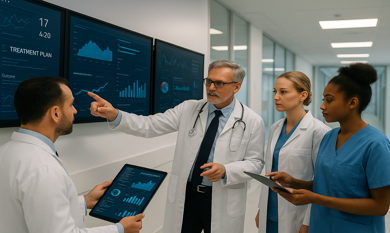
The clinic is not just collecting more data, it is collecting it earlier and acting on it faster. A nurse or physician reviewing a dashboard each morning can spot the one or two patients whose numbers need a phone call, instead of waiting for that patient to either show up at the clinic or end up in an emergency room. This kind of connected health devices chronic care pipeline works best when it is designed around the clinic's actual patient population rather than adapted from a generic template. Clinics that want a system built this way often turn to a custom IoT development company that understands both the device side and the clinical workflow side, since that combination tends to produce a system that actually gets used, rather than one that sits unopened after the first month.
NABIDH and DHA Compliance: What Clinics Need to Know
None of this data is useful if it stays trapped in a separate app the clinic's main systems cannot see. For clinics operating in Dubai, this is where NABIDH, the Dubai Health Authority's health information exchange platform, becomes relevant. NABIDH was built to unify patient records across public and private providers in the emirate, and NABIDH integration is a requirement under Dubai's health data regulations for facilities operating in the emirate, as outlined on the official NABIDH platform.
It is worth being precise here: raw, minute by minute device readings are not what gets sent to NABIDH. Instead, the EMR captures and summarizes the clinically relevant entries, such as a verified reading or a documented clinical decision, and that summarized record syncs to NABIDH according to DHA's data exchange standards.
Practically, this means any connected device system a clinic builds should not be designed in isolation. It needs a clear path for readings and alerts to eventually reach the patient's broader medical record, not just live in a standalone monitoring dashboard. Clinics that plan for this integration from the start avoid a costly rebuild later, when a separate device platform and the clinic's compliance obligations end up pulling in different directions.
Why This Matters for Clinic Teams
Framed around clinic operations rather than general wellness marketing, the realistic benefits of IoT healthcare Dubai clinics can expect look like this:
- Fewer unnecessary in person visits for patients whose condition is stable, freeing appointment slots for those who need them
- Earlier intervention on concerning trends, which can reduce avoidable emergency visits and hospital readmissions
- Better use of staff time, since a dashboard review takes minutes compared to a full round of manual check in calls
- Stronger patient engagement, as patients who see their own data tend to stay more consistent with medication and lifestyle guidance
- A clearer record of patient monitoring, useful for both clinical decision making and internal quality reviews
None of these outcomes are automatic. They depend on the system being set up well and the clinic actually building a workflow around the alerts, not just installing the technology and hoping staff check it.
Common Implementation Challenges (and How to Solve Them)
Every clinic considering this runs into a similar set of concerns, and it is worth addressing them directly rather than glossing over them.
Data security is usually the first worry, and reasonably so. Health data is sensitive, and any connected system needs encryption in transit and at rest, plus clear access controls for who on the care team can see what. This is solvable with proper architecture. It is not a reason to avoid the approach, but it is a reason to involve people who have built compliant healthcare systems before.
Device interoperability is the second issue. Not every glucometer or blood pressure cuff speaks the same protocol, and clinics that let patients use whatever device they already own can end up with a fragmented, hard to maintain system. Standardizing on a small set of supported devices, or building a middleware layer that normalizes data from multiple device types, keeps this manageable. Clinics working through this stage often lean on established IoT development services to handle the device integration layer rather than building it from scratch in house.
Patient adherence, whether people actually use the device consistently, is a real challenge, but it is more of a design problem than a technology problem. Devices that require minimal setup and give patients some visibility into their own readings tend to see far better long term use than ones that feel like a chore.
EMR integration effort is often underestimated. Connecting a new monitoring system to an existing clinic EMR takes real engineering work, and skipping this step is how clinics end up with two disconnected systems that no one wants to check.
Building This Step by Step
A practical rollout usually follows a similar order.
- Pick a starting condition. Diabetes and hypertension are common starting points given how much they benefit from frequent readings.
- Select a small set of supported devices rather than trying to support everything on the market from day one. Confirm that every device on that list is registered and approved as a medical device by MOHAP and DHA before it reaches a patient. Consumer grade wearables that are not medically certified should not be used for clinical decision making, even if they happen to measure the same metrics.
- Set up the connectivity layer, the gateway or app that gets readings from the device to the cloud reliably.
- Build the alerting and dashboard layer so staff have a clear, simple view of who needs attention. This is where smart clinic technology actually earns its place, not just as a buzzword but as a working part of daily operations.
- Plan the NABIDH and EMR integration path early, even if it is phased in after the initial pilot.
- Pilot with a small patient group before expanding clinic wide, so workflow issues surface while they are still easy to fix.
For clinics that want the device layer and the app layer to work together as one coherent system rather than two separate projects, it helps to bring in a team with direct experience in IoT app development services for healthcare specifically, since the requirements around reliability and data handling differ meaningfully from a typical consumer app build. This kind of groundwork is also what makes broader digital health Dubai initiatives sustainable over time rather than a one off pilot that never scales.
Frequently Asked Questions
What are connected health devices used for in chronic care?
They are used to capture ongoing readings, such as blood pressure, blood glucose, heart rate, and weight, outside of clinic visits, giving care teams a continuous view of a patient's condition instead of a single point in time check up.
How do connected devices integrate with NABIDH in Dubai?
Data from connected devices typically flows into a clinic's monitoring dashboard first, then into the clinic's EMR system, which summarizes the clinically relevant entries before syncing with NABIDH, so records stay unified across Dubai's healthcare network, in line with DHA's data sharing framework.
What chronic conditions benefit most from remote monitoring?
Diabetes and hypertension are the most common use cases, since both are managed through daily trends rather than occasional readings, but the same approach applies to conditions like heart disease and obesity related monitoring.
Is patient data from connected devices secure?
It can be, when the system is built with encryption, restricted access controls, and a clear compliance plan from the start. Security depends entirely on how the system is architected, not on the devices themselves.
Do connected devices replace emergency medical services?
No. Connected devices support ongoing, asynchronous monitoring between visits. They are not designed for real time emergency response, and patients should still call 998 during a sudden, life threatening event.
Bringing It Together
Dubai clinics do not need to choose between overstretched staff and better chronic care outcomes. Connected health devices, built and integrated properly, give care teams earlier visibility into the patients who need attention, without adding to the daily workload of everyone else.
At Theta Technolabs, we work with clinics and healthcare providers across Dubai to design connected device systems that fit into existing clinical workflows rather than sitting on top of them, with NABIDH and DHA compliance built in from the start rather than added on as an afterthought. If you are exploring what this could look like for your clinic, sales@thetatechnolabs.com is a good place to start the conversation.




.png)


.png)
















.avif)
.avif)
.avif)










_How%20IoT%20Can%20Reduce%20Energy%20Costs%20in%20Smart%20Factories_Q4_25.avif)
_How%20AI%20Development%20Companies%20in%20Ahmedabad%20are%20Transforming%20the%20Shopping%20Experience_Q4_25.avif)
_Node.js%20and%20Blockchain_%20A%20Perfect%20Pair%20for%20Fintech%20Innovation%20in%20Dubai_Q3_24.avif)
_Choosing%20the%20Right%20Computer%20Vision%20Development%20Partner%20in%20Ahmedabad%20for%20Construction_Q3_24.avif)
_The%20Transformative%20Role%20of%20Open%20Banking%20APIs%20in%20Fintech%20for%202024_Q3_24.avif)
_Explore%20the%20Best%20Cross-Platform%20App%20Development%20Frameworks%20of%202024_Q3_24.avif)

_Integrating%20IoT%20with%20Mobile%20Apps%20for%20Advanced%20Renewable%20Energy%20Solutions_Q2_24.avif)
_Top%20Benefits%20of%20Cloud%20Computing%20for%20All%20Business%20Sectors_Q2_24.avif)
_Understanding%20the%20Impact%20of%20AI%20and%20Machine%20Learning%20on%20Fintech%20Web%20Apps%20in%20Dubai_Q2_24.avif)


_Smart%20Manufacturing%20in%20Dubai_%20How%20AI%20is%20Driving%20Efficiency%20and%20Innovation_Q1_In_24.avif)
_Automated%20Checkout%20Systems.avif)
_Smart%20Solutions%20for%20Healthcare_%20How%20IoT%20Development%20is%20Reshaping%20Dubai%20Hospitals_Q1_In_24.avif)
_Computer%20Vision-enabled%20Web%20and%20Mobile%20Interfaces%20for%20Mall%20Management%20in%20Dubai_Q1_In_24.avif)