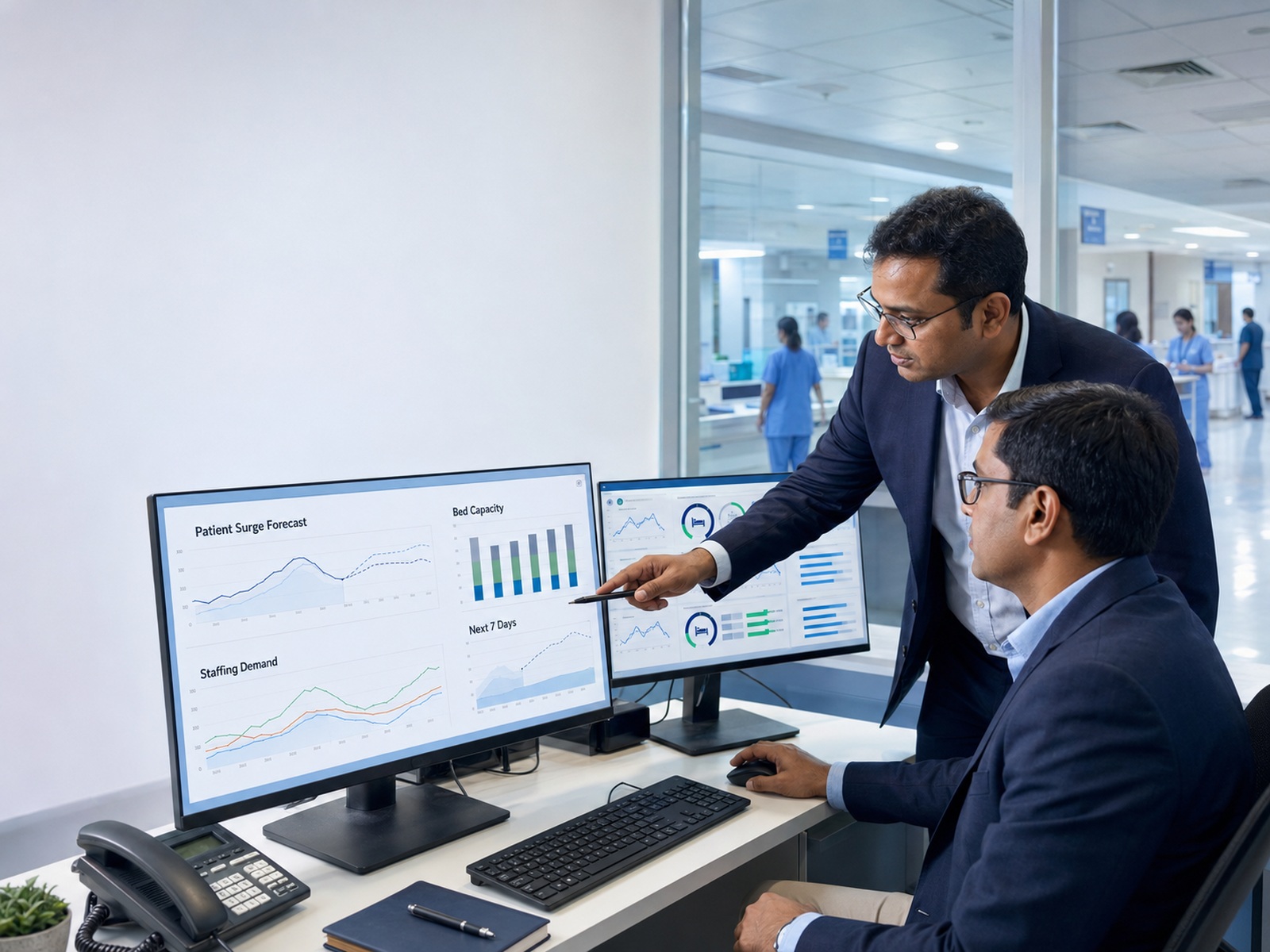


For many hospital networks in Hyderabad, patient surges arrive with little warning. A rush of viral fever cases fills the outpatient department, the emergency room runs out of free beds by mid-morning, and ward staff end up managing far more patients than the roster planned for. The real difficulty is that this is usually dealt with only after it has already begun, when the options left are few and stressful.
Predictive capacity planning offers a way to get ahead of it. Instead of reacting once beds are full, it uses a hospital's own data to anticipate likely pressure a few days out, so beds, staff, and supplies can be arranged before the surge builds.
This blog explains what predictive capacity planning is, how the forecasting works, what data and safeguards it needs, and how a hospital network in Hyderabad can begin.
Why patient surges strain Hyderabad hospital networks
Surges across Hyderabad hospital networks rarely arrive on a convenient schedule. The monsoon and the weeks that follow tend to bring spikes in dengue, viral fevers and other seasonal illness. Festival periods and long weekends often add road accident and trauma cases. On top of this, larger city hospitals draw referrals from across Telangana and neighbouring districts, so demand is shaped by events well outside their own catchment.
The difficulty is not only the volume. It is that the pressure is uneven and hard to see coming. One hospital may fill up while another branch in the same network still has capacity, yet without a shared view of beds across units, that spare capacity is hard to use. When patient surge management depends on phone calls and manual bed registers, decisions get made late and under stress. Staff are pulled in at short notice, elective procedures are postponed, and patients wait longer than anyone would like. None of this reflects poor effort. It reflects a system being asked to respond to demand it cannot yet predict.
What predictive capacity planning actually means
Predictive capacity planning is the use of predictive analytics in healthcare to estimate what demand is likely to look like in the near future, so a hospital can plan for it rather than absorb it. It draws on a hospital's own historical and current data to forecast likely admissions, bed occupancy and staffing needs across a rolling window of the next few days.
It helps to separate this from the dashboards most hospitals already have. A live dashboard tells you the position right now, how many beds are free and how full the ICU is. That is useful, but it is a picture of the present. Hospital capacity planning that is predictive goes a step further and estimates what the position is likely to be next, which is where the room to act actually lies.
This shift from reacting to anticipating matters in the Indian context. India's national policy think tank has noted that healthcare here has often been reactive, and that data-led approaches can help move it towards earlier, more proactive care (NITI Aayog, National Strategy for Artificial Intelligence). Capacity planning is a practical place to put that idea to work.
How the forecasting works, from data to decision
The forecasting itself is less mysterious than it sounds. In simple terms, it works through a few steps.
First, the system draws on historical records of admissions and discharges, so it can learn the hospital's own patterns. Second, it takes in live admission, discharge and transfer information, so it stays current. Third, it factors in emergency arrival volumes, typical length of stay and seasonality, including local patterns such as post-monsoon illness. Fourth, it produces forecasts, which is where hospital bed demand forecasting and broader healthcare demand forecasting come in, estimating likely demand over the coming days.
Those forecasts then feed practical decisions. If the model suggests ICU pressure is likely to build over a weekend, the team has time to review elective admissions, arrange cover and prepare beds, which supports smoother patient flow optimization across the network. This kind of forecasting sits within the wider set of AI-driven digital healthcare solutions a hospital may adopt.
One point is worth stating plainly. A forecast informs a decision; it does not make it. The value is in giving clinical and operational teams earlier, clearer information. The judgment stays with the people accountable for patient care.
What predictive capacity planning can do for a hospital network
Used well, this kind of planning can change how a network operates day to day, though the gains depend on the quality of the data behind it.
With earlier visibility of likely surge days, a network may be able to reduce last-minute diversions and the scramble for overtime cover. Better anticipation of demand may help shorten emergency waits and make elective scheduling more predictable. Applied across a group of hospitals rather than a single site, AI for hospital operations may also help balance load, directing planned cases or transfers towards branches with spare capacity instead of leaving one unit overwhelmed while another sits underused.
The underlying logic is not unique to healthcare. The same principle of matching demand against finite capacity is something Theta Technolabs has explored in AI-driven capacity planning in manufacturing, where forecasting is used to plan production against limited resources. Beds, operating theatres and nursing hours are the hospital equivalent of that finite capacity, and they respond to the same discipline of planning ahead rather than reacting late.
Building the data foundation, DPDP Act and ABDM readiness
None of this works on top of messy data, and it is honest to say so. A forecast is only as reliable as the records feeding it, so before expecting dependable results, a network needs reasonably clean and connected data across its units. If each branch keeps its own separate register in its own format, the first task is simply getting that information to talk to each other. Aligning with the standards promoted under the Ayushman Bharat Digital Mission can help here, since interoperability is exactly what makes a network wide view possible.
Patient data also carries clear obligations. Any use of it for analytics needs to respect the Digital Personal Data Protection Act, with sensible steps such as de-identification where possible and proper access controls. It is worth being clear about where responsibility sits. Compliance with the DPDP Act and other applicable health data rules rests with the hospital. A technology partner can build systems designed to support these obligations and make them easier to meet, but the accountability remains with the provider that holds the data.
How a Hyderabad hospital network can begin
The sensible way to start is small and specific. Rather than attempting a network wide rollout at once, a hospital can begin with a single high pressure area, the emergency department or a consistently busy ward, and run the forecasts alongside normal operations for a period. That allows the team to check the predictions against what actually happens and build confidence before expanding unit by unit.
On the question of building or buying, the priority is usually integration. A solution that connects with the existing hospital information system tends to serve better than a separate tool that staff have to maintain on the side. Working with an AI development company in Hyderabad that understands local healthcare operations can make this path shorter, and it typically sits within a broader programme of custom healthcare software development rather than a standalone project.
Throughout, the point is to support decisions, not to automate them away. Clinical teams and hospital leadership remain the people who decide how capacity is used. The technology simply gives them a clearer view, earlier.
Conclusion
Predictive capacity planning gives Hyderabad hospital networks a practical way to prepare for patient surges before they become operational challenges. By combining historical patterns, real-time hospital data, and predictive analytics, hospitals can improve bed utilization, staffing readiness, patient flow, and resource planning. The goal is not to replace human judgment, but to give clinical and administrative teams the information they need to act earlier and with greater confidence. For hospitals looking to build a more responsive and data-driven operation, starting with one department and scaling gradually can make predictive capacity planning a practical step toward better preparedness and more efficient care.
Start Predictive Capacity Planning for Your Hospital Network
If your hospital network in Hyderabad is beginning to explore predictive capacity planning, it helps to start with a clear, data-ready, and phased plan rather than a large leap. Theta Technolabs works with healthcare providers to scope practical solutions that fit existing systems and respect the obligations that come with patient data. To talk through what a first step could look like for your network, write to us at sales@thetatechnolabs.com.
Frequently Asked Questions
What is predictive capacity planning in a hospital?
It is the use of a hospital's own data to forecast likely admissions, bed occupancy and staffing needs a few days ahead, so the hospital can prepare for demand instead of reacting once beds are already full.
What data does a hospital need to forecast patient surges?
Typically historical admissions and discharges, live admission, discharge and transfer information, emergency arrival volumes, length of stay patterns and seasonality. The cleaner and more connected this data is, the more reliable the forecasts.
Is predictive capacity planning suitable for a mid-size Hyderabad hospital network?
It can be, and it is usually best introduced in phases. Starting with one high pressure area and expanding gradually keeps the risk low and lets the team validate results before scaling.
How does this stay compliant with the DPDP Act?
Through measures such as de-identifying data where possible and controlling access to it. Responsibility for compliance rests with the hospital, though systems can be built to support these obligations.
Does AI replace clinical or administrative judgment?
No. Forecasts inform decisions. Clinicians and hospital leadership remain accountable for how capacity is planned and used.






























.avif)
.avif)
.avif)
























_How%20IoT%20Can%20Reduce%20Energy%20Costs%20in%20Smart%20Factories_Q4_25.avif)
_How%20AI%20Development%20Companies%20in%20Ahmedabad%20are%20Transforming%20the%20Shopping%20Experience_Q4_25.avif)
_Node.js%20and%20Blockchain_%20A%20Perfect%20Pair%20for%20Fintech%20Innovation%20in%20Dubai_Q3_24.avif)
_Choosing%20the%20Right%20Computer%20Vision%20Development%20Partner%20in%20Ahmedabad%20for%20Construction_Q3_24.avif)
_The%20Transformative%20Role%20of%20Open%20Banking%20APIs%20in%20Fintech%20for%202024_Q3_24.avif)
_Explore%20the%20Best%20Cross-Platform%20App%20Development%20Frameworks%20of%202024_Q3_24.avif)


_Integrating%20IoT%20with%20Mobile%20Apps%20for%20Advanced%20Renewable%20Energy%20Solutions_Q2_24.avif)
_Top%20Benefits%20of%20Cloud%20Computing%20for%20All%20Business%20Sectors_Q2_24.avif)

_Understanding%20the%20Impact%20of%20AI%20and%20Machine%20Learning%20on%20Fintech%20Web%20Apps%20in%20Dubai_Q2_24.avif)


_Smart%20Manufacturing%20in%20Dubai_%20How%20AI%20is%20Driving%20Efficiency%20and%20Innovation_Q1_In_24.avif)
_Automated%20Checkout%20Systems.avif)
_Smart%20Solutions%20for%20Healthcare_%20How%20IoT%20Development%20is%20Reshaping%20Dubai%20Hospitals_Q1_In_24.avif)
_Computer%20Vision-enabled%20Web%20and%20Mobile%20Interfaces%20for%20Mall%20Management%20in%20Dubai_Q1_In_24.avif)