



For a payment startup, collecting merchant documents is only one part of onboarding. The larger question is whether the available evidence supports accepting that merchant before payment processing begins. Merchant onboarding risk checks are the verification and assessment steps used to examine the business, relevant individuals, settlement details, declared activity, and risk conditions before activation.
A sound merchant risk assessment workflow should not force every application into an automatic yes or no decision. It should verify information, apply approved rules, identify exceptions, and send cases for human review when evidence is incomplete or inconsistent.
Why Risk Assessment Has to Happen Before Merchant Acceptance
A merchant application has to answer two different questions. First, is the information genuine and sufficiently verified? Second, does the merchant meet the payment company’s approved acceptance criteria?
Those questions are related, but they are not identical. A business can complete identity and registration checks while still requiring further assessment because its activity, settlement information, ownership structure, website, or another policy condition needs review.
For businesses operating in a regulated Payment Aggregator role, payment aggregator compliance also affects onboarding design. The Reserve Bank of India’s current Payment Aggregator directions require customer due diligence of merchants, KYC retrieval from CKYCR with consent where applicable, background and antecedent checks, Merchant Category Code allocation, validation around crediting merchant funds, and subsequent monitoring against the merchant’s business profile. These requirements apply according to the company’s regulatory role and should not be treated as rules for every FinTech startup. Reserve Bank of India Payment Aggregator Master Direction Reserve Bank of India
This makes payment aggregator merchant onboarding more than a document collection exercise. Merchant due diligence should produce enough verified context for an acceptance decision and a profile that can support later monitoring.
What Should Be Checked Before a Merchant Is Accepted?
A practical merchant verification process should bring together business identity, ownership, settlement, and activity information. The exact checks depend on the merchant type, the company’s onboarding policy, and applicable regulatory requirements.
Business and Registration Information
The onboarding flow should collect the merchant’s legal business name, business type, registered details, business address, and relevant tax or registration information. Where reliable APIs or verified data sources are available, the platform can compare submitted information against those sources.
If the merchant enters one business name but a verified record returns another, the system should not silently continue. It should identify the inconsistency, record the result, and decide whether more information or review is required.
Owners and Responsible Individuals
Merchant KYC and KYB serve different purposes within the same onboarding journey. KYC generally relates to the relevant individuals behind or responsible for the merchant, while KYB focuses on the business entity and its commercial identity.
Depending on the entity type and applicable requirements, the workflow may also need information about proprietors, authorised signatories, beneficial owners, or other responsible individuals. The system should make these relationships clear so reviewers can understand who is connected to the business and which checks have been completed.
Bank Account and Settlement Details
Settlement information should be verified before the merchant begins receiving funds. The workflow should confirm that the submitted bank information appropriately corresponds to the merchant being onboarded and flag mismatches for investigation.
A mismatch is not automatically proof of wrongdoing. It should trigger a defined next step, such as requesting information, repeating a check, or sending the application to review.
Business Activity and Online Presence
The company also needs to understand what the merchant actually sells or provides. That can include reviewing the website or application, business description, products or services, merchant category, and information required by the onboarding policy. The declared activity, website content, registration information, and expected payment use should make sense together before activation.
How Onboarding Software Can Turn Those Checks into a Risk Decision
A useful workflow separates evidence collection from decision logic:
Merchant application → Data verification → Consistency checks → Risk rules → Risk classification → Review if required → Acceptance decision
A well-designed merchant onboarding software system makes each stage visible rather than hiding the decision inside a single approval button.
Collect Structured Merchant Data
A merchant portal should capture important details in structured fields wherever possible, including business information, ownership details, settlement information, declarations, and supporting documents.
Structured data makes repeatable checks easier. A secure merchant portal and internal review dashboard can be built through web app development services, combining front-end, back-end, and portal development so applicants and reviewers can work within one controlled workflow instead of disconnected forms and spreadsheets.
Run Verification and Consistency Checks
The backend can coordinate approved verification services and compare results with what the merchant submitted. Examples include checking whether names match, whether required business information is present, whether settlement details pass validation, and whether declared business activity aligns with supporting information.
A failed or uncertain check should create a reason code or exception status that a reviewer can understand.
Apply Approved Risk Rules
After verification, the platform can apply business rules defined by the company’s risk and compliance policy. Those rules might consider merchant category, verification status, missing evidence, information conflicts, or other conditions defined by the organisation.
Merchant risk scoring does not have to mean a single numerical score. Depending on policy, it may use risk bands, decision flags, rule outcomes, or combinations of these. The system should be able to show why an application moved forward, stopped, or required review.
When Should an Application Go to Human Review?
Automation works best when the input is clear and the policy outcome is defined. Human review becomes important when the system cannot reach a reliable decision using approved checks, or when company policy specifically requires judgement.
Typical review triggers can include conflicting business information, a bank account mismatch, missing documents, an unsuccessful verification, unclear business activity, or a risk condition needing additional assessment.
Good fintech compliance software should show what check failed, which information conflicted, what rule was triggered, and the merchant information supporting the alert. Straightforward checks can often be automated, but exceptions should remain visible and reviewable.
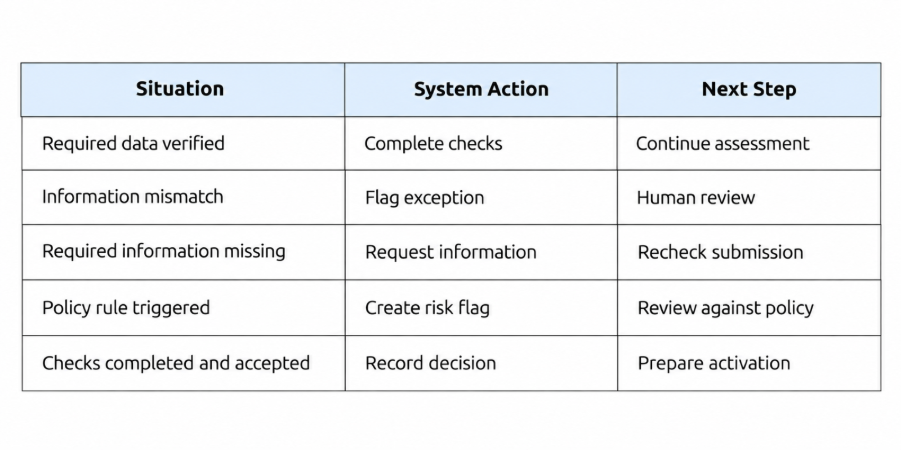
The Acceptance Decision Should Create an Auditable Merchant Profile
An approved merchant should leave onboarding with more than an "approved" status. The system should retain the information needed to understand how that decision was reached.
That record can include verified merchant details, completed checks, the applicable risk classification, exceptions that were resolved, reviewer decisions where required, supporting evidence, and the final onboarding status.
The result becomes a baseline for later monitoring. Subsequent activity can be compared with the approved business profile so material inconsistencies can be reviewed through the defined monitoring process.
This is an important difference between a simple merchant onboarding checklist and an operational risk system. A checklist confirms that tasks were completed. An auditable profile preserves the context and decision path behind merchant acceptance.
Building the Workflow for an Ahmedabad Payment Startup
The architecture depends on merchant segments, regulatory role, onboarding policy, integrations, review process, and existing payment infrastructure. It may include a merchant portal, backend APIs, verification integrations, a configurable rules engine, role-based access, review queues, and audit logging.
For teams considering fintech software development in Ahmedabad, the onboarding system should be designed as part of the wider payment product rather than as an isolated compliance screen. Custom fintech software development can connect merchant onboarding with payment processing, settlement, compliance, operations, and risk workflows so verified information can move through the product without unnecessary re-entry.
Where AI Can Support the Workflow
AI can support specific tasks without becoming the final merchant acceptance authority. It can help extract information from documents, organise submitted evidence, highlight possible inconsistencies for review, or help operations teams prioritise large queues.
An AI development company in Ahmedabad can integrate AI-assisted document processing, information checks, and compliance workflow automation where they provide practical value. Approved rules and human review should still govern cases that require policy judgement, and the system should clearly record whether an outcome came from a rule, verification service, AI-assisted step, or human reviewer.
Frequently Asked Questions
What are merchant onboarding risk checks?
They are the verification, due diligence, risk assessment, and acceptance controls a payment company uses before enabling a merchant to process transactions. They help determine whether submitted information is verified and whether the merchant meets approved onboarding criteria.
What is the difference between KYC and KYB in merchant onboarding?
KYC generally verifies relevant individuals associated with the merchant, while KYB focuses on verifying the business entity and its business information. Both may be required within the same onboarding workflow depending on the merchant structure and applicable requirements.
Can merchant onboarding risk checks be automated?
Many structured checks can be automated, including data validation, verification calls, required-field checks, and policy rules. Incomplete, conflicting, uncertain, or policy-defined cases should be routed for human review rather than forced through an automatic decision.
What should happen after a merchant passes onboarding checks?
The decision should be recorded with the verified merchant profile, completed checks, relevant risk classification, resolved exceptions, and reviewer actions where applicable. That profile can then support later monitoring and operational review.
Build Merchant Onboarding Around Verifiable Risk Decisions
Merchant onboarding works best when evidence collection, verification, risk rules, exception handling, and human review are connected in one traceable process. Theta Technolabs can build and integrate these workflows using technologies such as Python, JavaScript, and REST APIs, based on the startup’s existing FinTech architecture, operational processes, and integration requirements.
To discuss a merchant onboarding or FinTech software development requirement, contact us at sales@thetatechnolabs.com.

















.png)





.png)






































.avif)
.avif)
.avif)
























_How%20IoT%20Can%20Reduce%20Energy%20Costs%20in%20Smart%20Factories_Q4_25.avif)
_How%20AI%20Development%20Companies%20in%20Ahmedabad%20are%20Transforming%20the%20Shopping%20Experience_Q4_25.avif)
_Node.js%20and%20Blockchain_%20A%20Perfect%20Pair%20for%20Fintech%20Innovation%20in%20Dubai_Q3_24.avif)
_Choosing%20the%20Right%20Computer%20Vision%20Development%20Partner%20in%20Ahmedabad%20for%20Construction_Q3_24.avif)
_The%20Transformative%20Role%20of%20Open%20Banking%20APIs%20in%20Fintech%20for%202024_Q3_24.avif)
_Explore%20the%20Best%20Cross-Platform%20App%20Development%20Frameworks%20of%202024_Q3_24.avif)


_Integrating%20IoT%20with%20Mobile%20Apps%20for%20Advanced%20Renewable%20Energy%20Solutions_Q2_24.avif)
_Top%20Benefits%20of%20Cloud%20Computing%20for%20All%20Business%20Sectors_Q2_24.avif)

_Understanding%20the%20Impact%20of%20AI%20and%20Machine%20Learning%20on%20Fintech%20Web%20Apps%20in%20Dubai_Q2_24.avif)


