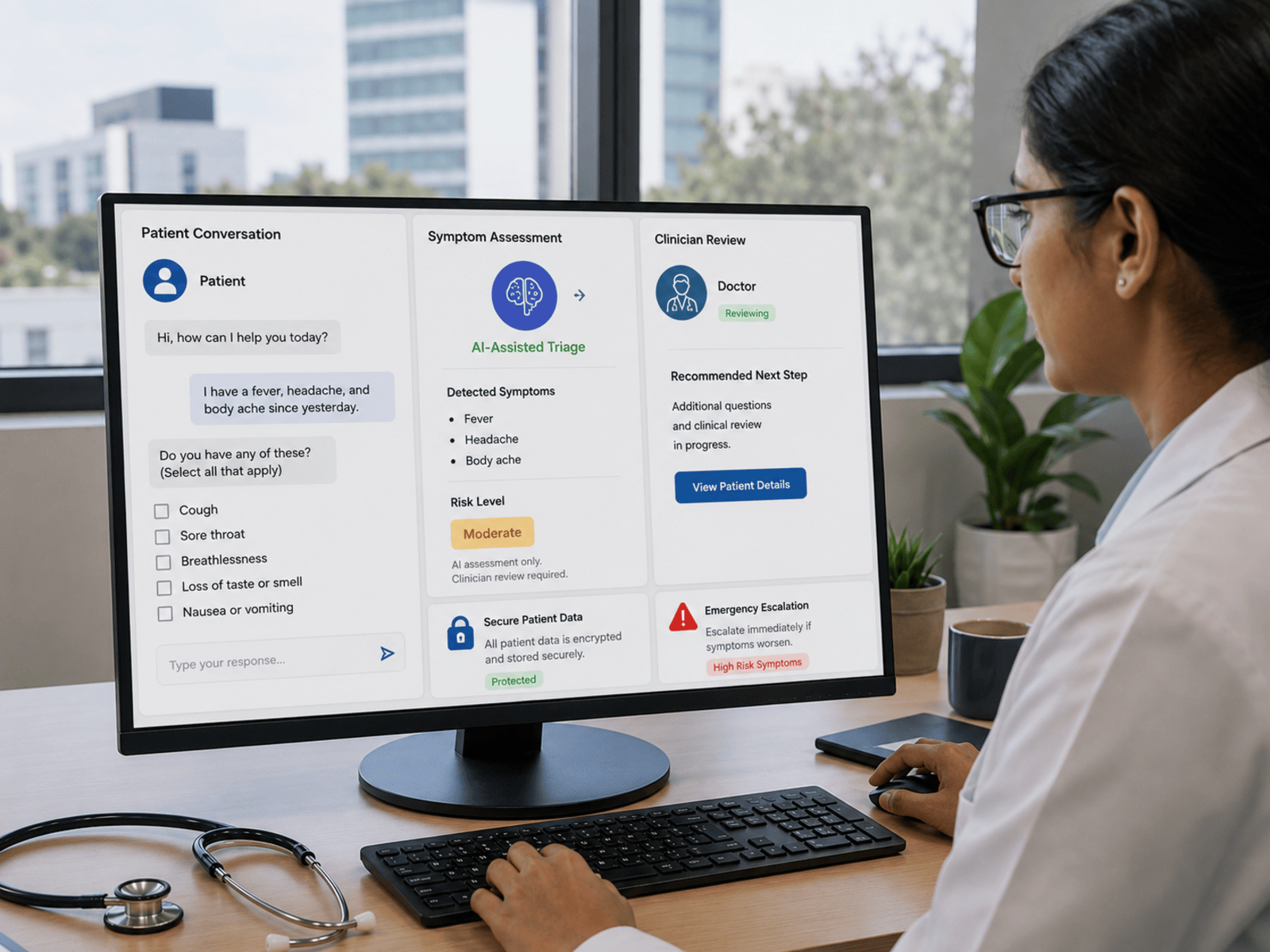


Telehealth usage in India has grown well past its pandemic-era spike, and patient expectations have grown right along with it. People who once tolerated a next-day callback now expect a response within minutes, at any hour, for even minor symptoms. That shift is putting real pressure on virtual care platforms, especially in cities like Bengaluru where patient volumes and after-hours queries keep climbing.
It usually shows up as a support ticket. A patient messages at 11 PM describing chest tightness and mild nausea, and the on-call coordinator is already juggling four other conversations. Somewhere in that scramble, a founder starts wondering if an AI symptom checker telehealth startup teams keep hearing about could take some of that pressure off the front line.
It's a reasonable question. It's also a bigger decision than it first appears. Adding conversational AI healthcare Bengaluru platforms use for triage is not just a product feature you slot into your app. It touches clinical safety, data law, and liability in ways that a typical software feature never does. Before any line of code gets written, it helps to understand what you are actually signing up for.
The Pressures Pushing Bengaluru Telehealth Platforms Toward AI Triage
Founders running virtual care platforms in Bengaluru tend to hit the same wall eventually. Consultation volumes climb, after-hours queries pile up, and the cost of staffing round-the-clock human triage starts to strain the budget. Patients who wait too long for a first response often just leave for a competitor's app instead.
This is the point where many founders start evaluating a telehealth AI triage India approach, not because it's trendy, but because the manual process is genuinely breaking down. A well-designed virtual care AI assistant India teams can rely on doesn't replace clinicians. It handles the repetitive first-contact questions (how long have symptoms lasted, is there fever, has this happened before) so human staff can spend their time on the cases that actually need judgment.
Bengaluru's position as a hub for both healthcare providers and technology talent, similar to what companies explore through an AI development company in Bengaluru, makes it a natural place for this kind of build to happen. But local ecosystem strength doesn't remove the underlying complexity.
What "AI Symptom Checker" Actually Means, and What It Doesn't
Before going further, it's worth being precise about the term, because vague language here is where trouble starts.
An AI symptom checker, in the context most Indian telehealth startups are building for, is a decision-support and triage tool. It asks structured questions, flags red-flag symptoms, and routes patients toward the right level of care. It is not a diagnostic device making a final medical determination, and it should never be marketed or built as one.
That distinction matters for AI symptom checker compliance India purposes. A tool that only assists routing carries a very different regulatory and liability profile than one that claims to diagnose a condition. Getting this framing wrong in your marketing copy or your product UX can create legal exposure that has nothing to do with how good your model actually is.
The Regulatory Reality in India (There's No Dedicated AI Law Yet)
India does not currently have a standalone law governing AI in healthcare. That's the first thing to internalize, because it shapes almost every other decision in this section.
What does exist is a patchwork of adjacent frameworks. The DPDP Act healthcare AI obligations under the Digital Personal Data Protection Act, 2023 set out consent and data-handling requirements that apply directly to any platform collecting patient symptom data, with health information treated as particularly sensitive. Separately, the Indian Council of Medical Research published Ethical Guidelines for the Application of AI in Biomedical Research and Healthcare in 2023. These guidelines are not legally binding in the way a statute would be, but they are the closest thing India has to an official benchmark for responsible AI use in clinical settings, and regulators, hospitals, and courts are increasingly likely to reference them when questions of standard of care come up.
On the liability question specifically, research published through the National Library of Medicine notes that while India's legal framework, including the Information Technology Act, intersects with AI usage, it lacks specific provisions addressing AI liability. That gap does not mean AI tools operate in a lawless space. It means liability gets assessed through existing frameworks (consumer protection law, medical negligence principles, contract law) applied to a technology those frameworks were not originally written for. For a founder, the practical takeaway is that DPDP Act alignment and ICMR guidance are the two concrete things you can act on today, even while broader AI healthcare liability India questions remain unsettled at the legislative level. PubMed Central
Who's Liable When the AI Gets a Symptom Wrong?
This is the question every founder should ask before launch, not after an incident.
In most current arrangements, liability tends to sit with a combination of parties: the platform operating the tool, the treating physician who ultimately reviews or acts on the AI's output, and in some structures the technology vendor who built the underlying system. Contracts between these parties should spell out exactly where responsibility sits, rather than assuming it will sort itself out later.
What's not in serious dispute is that a human clinician needs to remain in the loop for any consequential decision. An AI symptom checker that quietly makes a final call without physician oversight is taking on a level of legal and clinical risk that very few Indian telehealth platforms are currently positioned to absorb, regardless of how accurate the underlying model tests out to be.
Clinical Safety Design Rules Before You Ship This Feature
Once the regulatory picture is clear, the engineering choices matter just as much. A few AI triage clinical safety design principles tend to separate safe implementations from risky ones:
- Build hard-coded escalation logic for red-flag symptoms (chest pain, severe breathing difficulty, stroke signs) that routes straight to emergency guidance, bypassing the conversational flow entirely.
- Keep a human clinician in the loop for any output that could influence a treatment decision, not just for edge cases.
- Display clear, unavoidable disclaimers stating the tool is for triage support, not diagnosis.
- Log every conversation and every triage recommendation for audit purposes, since regulators and courts will look at these records if something goes wrong.
- Version and clinically review your symptom logic the same way you would version and review any other piece of medical content, with sign-off from a qualified clinician before each update goes live.
- Test the system against ambiguous or atypical symptom presentations, not just textbook cases, since real patients rarely describe things in tidy language.
This is the kind of groundwork that goes into building conversational AI for virtual care that platforms can actually trust in production, rather than a chatbot that happens to talk about symptoms.
Build vs. Buy: What Actually Makes Sense for a Startup
There's no universally correct answer here, but the trade-offs are fairly consistent across most Indian telehealth startups.
Building in-house gives you full control over clinical logic, data handling, and how the tool integrates with your existing patient records. It also means carrying the full weight of clinical review, ongoing model maintenance, and regulatory documentation yourself, which is a meaningful commitment for a small team.
Licensing an existing clinical-grade triage engine gets you to market faster and shifts some of the clinical validation burden onto a vendor with existing track record. The trade-off is less flexibility and an ongoing dependency on someone else's roadmap and pricing.
A hybrid approach, licensing a clinical decision-support core while building your own conversational layer and integration on top, is what a lot of growing platforms land on. It's rarely the cheapest option upfront, but for a build vs buy AI symptom checker decision, it often ends up being the most defensible one when a regulator or an investor asks how the clinical logic was validated. Whichever path a telemedicine startup AI features roadmap takes, the decision should be documented with the same rigor as any other regulated product choice.
Localizing AI Triage for Bengaluru's Patient Base
Bengaluru's telehealth market has its own texture. Patients span a wide range of first languages, from Kannada to English to Hindi and beyond, and any symptom checker built for this market needs to handle that linguistic range without losing clinical precision in translation.
Data residency is another local consideration. Platforms serving Bengaluru patients need clarity on where symptom and health data is stored and processed, particularly given DPDP Act obligations around cross-border data transfer for sensitive personal data.
There's also a case for looking at how conversational AI is already being applied in adjacent care settings locally. Our blog on conversational AI patient engagement in Bengaluru hospitals covers how similar systems handle scheduling, routing, and follow-up communication in a hospital context, offering a useful reference point for triage-focused telehealth platforms building something adjacent.
Frequently Asked Questions
Is an AI symptom checker legal to use in Indian telehealth apps?
Yes, but there is no dedicated law governing it specifically. Compliance currently rests on adhering to the DPDP Act for data handling and aligning with ICMR's ethical guidelines for AI in healthcare, alongside standard consumer protection and medical negligence principles.
Who is liable if the AI gives incorrect triage advice?
Liability typically falls across the platform operator, the supervising physician, and in some cases the technology vendor, depending on contractual terms. A human clinician remaining in the decision loop is essential to managing this risk.
Should a startup build or license an AI symptom checker?
It depends on team size, timeline, and appetite for handling clinical validation in-house. Many growing platforms use a hybrid model, licensing a clinical decision-support core while building their own conversational and integration layer.
What data protection rules apply to AI health tools in India?
The Digital Personal Data Protection Act, 2023 governs consent and handling of personal data, including health information, and applies directly to any AI symptom checker collecting patient input.
Getting the Foundation Right
Adding an AI symptom checker to a Bengaluru telehealth platform is as much a clinical safety and compliance decision as it is a product one. Get the escalation logic, the human oversight, and the data handling right from day one, and the feature becomes a genuine asset rather than a liability waiting to surface.
If your team is weighing this decision and wants a technical partner who understands both the engineering and the compliance context, Theta Technolabs can help. Reach out to us at sales@thetatechnolabs.com.



















.png)





.png)
































.avif)
.avif)
.avif)























_How%20IoT%20Can%20Reduce%20Energy%20Costs%20in%20Smart%20Factories_Q4_25.avif)
_How%20AI%20Development%20Companies%20in%20Ahmedabad%20are%20Transforming%20the%20Shopping%20Experience_Q4_25.avif)
_Node.js%20and%20Blockchain_%20A%20Perfect%20Pair%20for%20Fintech%20Innovation%20in%20Dubai_Q3_24.avif)
_Choosing%20the%20Right%20Computer%20Vision%20Development%20Partner%20in%20Ahmedabad%20for%20Construction_Q3_24.avif)
_The%20Transformative%20Role%20of%20Open%20Banking%20APIs%20in%20Fintech%20for%202024_Q3_24.avif)