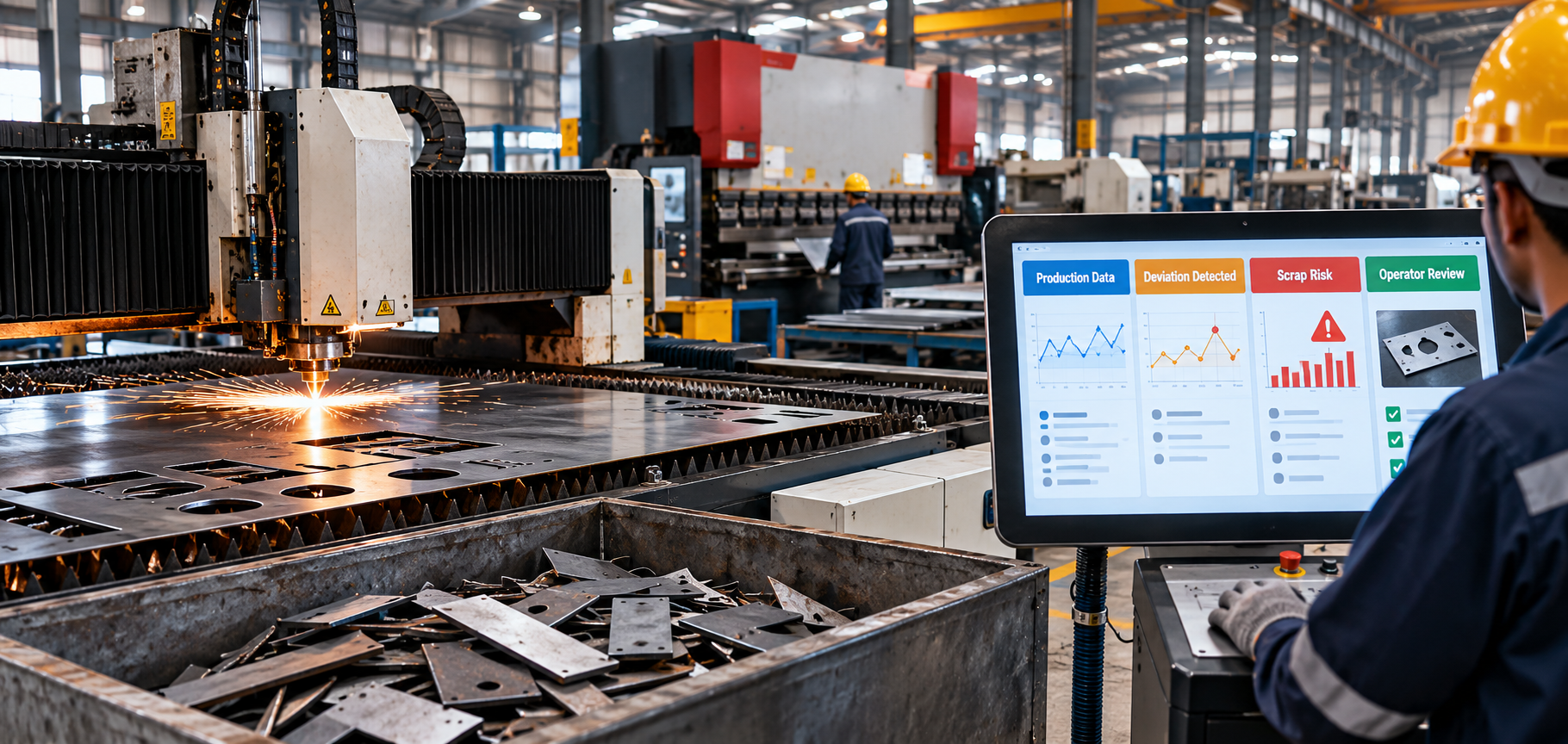


Metal fabrication plants usually know how much scrap they produced after a job is complete. The harder question is why the loss happened and whether the same conditions can be recognized before more material is wasted. AI scrap reduction addresses that gap by connecting production conditions with quality and scrap outcomes.
For scrap reduction in metal fabrication, useful signals may already exist in nesting files, machine settings, job records, quality checks, tooling information, and scrap logs. Predictive analytics can bring these records together, identify combinations associated with higher waste risk, and alert production teams when similar conditions appear again. Depending on the available data, this risk can be identified before a job starts from setup parameters or during production when machine and process data are available continuously.
Why Scrap Cost Cannot Be Understood from the Scrap Bin Alone
Scrap is recorded when material or a finished part is rejected, but the condition that contributed to the loss may have appeared earlier. That is why metal fabrication waste reduction requires more than counting discarded sheets, plates, sections, or components.
Poor nesting can leave unnecessary offcuts. Cutting parameters may drift. Tool wear can affect cut quality. Press brake setup can contribute to dimensional errors. Differences in material grade, thickness, machine settings, or production sequence can also coincide with recurring defects.
Scrap is the outcome. The predictive signal may be a combination of process conditions that repeatedly appears before it.
A practical production waste reduction program therefore connects the scrap record back to the job, machine, material, process settings, and inspection result. The aim is not to assume one variable caused the defect, but to find repeatable relationships that deserve attention.
Which Production Data Can Reveal Scrap Risk?
A scrap prediction system does not need every possible plant data source on day one. It needs reliable records that can connect production conditions with outcomes.
Material and Job Information
Useful fields can include material grade, sheet or plate thickness, dimensions, work order, part geometry, batch reference, and the machine or line used for the job.
Machine and Process Conditions
For AI in metal fabrication, process information may include cutting speed, machine settings, tool condition, nesting or material utilization data, press brake setup, alarms, production sequence, and other operating readings.
Where a plant already uses connected systems, AI for manufacturing can extend that data foundation by linking process conditions with quality and scrap results. Depending on the environment, data may come from CNC equipment, CAD/CAM software, MES, ERP, industrial sensors, or quality systems.
Quality and Scrap Records
Useful outcome records include accepted and rejected output, defect category, rework, scrap quantity or weight, inspection result, and the related job or machine.
This is where predictive analytics for manufacturing becomes useful. Instead of reviewing each source separately, the analysis can align material, machine, job, quality, and scrap information around the same production event.
How AI Connects Production Deviations with Scrap Outcomes
The goal is to connect historical production evidence with current conditions so teams can recognize increasing scrap risk.
Step 1: Build the Historical Relationship
Historical records can be aligned around job, material, machine, process parameters, inspection result, and scrap outcome. Machine learning can then look for combinations historically associated with a higher probability of rejects or scrap.
This is scrap prediction in manufacturing in practical terms. The system is estimating risk from patterns found in previous production, not proving that a single parameter caused the waste.
Step 2: Evaluate Current Production Conditions
Once the predictive logic has been tested against known outcomes, current production data can be evaluated against those historical patterns.
For example, a particular material thickness, machine setting, and tool condition may resemble previous jobs that produced more rejects. That combination can be treated as a risk signal.
Step 3: Flag Risk Before More Material Is Processed
Predictive quality analytics can surface abnormal parameter combinations, rising predicted scrap risk, recurring defect patterns, or process drift. The alert should give the production or quality team enough context to review the issue.
Step 4: Keep Production Decisions With the Team
A prediction should support the operator, engineer, or quality team rather than automatically making every production decision. The response may be to check tooling, confirm settings, inspect a sample, review nesting, or investigate another condition.
Automatic machine adjustment or stoppage should only be introduced when the control logic, safety requirements, plant procedures, and integration have been properly designed and validated.
In simple terms, scrap prediction matches historical production conditions with actual quality and scrap outcomes, then checks current conditions for similar patterns that indicate increasing waste risk.
A Practical Scrap Prediction Workflow for a Fabrication Plant
A usable workflow should be understandable to both production and technical teams:
Production data → Data validation → Scrap-risk analysis → Risk alert → Operator or engineer review → Corrective action → Outcome recorded
Data validation comes first because missing job identifiers, inconsistent defect labels, or incomplete machine records can weaken the analysis. When a risk is flagged, the plant team reviews the evidence and decides what action is appropriate. The result is then recorded for later evaluation.
For AI for metal fabrication plants in Kolkata, this workflow can be adapted to the data a facility actually has. The plant needs enough reliable information to connect a defined scrap problem with the production conditions surrounding it.
The ROI Question: Is the Scrap Reduction Worth the AI Investment?
A technically accurate prediction is not enough. Management also needs to know whether the project supports meaningful manufacturing scrap cost reduction.
The first step is to establish a baseline. That can include material consumed, material scrapped, rework, rejected parts, scrap reasons, affected jobs or machines, and the financial cost associated with material loss and avoidable processing.
After implementation, the same measures should be tracked over a meaningful production period. The plant can then assess whether scrap quantity, scrap cost, rework, repeat defects, yield, or avoidable processing changed relative to the baseline.
A practical scrap reduction ROI assessment compares the financial benefit associated with avoided scrap and related waste against the cost of implementing and operating the solution. Changes in job mix, material, volume, and operating conditions should also be considered.
The National Institute of Standards and Technology's Manufacturing Extension Partnership identifies scrap reduction as an AI use case and recommends defining a specific problem, checking whether the required data exists, quantifying its financial impact, and beginning with a focused pilot before scaling.
Start With One High-Value Scrap Problem, Not the Whole Plant
A fabrication company does not need to connect every machine before testing whether predictive analytics is useful.
A pilot can focus on one cutting process, one machine group, one product family, one recurring defect, or one material category with meaningful scrap cost:
Define the problem → establish the baseline → connect relevant data → build and validate the prediction → run with human review → measure outcomes → decide whether to expand
Custom AI consulting and development services can help connect plant data, build the predictive logic, and integrate risk alerts into an existing manufacturing workflow. The design should follow the process being improved rather than forcing the plant to redesign every production system.
Starting narrowly also makes the financial evaluation clearer. If the pilot cannot show reliable operational value on a defined problem, expansion should wait.
Applying the Approach in Kolkata Metal Fabrication Operations
For a Kolkata fabrication business, the first implementation questions are practical: Where is costly scrap occurring? Are the related process and quality records accessible? Can those records be linked to specific jobs, machines, materials, and outcomes? Who will review a risk alert?
A business evaluating an AI development company in Kolkata should therefore assess more than prediction accuracy. Data integration, manufacturing context, validation, alert design, and usability for plant teams all affect whether the system becomes operationally useful.
The objective is not to add AI everywhere. It is to make a defined production problem measurable, predictable where the data supports it, and easier for the responsible team to act on.
Frequently Asked Questions
How can AI reduce scrap in metal fabrication?
AI can connect historical production conditions with scrap and quality outcomes, identify patterns associated with higher waste risk, and alert plant teams before a job starts or during production, depending on the available data.
What production data is needed for scrap prediction?
Useful data can include material and job information, machine settings, tool condition, inspection results, defect records, rework, and actual scrap outcomes.
Can predictive analytics work with existing manufacturing equipment?
It may be possible when useful production, machine, or quality data can be accessed reliably. Feasibility depends on interfaces, data quality, and how consistently records can be linked.
How should a manufacturer measure scrap reduction ROI?
Establish a baseline for scrap cost and related waste, track the same measures during the pilot, and compare measurable benefits with implementation and operating costs.
Turn Scrap Records into Earlier Production Decisions
Scrap prediction is useful when it connects production and quality information, identifies conditions associated with higher waste risk, and gives plant teams enough context to review the issue as early as the available production data allows.
A practical implementation may combine machine learning, predictive analytics, and REST API integrations to connect data, evaluate risk, and return alerts to existing workflows. These capabilities can be delivered for Kolkata manufacturing operations through AI development and integration services.
Theta Technolabs can help design and integrate this type of solution around a defined manufacturing problem. For project discussions, contact sales@thetatechnolabs.com.

















.png)





.png)






































.avif)
.avif)
.avif)
























_How%20IoT%20Can%20Reduce%20Energy%20Costs%20in%20Smart%20Factories_Q4_25.avif)
_How%20AI%20Development%20Companies%20in%20Ahmedabad%20are%20Transforming%20the%20Shopping%20Experience_Q4_25.avif)
_Node.js%20and%20Blockchain_%20A%20Perfect%20Pair%20for%20Fintech%20Innovation%20in%20Dubai_Q3_24.avif)
_Choosing%20the%20Right%20Computer%20Vision%20Development%20Partner%20in%20Ahmedabad%20for%20Construction_Q3_24.avif)
_The%20Transformative%20Role%20of%20Open%20Banking%20APIs%20in%20Fintech%20for%202024_Q3_24.avif)
_Explore%20the%20Best%20Cross-Platform%20App%20Development%20Frameworks%20of%202024_Q3_24.avif)


_Integrating%20IoT%20with%20Mobile%20Apps%20for%20Advanced%20Renewable%20Energy%20Solutions_Q2_24.avif)
_Top%20Benefits%20of%20Cloud%20Computing%20for%20All%20Business%20Sectors_Q2_24.avif)