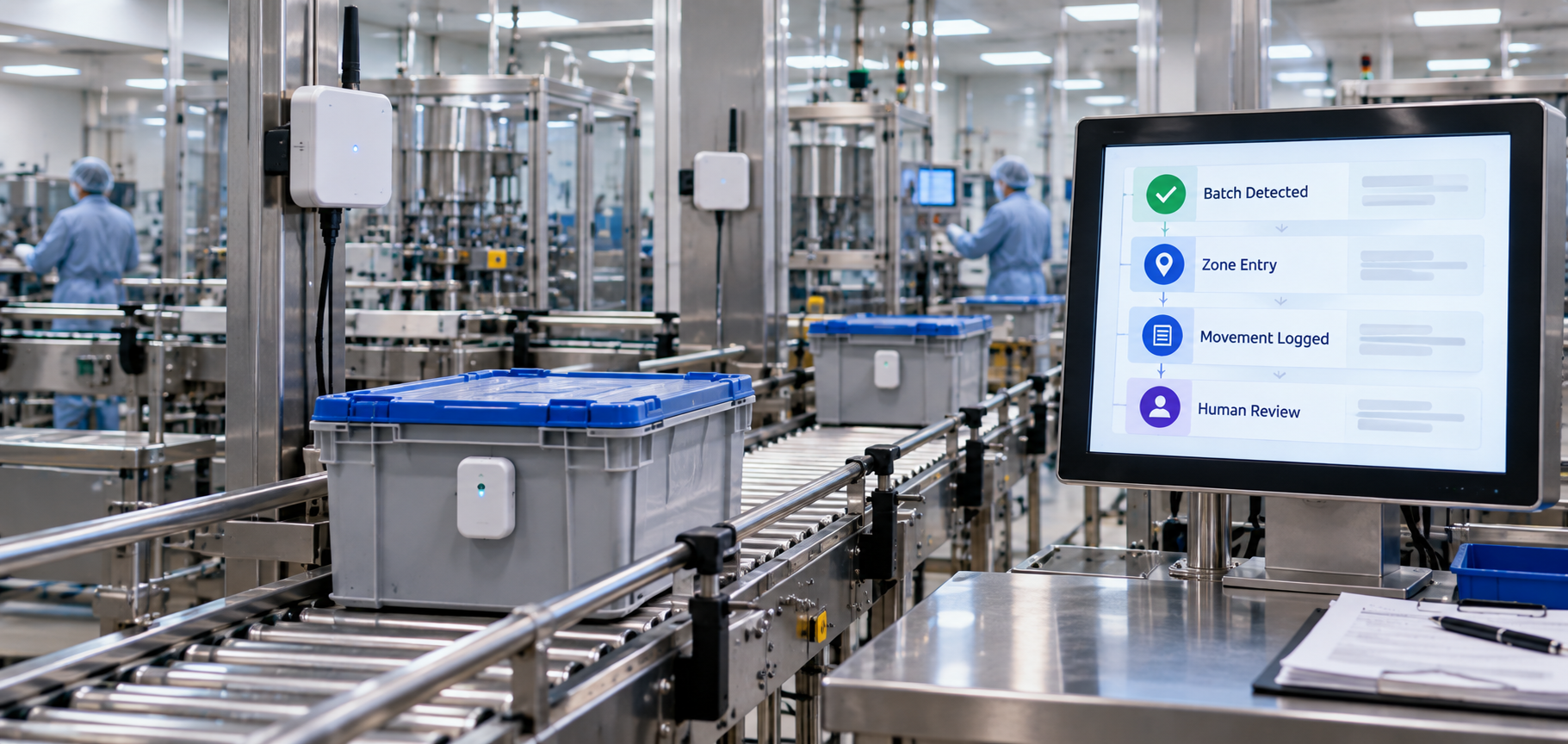


Pharmaceutical manufacturers may already have batch numbers, production records, quality status, and material transactions in digital systems, yet physical movement can still depend on manual scans or staff updates. Pharma batch traceability becomes more useful when those records also reflect where a batch-associated container, tote, or pallet was detected.
Pharmaceutical batch tracking with Bluetooth Low Energy can help capture selected movement and zone events automatically. BLE does not make an operation compliant by itself. Its role is to supply movement data that can connect with controlled manufacturing and quality records. This article explains how that flow works, where BLE fits, and what manufacturers should plan before deployment.
Where Batch Traceability Can Lose Visibility Inside the Plant
Pharmaceutical manufacturing traceability needs more than a batch number. Teams may need to reconstruct where a batch-associated item moved, when it entered a controlled area, and whether its physical location matched the expected process stage.
A batch may pass through dispensing, production, an in-process hold area, quality control, packaging, and finished-goods staging. Visibility can weaken when each transition requires a manual scan or update.
This is where real-time batch tracking can add context. A digital record shows what was recorded about the batch, while BLE-based events can show where the tagged item was detected at selected points. Location data should support the manufacturing record, not replace it.
How BLE Adds a Movement-Data Layer to Pharma Batch Tracking
BLE batch traceability starts by associating a BLE identifier with a known batch, material container, tote, pallet, or other physical item used to move work in progress. The association should be managed in the application or manufacturing system rather than relying on the beacon to hold the complete record.
A BLE tracking system for pharma can use gateways placed around defined zones such as dispensing, production, staging, quality handoff, packaging, or warehouse areas.
When the tagged item moves, software can filter repeated signals, confirm the mapped identifier, apply zone rules, and create useful events such as "entered packaging" or "left staging." A radio detection alone should not automatically become a manufacturing event.
For BLE batch tracking in Hyderabad, the design should match the actual process and radio environment rather than assuming that more gateways always provide better traceability.
In simple terms, BLE batch tracking detects tagged items in defined areas, converts suitable detections into movement events, and links those events with the correct batch context.
From BLE Signal to Batch Record: A Practical Data Flow
A practical IoT batch tracking flow can be designed as:
BLE tag or beacon → gateway → edge or IoT platform → batch association → validated movement event → MES, ERP, eBMR/eBPR, or QMS → dashboard or investigation record.
The application layer is important because a gateway may receive many observations from the same device. Software can verify device identity, confirm the associated batch, remove duplicate detections, apply zone logic, and create a movement event only when defined conditions are met.
This is where IoT application development becomes relevant. The software layer can manage device data, dashboards, integration logic, and connected workflows instead of sending every raw beacon signal directly into a manufacturing system.
Each connected system still keeps its own role. MES may manage execution status, ERP may hold inventory transactions, QMS may manage deviations, and eBMR/eBPR may contain controlled batch documentation. BLE movement events can enrich those systems through approved interfaces, APIs, or middleware.
The result is not simply a live location. It is a usable movement history tied to the batch context.
What the Workflow Can Look Like During a Pharma Batch Movement
Consider a batch-associated container moving from dispensing to production, then through an in-process hold area, quality handoff, and packaging. BLE can capture selected transitions without requiring a manual scan at every point.
The record can help teams review whether physical movement matches the expected process and investigate an unexpected zone or excessive dwell time.
BLE should not be confused with visual inspection. It can confirm that a batch-associated item reached an inspection or packaging zone, but it cannot determine whether a label, vial, or package has a visual defect. That is a different use case, addressed through workflows such as pharma batch quality control in Hyderabad using computer vision where appropriate.
How BLE Can Support Traceability Requirements Without Becoming the Compliance System
GMP batch traceability depends on controlled processes, documentation, responsibilities, and records. India's revised Schedule M states that good documentation is an essential part of the quality assurance system and requires a batch processing record for each batch processed. It also addresses production, quality-control, and distribution documentation.
BLE can support that environment by contributing time-stamped movement data, zone entry or exit events, an associated batch identifier, movement sequence, or dwell information. It should not be presented as an independent compliance mechanism.
The wider system still needs controls for user access, record integrity, approvals, deviations, retention, audit trails, and computerized-system validation where applicable. If BLE events enter electronic batch records in pharma, the source and meaning of each event should remain clear.
The practical principle is to use BLE to improve the evidence available to the traceability process while keeping compliance decisions and controlled records within the appropriate workflows.
What Pharma Manufacturers Should Decide Before Deploying BLE
Start by defining what needs to be tracked. A manufacturer may choose batch-associated containers, totes, pallets, work-in-progress items, or transport equipment. Tagging every movable object is not automatically necessary.
Next, define zones around the process. BLE performance can be affected by walls, metal equipment, liquids, neighboring rooms, and gateway placement, so site testing matters.
The team must also define what counts as a valid event. Entry, exit, dwell, handoff, and unexpected-movement rules should reflect the operating procedure rather than treating every detection as meaningful.
Connectivity also needs planning. Edge buffering or synchronization may be required when a gateway cannot continuously reach the central platform.
Finally, batch genealogy in pharma manufacturing is broader than location history. It can include raw materials, processing, quality status, packaging, release, and transaction history. BLE movement data is one layer within that larger genealogy.
When BLE Is a Good Fit, and When It Should Work with Other Identification Methods
BLE can be useful for passive detection across defined areas, movement history without scanning at every transition, zone-level visibility, and selected movement alerts.
It does not need to replace barcode, QR, RFID, MES, ERP, QMS, or electronic batch-record workflows. Barcode or QR scanning may remain suitable where deliberate operator confirmation is required. RFID may fit different read-range or identification needs.
There is no universal answer to whether BLE is better than barcode or RFID for pharmaceutical traceability. The choice depends on identification behavior, location granularity, process design, infrastructure, validation needs, and existing systems. A hybrid architecture may be more practical than a BLE-only approach.
Building BLE Batch Traceability for Hyderabad Pharma Operations
Implementation should begin with the process rather than the devices. Map the batch journey, define important movements, identify the systems that own related records, and decide how each BLE event will be interpreted.
Then plan gateway zones, build event-processing logic, connect approved systems, test under real plant conditions, and review the resulting records with manufacturing and quality teams.
For organizations evaluating IoT and BLE development services in Hyderabad, the technical scope may include BLE device integration, IoT gateways, edge processing, dashboards, cloud connectivity, and REST API integration. The architecture should adapt to the plant's traceability workflow rather than forcing the workflow around the technology.
Conclusion
BLE is most useful in pharmaceutical traceability when it closes the gap between physical batch movement and existing digital records. A dependable implementation needs mapped BLE identifiers, planned gateways, event-processing rules, and controlled integration with manufacturing systems.
Bluetooth Low Energy, MQTT, and REST APIs can support the device-to-platform-to-system flow when suited to the plant environment. These technologies are part of the available IoT and BLE technology stack.
Theta Technolabs develops connected IoT and BLE solutions for manufacturing workflows. To discuss a batch-traceability implementation, contact sales@thetatechnolabs.com.
Frequently Asked Questions
What is BLE batch traceability in pharmaceutical manufacturing?
It uses a BLE identifier associated with a physical batch container, tote, pallet, or similar item. Gateways detect the tagged item in defined zones, and software converts suitable detections into movement events that can be linked with manufacturing records.
Can BLE support GMP batch traceability?
Yes, as a supporting data-capture layer. BLE can provide movement and location events, but it does not create GMP compliance on its own. Controlled records, approvals, validation, quality procedures, and other applicable requirements remain necessary.
Can BLE track raw materials, WIP, and finished batches?
It can track a tagged physical item associated with those materials or batches. The value of the data depends on correct identifier mapping and well-defined plant zones and events.
How does BLE integrate with MES or ERP systems?
Gateways send observations to an application, edge layer, or IoT platform. That layer validates and interprets the data, creates meaningful events, and can pass approved information to MES, ERP, QMS, or batch-record systems.
Is BLE better than RFID or barcode tracking for pharma manufacturing?
Not in every case. BLE suits passive zone detection and movement visibility, while barcode, QR, or RFID may fit other identification and confirmation requirements. The right approach depends on the workflow, infrastructure, traceability objective, and validation needs.








.png)




.png)
























.avif)
.avif)
.avif)

















_How%20IoT%20Can%20Reduce%20Energy%20Costs%20in%20Smart%20Factories_Q4_25.avif)
_How%20AI%20Development%20Companies%20in%20Ahmedabad%20are%20Transforming%20the%20Shopping%20Experience_Q4_25.avif)
_Node.js%20and%20Blockchain_%20A%20Perfect%20Pair%20for%20Fintech%20Innovation%20in%20Dubai_Q3_24.avif)
_Choosing%20the%20Right%20Computer%20Vision%20Development%20Partner%20in%20Ahmedabad%20for%20Construction_Q3_24.avif)
_The%20Transformative%20Role%20of%20Open%20Banking%20APIs%20in%20Fintech%20for%202024_Q3_24.avif)
_Explore%20the%20Best%20Cross-Platform%20App%20Development%20Frameworks%20of%202024_Q3_24.avif)


_Integrating%20IoT%20with%20Mobile%20Apps%20for%20Advanced%20Renewable%20Energy%20Solutions_Q2_24.avif)
_Top%20Benefits%20of%20Cloud%20Computing%20for%20All%20Business%20Sectors_Q2_24.avif)

_Understanding%20the%20Impact%20of%20AI%20and%20Machine%20Learning%20on%20Fintech%20Web%20Apps%20in%20Dubai_Q2_24.avif)