

Managing hospital staff schedules involves more than assigning doctors and nurses to available shifts. Hospital administrators must consider employee availability, qualifications, department requirements, leave requests, and unexpected absences while maintaining appropriate patient care coverage.
For hospitals in Dubai, these responsibilities become more complicated when departments use separate spreadsheets, messaging groups, and HR systems to manage their schedules. A late absence or an unrecorded shift change can leave managers working with outdated information.
Hospital staff scheduling software brings these activities into one system. It helps administrators create schedules, identify staffing gaps, manage changes, and share updated assignments with employees.
This article explains how Dubai hospitals can use scheduling software, which features matter most, and how to connect it with existing workforce systems.
Why Hospital Staff Scheduling Needs More Than a Basic Calendar
A hospital schedule must reflect the actual staffing requirements of each department.
An emergency department may require different clinical competencies from a surgical ward. Diagnostic departments depend on technician availability, while intensive care units need carefully planned clinical coverage.
General calendar applications can show who is working, but they may not verify whether someone is qualified for a particular assignment.
For effective Dubai hospital workforce management, scheduling systems must consider department needs alongside employee records.
The software should help managers answer practical questions:
- Which employees are available for the next shift?
- Does every department have appropriately qualified staff?
- Are any approved leave requests affecting coverage?
- Which assignments require confirmation?
- Who can replace an unavailable employee?
These questions should be answered from current information rather than separate files maintained by different departments.
Build Schedules Around Department Requirements
Before hospitals automate rostering, they need to define what constitutes suitable coverage.
Match employees with the correct clinical responsibilities
Effective nurse shift scheduling begins with understanding each employee's role, competencies, and approved work assignments.
For example, a nurse assigned to a specialist department may require particular training or authorization. Scheduling software should record the relevant qualifications and compare them with the requirements of the shift.
Scheduling software can identify employees whose recorded qualifications match a department's requirements. However, hospital managers must still evaluate clinical competencies, staffing needs, applicable work requirements, and professional authorization before confirming shift assignments.
A useful roster also identifies the department, shift timing, reporting location, assigned supervisor, and any special coverage requirements.
This approach helps hospitals avoid treating every available employee as interchangeable.
Maintain a current view of staff availability
Scheduling depends on accurate clinical staff availability.
Employee records should distinguish between approved leave, planned training, existing assignments, part-time availability, and temporary restrictions.
When these details are recorded centrally, managers can see which employees are genuinely available before creating a new assignment.
Availability should also reflect whether a staff member has already accepted another shift.
Without these checks, hospitals may unintentionally assign overlapping duties or propose replacements who are unavailable.
Connect Rosters with Professional Licence Information
Hospital administrators in Dubai must consider professional licensing when assigning clinical duties.
The Dubai Health Authority (DHA) manages healthcare professional registration and licensing through its official Dubai Health Licensing System (Sheryan). Hospitals should follow the applicable DHA licensing procedures to verify professional credentials before confirming clinical assignments.
Scheduling software can support DHA licence status checks by storing previously verified licence details, tracking expiry dates, and reminding administrators when credentials require another check. Hospitals should verify each professional's active licence, approved specialty, and relevant facility information through the applicable official licensing process.
However, hospitals should not assume that a software dashboard automatically establishes a person's legal eligibility to practise. Official verification, facility permissions, professional scope, and applicable DHA requirements must still be considered.
Where direct electronic verification is unavailable or unauthorized, the software can record manually verified information and the date of verification.
This provides useful oversight without presenting an internal credential record as an official regulatory approval.
Create Rosters with Rules, Not Just Employee Names
A scheduling engine can help managers prepare proposed assignments using the rules established by the hospital.
These rules may consider:
- Department coverage requirements
- Staff qualifications and approved duties
- Employee availability and leave
- Applicable working-time and rest requirements
- Previously assigned shifts
- Supervisor approval requirements
Automated shift allocation uses this information to prepare suitable roster suggestions.
However, the system should identify conflicts rather than automatically ignore them.
If a department does not have enough eligible employees, it should flag the staffing gap and request a manager's decision.
A hospital should never rely on an algorithm to create the appearance of complete coverage when the required staff are unavailable.
Managers must retain the ability to adjust assignments, provide reasons for changes, and approve the final schedule.
Handle Last-Minute Absences Without Losing Track of Changes
Even a carefully prepared schedule can change unexpectedly.
An employee may report sick, a procedure may require additional personnel, or another department may request temporary staffing support.
A reliable hospital roster management system should distinguish between the published schedule and pending changes.
Consider a nurse who reports an unexpected absence before an evening shift.
The system could identify the affected department, display eligible replacements, check their availability, and send a replacement request.
The receiving employee can accept or decline. A manager then confirms the assignment and the roster is updated.
The original assignment should remain visible in the change history rather than disappearing from the records.
Give shift exchanges a clear approval process
Hospitals can also introduce hospital shift swap approvals through staff portals or mobile applications.
Employees request an exchange, the software checks basic eligibility, and an authorized manager reviews the proposed change.
This reduces the chances of informal arrangements creating differences between actual staffing and published rosters.
The application should record who requested the change, who approved it, and when the updated schedule became effective.
For higher-acuity departments, additional approval rules may be necessary.
What Should Hospital Scheduling Software Manage?
The most useful features depend on the hospital's operating model.
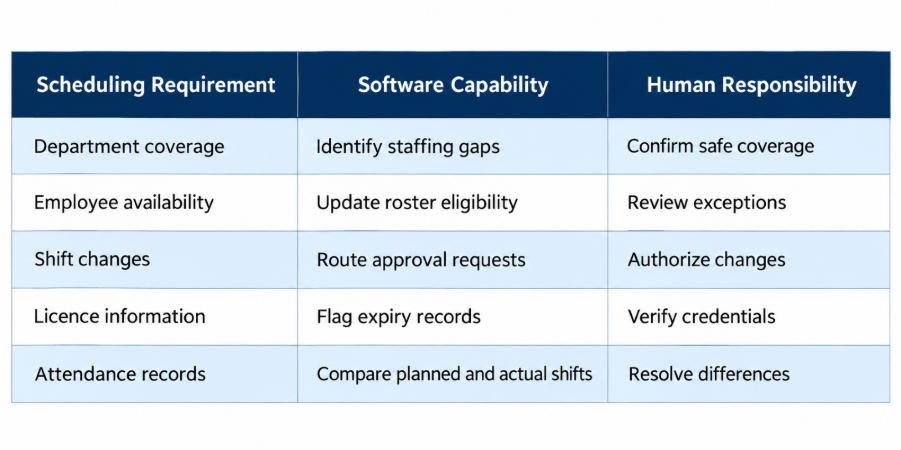
This separation matters because hospital scheduling software should support management decisions rather than replace clinical judgment.
For instance, a completed roster does not automatically mean that the department has the correct clinical skills available.
Managers should review coverage quality, not simply the number of assigned employees.
Connect Scheduling with Existing Hospital Systems
Hospitals often operate payroll, attendance, HR, and hospital management applications separately.
A scheduling platform becomes more useful when relevant information can move securely between these systems.
HR and payroll connectivity
Healthcare HR software integration allows approved employee information, leave records, and relevant attendance details to support scheduling.
Where appropriate, published shifts and approved attendance records can also feed payroll processes.
The integration must clearly distinguish between scheduled hours and hours actually worked.
Payroll calculations should not rely solely on planned rosters when attendance corrections or approved exceptions exist.
Hospital management system connectivity
A hospital management system may contain department information, service schedules, and operational requirements useful for workforce planning.
Scheduling software can receive permitted operational information without importing unnecessary patient details.
If workload estimates are used, they should be aggregated where possible and reviewed by the appropriate management team.
The aim is better staffing visibility, not unrestricted access to clinical records. Hospitals should ensure that workforce scheduling integrations follow applicable privacy and security requirements. Patient information should not be transferred into a scheduling system unless there is a justified, authorized need.
Mobile access for employees
Through mobile app development in Dubai, hospitals can introduce secure employee applications that display schedules, notify staff about changes, and accept availability requests.
Employees should see only information relevant to their permissions.
For example, a nurse may view personal shifts while department managers receive broader staffing information.
Mobile notifications should avoid unnecessary clinical or personal information.
How Dubai Hospitals Can Introduce Scheduling Software
Hospitals do not need to replace every existing system to improve workforce scheduling.
A gradual implementation allows management teams to evaluate processes and identify problems before expanding the system.
Start with one department
Choose a department with clear staffing requirements and an established approval process.
Document how schedules are prepared, how employee availability is recorded, and how managers respond to unexpected absences.
The objective is to understand existing responsibilities before introducing automation.
Prepare accurate workforce information
Import relevant employee records, department assignments, qualifications, and approved availability.
Check for duplicate profiles, outdated credentials, and conflicting employee information.
Incorrect input records can produce unsuitable roster suggestions even when scheduling logic is technically correct.
Configure rules and approvals
Define eligibility checks, staffing requirements, shift approval permissions, and escalation procedures.
Test situations involving insufficient coverage, simultaneous leave requests, licence expiry alerts, and unexpected absences.
The software should clearly communicate when it cannot generate a suitable proposed roster.
Expand after operational review
Once managers are comfortable with the workflow, introduce additional departments.
Hospitals may also use web app development in Dubai to create centralized administrative portals across facilities.
Multi-site deployment requires clear permissions, consistent employee identifiers, and rules for staff who work at more than one approved location.
How to Measure Whether Scheduling Has Improved
Hospitals should evaluate scheduling software using operational results rather than relying only on the speed of roster creation.
Useful measures include the time required to prepare and approve schedules, the number of uncovered shifts detected before publication, and how long replacement requests remain unresolved.
Managers can also review the frequency of last-minute roster changes and differences between scheduled and actual attendance.
Staff feedback is equally important. Employees should understand their assigned duties and have a reliable way to report incorrect information.
These measures help administrators identify whether the new software is improving coordination or merely transferring existing problems into a digital system.
The results will depend on data quality, management practices, system adoption, and the hospital's staffing capacity.
Choosing Software That Fits Hospital Operations
Hospitals should compare their actual workflows before selecting a standard scheduling platform or commissioning a custom solution.
Ready-made systems may be sufficient for organizations with straightforward rosters and limited integration requirements.
Custom solutions become more relevant when departments have specialized staffing rules, multiple approval levels, or existing systems that require tailored connectivity.
Through custom healthcare software development, hospitals can design scheduling functionality around their operational requirements.
Security testing, permission management, audit records, and reliable information synchronization should be considered during development.
The most suitable system is one that staff can use consistently and managers can rely on when schedules change.
Conclusion
Better hospital scheduling begins with accurate workforce information, clear departmental requirements, and reliable communication.
For Dubai hospitals, software can make roster preparation more organized while supporting credential reviews, shift changes, and staffing decisions.
The strongest approach combines automated checks with appropriate human oversight.
Theta Technolabs can develop tailored hospital scheduling platforms using modern web technologies, Node.js, and cloud infrastructure, with connections to existing HR and hospital management systems where integration is supported.
For custom hospital scheduling software development, contact us at sales@thetatechnolabs.com.