

In 2026, fintech risk is no longer about spotting obvious red flags. It is about identifying threats that look perfectly legitimate. Synthetic identities built from fragmented real data can pass traditional KYC checks. Deepfake audio can mimic executives to authorize high-value transactions. Fraud rings use automation to test thousands of micro-transactions in seconds.
The scale and sophistication of financial crime have changed. What has not changed, in many firms, is the underlying risk engine. Rules-based systems, static scorecards, and legacy statistical models were designed for a slower, more predictable environment.
The industry has moved beyond experimentation. Machine learning in fintech risk analysis is no longer a pilot initiative confined to innovation labs. It is becoming the operational core of resilient financial institutions.
The real question for leaders is not whether machine learning works. It is this: If a fintech firm were to integrate advanced ML models across every risk touchpoint today, what measurable impact would it see tomorrow?
Reimagining Risk With Intelligence
Imagine a fintech company deciding to embed machine learning across onboarding, transactions, lending, and portfolio monitoring.
At onboarding, instead of checking static identity rules, an ML model evaluates thousands of subtle signals simultaneously. Think of it like a seasoned investigator who does not just look at one document but considers patterns across devices, behavior, location consistency, and historical linkages. The system continuously learns from confirmed fraud cases, refining its sensitivity.
In transactions, real-time models evaluate context, not just thresholds. Rather than blocking a payment because it exceeds a predefined amount, the system asks: Is this behavior consistent with this user’s history? Does the device fingerprint align with prior sessions? Has a similar pattern appeared in recent fraud clusters?
For lending, ai-driven credit risk assessment shifts from static credit bureau reliance to dynamic behavioral insights. Spending patterns, repayment rhythms, digital engagement, and even micro-behavioral signals can inform underwriting decisions. It is like moving from a single photograph of a borrower to a live video stream of their financial habits.
Across the portfolio, fintech risk modeling evolves from quarterly reviews to continuous recalibration. As macroeconomic conditions shift or customer segments behave differently, models adjust in near real time.
The result is not incremental improvement. It is structural change.
Achieving this level of integration requires robust infrastructure. Leading firms often partner with specialized fintech software development services to build secure, scalable, and AI-native risk engines that align with global regulatory standards.
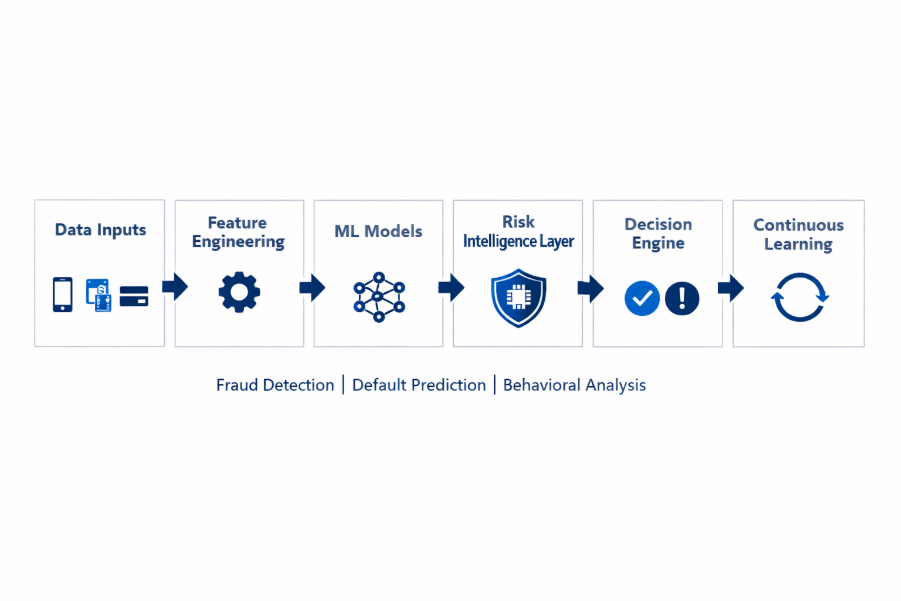
Figure: End-to-End Workflow of Machine Learning in Fintech Risk Analysis
Strategic Benefits: Rethinking Credit Risk and Lending
One of the most transformative areas is AI-driven credit risk assessment.
Traditional lending models rely heavily on linear regression and bureau scores. These approaches assume that risk factors behave in predictable, straight-line relationships. In reality, borrower behavior is rarely linear.
Machine learning models, such as gradient boosting algorithms, work differently. Imagine a panel of experts, each focusing on a small aspect of risk. One expert looks at income volatility. Another analyzes repayment frequency. A third evaluates transaction anomalies. Each expert contributes a partial opinion, and together they form a more accurate conclusion. That is essentially how ensemble models improve decision quality.
Neural networks go a step further. They function like interconnected layers of analysts, where each layer extracts deeper patterns from raw data. While they are more complex, they can capture nonlinear relationships that traditional models miss.
If implemented strategically, a fintech firm could expect:
- Improved approval rates for low-risk customers who were previously misclassified
- Reduced default rates through more granular default prediction
- Faster decision cycles without increasing exposure
This is not about replacing human judgment. It is about equipping risk teams with sharper tools.
Default Prediction, Fraud Detection, and Behavioral Intelligence
1. Default Prediction
Default prediction models powered by ML analyze far more than credit history. They consider transaction variability, seasonal income shifts, repayment timing, and even digital engagement patterns.
If a fintech lender deployed advanced default prediction models today, it could identify early warning signals weeks or months before a missed payment occurs. That enables proactive interventions, such as restructuring options or targeted communication, which reduce losses.
Instead of reacting to delinquency, the firm anticipates it.
2. Fraud Detection
Fraud detection in 2026 demands adaptive intelligence. Fraudsters continuously test systems, searching for blind spots.
Machine learning models excel here because they detect anomalies rather than relying solely on predefined rules. If a pattern deviates from learned normal behavior, even slightly, the system flags it.
For example, a transaction might match the customer’s average spending amount but occur from a device cluster previously associated with mule accounts. A traditional rule engine may miss this. An ML-based fraud detection system recognizes the subtle correlation.
The measurable impact? Higher fraud detection rates with fewer false positives, which directly improves customer trust and operational efficiency.
3. Behavioral Analysis
Behavioral analysis is becoming central to fintech risk modeling. It examines how users interact with platforms: typing speed, navigation paths, session timing, and device switching patterns.
Think of it as digital body language. Just as a human risk officer may sense hesitation or inconsistency in a face-to-face meeting, ML models detect subtle behavioral deviations in digital channels.
If implemented comprehensively, behavioral analysis reduces account takeover incidents and strengthens authentication without adding friction for genuine users.
4. Risk Scoring Accuracy
At the heart of all these applications lies one metric: risk scoring accuracy.
Improved risk scoring accuracy means capital is allocated more efficiently. High-risk customers are identified with greater precision. Low-risk customers are not over-penalized.
For a fintech firm, even a 3 to 5 percent improvement in risk scoring accuracy can translate into significant revenue gains and loss reductions at scale.
The cost of inaction is equally clear. Firms relying on outdated models face higher charge-offs, increased compliance scrutiny, and reputational damage from preventable fraud.
Fintech Evolution in Bengaluru
Bengaluru has emerged as one of the most dynamic fintech innovation hubs globally. With its dense ecosystem of startups, data scientists, and technology providers, it reflects how rapidly financial services are evolving.
In such an environment, competitive advantage is short-lived. Fintech firms that embrace machine learning in fintech risk analysis position themselves as forward-looking institutions. Those that delay risk becoming obsolete.
The shift is no longer experimental. It is structural and strategic.
Conclusion
The financial ecosystem of 2026 does not reward hesitation. Synthetic fraud, deepfakes, and automated attack vectors have redefined what risk looks like. In this environment, machine learning in fintech risk analysis is not a competitive advantage. It is a survival requirement.
Fintech firms that integrate advanced default prediction, fraud detection, and behavioral analysis models across their operations gain sharper insight, stronger resilience, and measurable gains in risk scoring accuracy. Those that delay face compounding exposure and eroding trust.
For businesses to thrive, they need a partner who understands machine learning development company excellence and can translate strategy into scalable systems. Theta Technolabs brings deep expertise across Web, Mobile and Cloud solutions, enabling fintech organizations to modernize their risk engines with confidence and precision.
Elevate Your Risk Strategy
Your risk strategy cannot remain static while threats evolve daily.
If you are evaluating how to implement advanced fintech risk modeling or ai-driven credit risk assessment within your organization, now is the time to act. Whether you need to enhance fraud detection, improve default prediction, or elevate risk scoring accuracy, the right architecture and governance framework are critical.
Connect with Theta Technolabs to discuss your specific implementation roadmap. Our experts in Web, Mobile and Cloud platforms can help you design and deploy scalable machine learning solutions tailored to your regulatory and operational needs.
Start the conversation today at sales@thetatechnolabs.com and move from reactive risk management to predictive intelligence.
Frequently Asked Questions
1. What is machine learning in fintech risk analysis?
Machine learning in fintech risk analysis refers to the use of advanced algorithms that learn from data to assess creditworthiness, detect fraud, predict defaults, and improve risk scoring accuracy without relying solely on static rules.
2. How does ai-driven credit risk assessment improve lending decisions?
Ai-driven credit risk assessment analyzes large volumes of structured and unstructured data, identifying nonlinear patterns that traditional models miss. This leads to better borrower segmentation, lower default rates, and more accurate pricing.
3. Can machine learning reduce fraud without increasing false positives?
Yes. Modern fraud detection models use anomaly detection and behavioral analysis to identify suspicious activity more precisely, which helps reduce unnecessary transaction declines and improve customer experience.
4. Is machine learning suitable for regulated fintech environments?
When implemented with proper governance, model validation, explainability layers, and audit trails, ML-based fintech risk modeling can align with regulatory requirements while improving decision quality.
5. What is the biggest risk of not adopting ML in risk analysis?
The biggest risk is falling behind competitors who achieve higher risk scoring accuracy, lower losses, and better customer trust. In a high-speed fraud landscape, static systems create structural vulnerability.