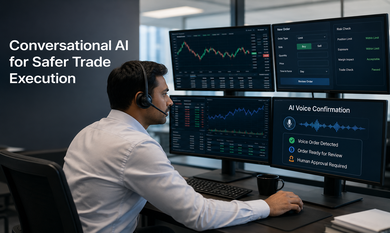


Fintech leaders in 2026 are no longer competing on speed alone. Speed is expected. What separates market leaders now is inference advantage, the ability to interpret complex signals in real time and act with precision before competitors even recognize the pattern.
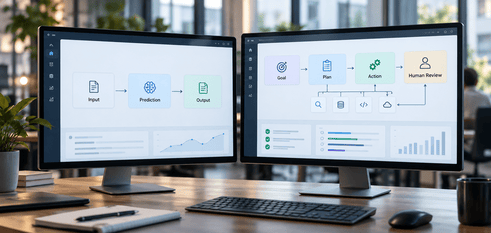
This is where agentic ai in fintech decision-making has moved from innovation labs into live production environments. These systems do not simply execute predefined rules. They reason across variables, plan next-best actions, and act within defined governance boundaries. They evaluate risk, assess trade-offs, and optimize outcomes in motion.
For CEOs, this translates into measurable stability and faster strategic cycles. For CTOs, it means building systems that can think through edge cases without constant human intervention. The conversation is no longer about adopting AI. It is about how operations evolve once autonomy becomes embedded in the core decision engine.
The Shift to Autonomy
Traditional automation followed scripts. If a credit score exceeded a threshold, approve. If a transaction crossed a risk limit, flag. These systems were efficient but static. They required constant updates when markets shifted or regulations changed.
Today’s autonomous financial decision systems operate differently. They continuously evaluate context. They compare historical patterns with live data streams. They simulate multiple possible outcomes before choosing the optimal path. Instead of waiting for manual escalation, they make structured decisions within approved guardrails.
The difference is subtle but powerful. Automation reacts. Autonomy reasons.
In high-volume fintech environments, this shift reduces operational drag. Decision trees no longer need to be rewritten every quarter. Adaptive models refine themselves using performance feedback. Risk parameters evolve based on actual exposure, not assumptions made months earlier.
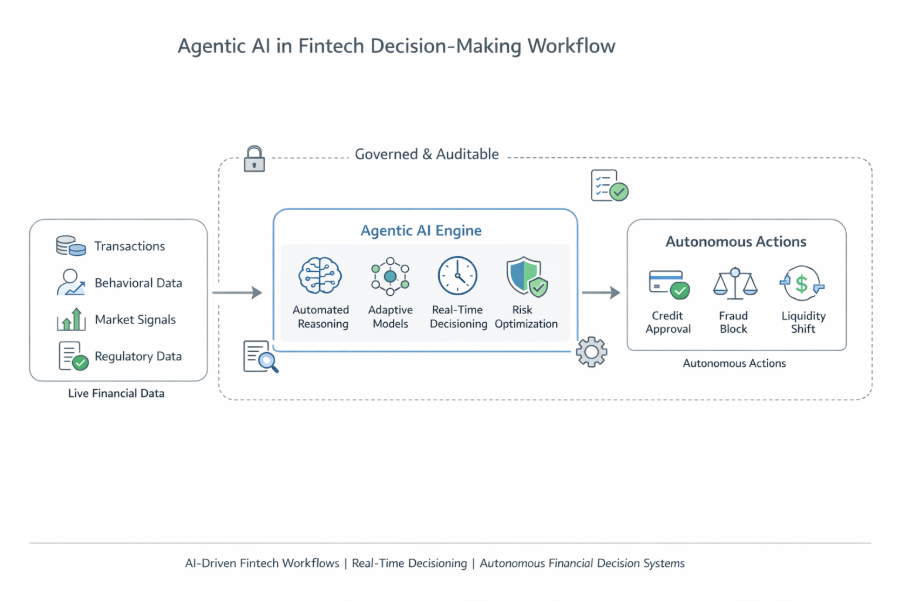
Figure: Agentic AI in Fintech Decision-Making Workflow, illustrating real-time decisioning, adaptive models, and autonomous financial actions under governed control.
Real-Time Decisioning in High-Frequency Credit Underwriting
Imagine a digital lending platform processing thousands of micro-loans per minute. Traditional systems rely on static scoring models and periodic recalibration. When market behavior shifts, approval accuracy declines until models are manually updated.
Now consider a system powered by agentic ai in fintech decision-making. The platform ingests behavioral data, device intelligence, transaction velocity, and regional macro signals in real time. Instead of applying a single risk formula, the system evaluates multiple lending strategies simultaneously.
An applicant’s profile triggers adaptive models that assess repayment probability under various economic scenarios. The system runs automated reasoning checks. If volatility increases in a specific segment, exposure limits adjust instantly. Approval thresholds shift without waiting for executive review meetings.
A micro-case example: A regional lender integrates autonomous underwriting agents. Within three months, default rates drop by 18 percent, while approval rates for low-risk applicants increase by 12 percent. The system identifies micro-patterns in spending behavior that human analysts previously overlooked. Decision latency drops from minutes to milliseconds.
This is real-time decisioning in action. The model does not just score. It interprets and adapts.
Risk Optimization in Volatile Markets
Volatility is no longer an exception. It is the baseline. Payments, cross-border transfers, crypto-linked products, and embedded finance platforms face continuous exposure to market shifts.
In traditional setups, risk teams analyze exposure reports at intervals. By the time action is taken, the opportunity window may have closed.
With adaptive models embedded into ai-driven fintech workflows, risk optimization becomes continuous. The system monitors liquidity positions, counterparty performance, fraud signals, and geopolitical data streams. It simulates impact scenarios before thresholds are breached.
Consider a fintech operating in multiple emerging markets. Currency fluctuations begin accelerating. An agentic system recalibrates hedging strategies in real time. Exposure to specific corridors is temporarily reduced. Pricing models adjust automatically to maintain margin stability.
The executive team does not scramble. Instead, they review a dashboard showing that the system has already implemented mitigation strategies aligned with policy frameworks.
The result is not just reduced losses. It is strategic calm.
Optimizing Workflows Through Automated Reasoning
One of the biggest inefficiencies in fintech has been human drag, the time lost in review loops, escalation chains, and cross-team validation. Even well-designed platforms suffer from fragmented decision flows.
Modern ai-driven fintech workflows integrate automated reasoning across departments. Compliance checks are embedded directly into transaction flows. When a high-risk pattern emerges, the system gathers contextual evidence, runs regulatory alignment tests, and proposes a documented decision path.
For example, in fraud investigation, instead of sending cases to analysts with incomplete context, the system assembles a narrative. It highlights anomaly clusters, cross-references known fraud typologies, and estimates potential loss impact. Analysts validate and refine rather than reconstruct from scratch.
A mid-sized payments company implementing autonomous financial decision systems reports a 40 percent reduction in manual review workload within six months. Analysts shift from repetitive verification tasks to strategic fraud pattern development.
The workflow evolves from reactive queue management to proactive oversight.
Governance and Control in Autonomous Environments
Autonomy does not mean a lack of control. In 2026, regulatory scrutiny remains high, especially in global financial hubs. The strength of agentic systems lies in structured governance frameworks.
Every decision is logged with explainable reasoning layers. Risk parameters are version-controlled. Adaptive model updates are auditable. Boards and regulators can trace how decisions were made and under which constraints.
This transparency transforms how compliance teams operate. Instead of chasing documentation, they access real-time audit trails embedded into the decision engine.
A Global Lens: Dubai’s Fintech Ecosystem
Fintech hubs are rapidly embedding these systems into their digital frameworks. Dubai, for example, continues to strengthen its position as a leading digital finance ecosystem. Financial institutions are increasingly collaborating with specialized technology partners, such as an AI development company in Dubai, to embed autonomous financial decision systems directly into regulated digital infrastructures.
Financial institutions in Dubai are integrating real-time decisioning engines into payment gateways, lending platforms, and digital asset exchanges. Adaptive models align with evolving regulatory guidelines while maintaining transaction velocity.
The focus is not experimentation. It is scalable implementation within secure digital infrastructures.
Frequently Asked Questions
1. How complex is it to implement agentic systems within existing fintech architecture?
Implementation typically begins with a modular integration layer. Core transaction systems remain intact while autonomous agents operate within defined APIs. This phased approach reduces disruption and allows performance benchmarking before full-scale deployment.
2. Are autonomous financial decision systems secure enough for regulated environments?
Yes, provided governance is embedded from the start. Modern implementations include explainable AI layers, audit logging, encryption standards, and role-based access controls. Regulatory alignment is built into workflow design rather than added later.
3. What measurable ROI can leadership expect?
Organizations commonly report reductions in manual workload between 30 to 50 percent, improved risk accuracy, and faster decision cycles. More importantly, revenue stability improves due to real-time risk optimization.
4. How do adaptive models stay aligned with changing market conditions?
Adaptive models retrain on live data streams under supervised oversight. Performance thresholds trigger model recalibration automatically. Human teams review model drift reports instead of rebuilding frameworks from scratch.
5. Will human roles disappear?
No. Roles evolve. Teams move from repetitive rule management to oversight, strategy, and governance. Human judgment remains critical, especially in complex ethical or regulatory scenarios.
Conclusion: The Strategic Imperative
Fintech decision-making in 2026 is defined by autonomy, transparency, and real-time intelligence. Systems that can reason, plan, and act within governed boundaries create a clear inference advantage. They reduce operational friction, sharpen risk optimization, and strengthen competitive positioning across global markets.
Organizations looking to embed agentic ai in fintech decision-making must prioritize scalable architecture, adaptive governance, and tightly integrated digital infrastructure. As a forward-thinking agentic ai development company, Theta Technolabs supports financial institutions in designing and deploying autonomous decision frameworks built for resilience, regulatory alignment, and long-term scalability. With deep expertise across web, mobile and cloud ecosystems, the company enables fintech platforms to remain secure, high-performing and ready for the next wave of digital evolution.
Begin Your Autonomous Transformation
If your fintech organization is preparing to integrate autonomous decision systems into core operations, now is the time to define a structured roadmap.
Connect with the experts at Theta Technolabs to explore implementation strategies tailored to your regulatory and operational landscape.
For inquiries, contact: sales@thetatechnolabs.com
Let’s design decision systems that reason, adapt, and act at the speed of modern finance.