

Why does patient flow keep breaking down even in well-run hospitals, and can technology actually fix it? Ask that question in a Delhi hospital and the answer usually isn't about staffing or effort. It's about visibility. Nobody in the building has a real-time picture of where patients, porters, or free beds actually are, so everyone ends up relying on phone calls and guesswork to fill that gap.
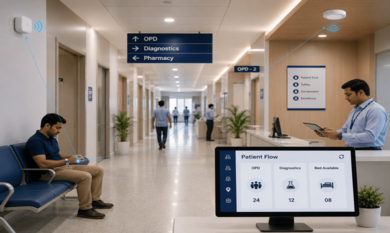
That gap shows up constantly. It's 11 a.m. on a weekday at a mid-sized Delhi hospital. The OPD waiting area is packed, a patient who finished their blood test twenty minutes ago is still trying to find the right corridor to radiology, and a nurse on the third floor is on the phone trying to figure out whether a discharged bed on ward two is ready for the next admission. None of this is unusual. It's simply how most hospitals run day to day, and it's exactly the kind of friction that adds up to longer waits, frustrated patients, and staff who spend more time coordinating than caring for people.
BLE technology in hospitals is starting to change that. Smart patient routing built on Bluetooth Low Energy isn't a futuristic idea anymore. It's a practical way to know where patients, staff, and equipment actually are inside a building, in real time, without adding heavy infrastructure costs.
What BLE Actually Means for Hospital Patient Flow
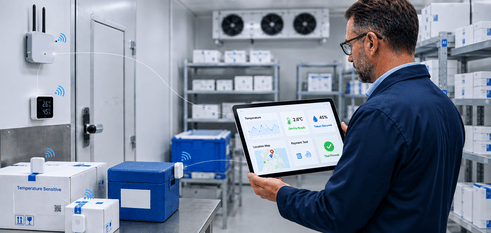
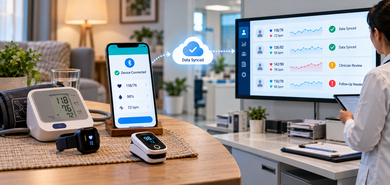
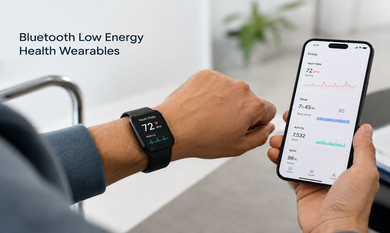
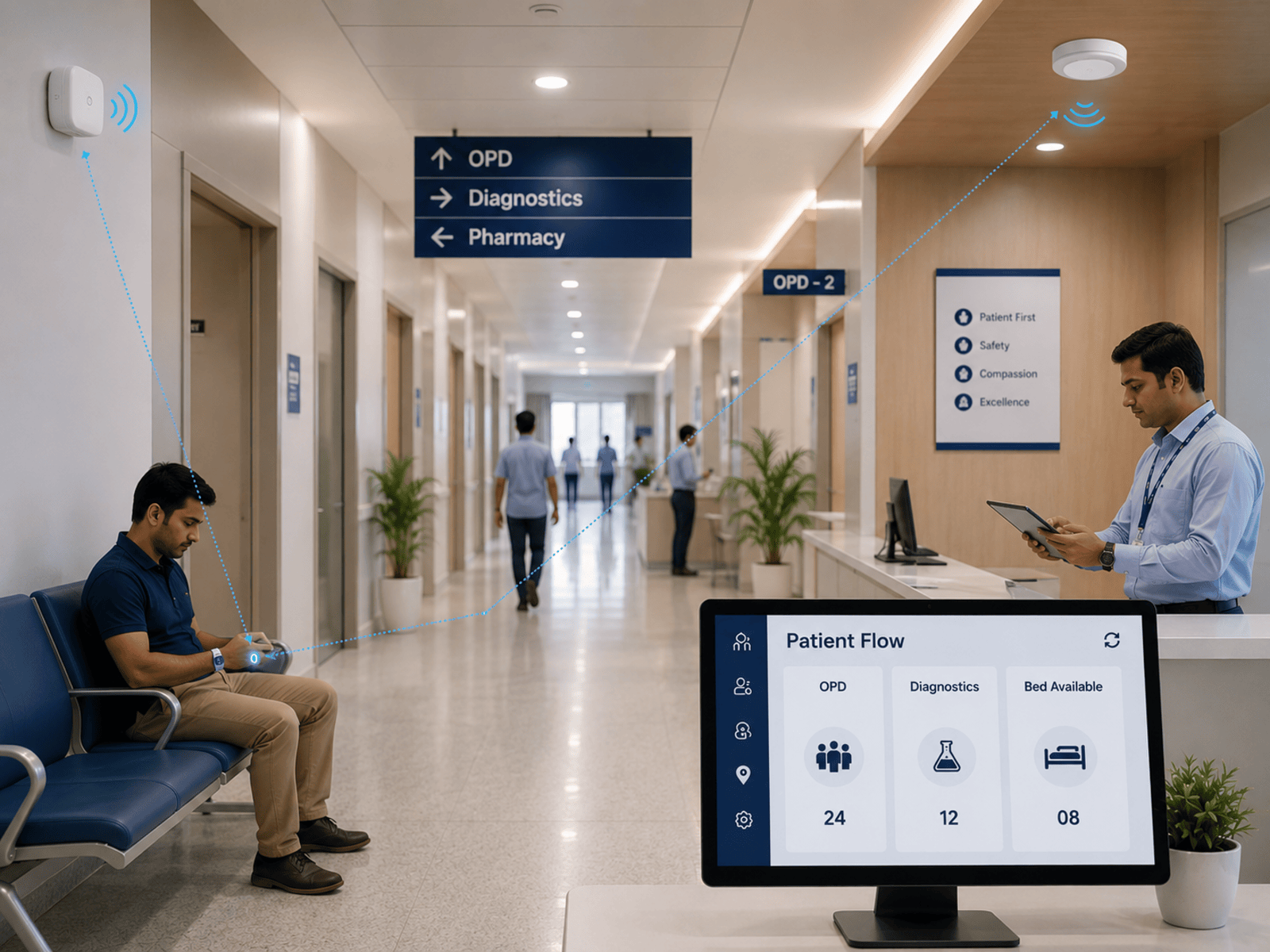
BLE, or Bluetooth Low Energy, is a short-range wireless technology that runs on very little power, the same technology used in fitness bands and smart locks. In a hospital setting, small BLE beacons are placed across departments and corridors, while patients and staff carry a lightweight tag or badge. As a tagged person moves through the building, nearby beacons pick up the signal and pass that location information to a central system.
Unlike RFID, which usually needs readers placed at fixed checkpoints and works best at close range, BLE beacons can cover a wider area with fewer devices, and staff can check the live dashboard from the smartphones and tablets a hospital already owns, while patients and porters carry a dedicated, low-power BLE badge or tag for the actual tracking. That makes it a more workable fit for facilities that want a real-time location system (RTLS) without rewiring the entire building.
It's worth being clear that this involves tracking people's movement inside the building, so how that data is handled matters. In a properly built system, location data is tied to a patient's temporary visit ID rather than their permanent medical record or personal identity, access is limited to the staff who actually need it for coordination, and tracking is covered under the consent a patient already gives at registration rather than treated as a separate, unexplained process. That's a governance decision hospital should raise directly with whoever builds the system, not an afterthought.
In simple terms, connected healthcare devices built on BLE turn a hospital's physical layout into something that can be tracked and managed, rather than something staff have to piece together through phone calls and guesswork.
Where Delhi Hospitals Lose the Most Time in Daily Patient Flow
Hospitals in Delhi deal with a specific set of pressures that make patient flow harder to manage than it looks on paper. Many operate across multiple buildings or floors added on over the years, OPD volumes run high most days, and a large share of patients arrive through referrals, meaning their first stop inside the hospital usually isn't their last.
Three points tend to cause the most delay:
- OPD to diagnostics handoff. A patient sees a doctor, gets sent for a test, and then has to find their own way to a lab or imaging unit that may sit in a completely different wing. Staff have no easy way of knowing whether the patient has actually arrived.
- Ward transfer delays. Moving a patient from the emergency department to a general ward, or between departments for a procedure, often comes down to whether a porter happens to be free at that moment.
- Discharge and bed turnover delays. A bed can sit empty for a while after discharge simply because housekeeping and admissions weren't told at the same time.
These aren't major system failures. They're small gaps that repeat dozens of times a day, and they're the kind of gaps that Delhi hospitals working with an established IoT and BLE development partner are increasingly closing through real-time visibility instead of adding more staff or more paperwork.
How Smart Patient Routing with BLE Actually Works
Smart patient routing takes the three bottlenecks above and replaces guesswork with a live view of where everyone is inside the facility. Here's roughly what that looks like once it's running.
Beacons go up at key points across departments, corridors, and entry points. Patients receive a wristband or badge with a BLE tag at registration, and staff already carry a tag as part of their ID. As people move through the hospital, the system quietly builds a real-time map of who is where. Getting this right does depend on proper beacon placement, since thick walls, lead-shielded rooms like radiology, and dense medical equipment can affect signal accuracy if beacons aren't positioned and tuned carefully, which is why planning beacon density room by room matters more than simply installing more hardware.
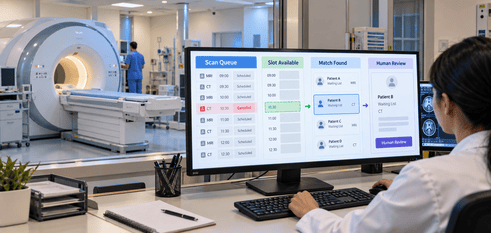
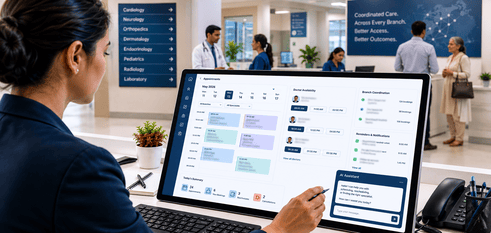
If a patient finishes a test and hasn't moved toward their next stop within an expected window, the system can flag it for staff to check. If a ward needs a porter, the nearest available one can be routed automatically instead of someone making several calls to track one down. If a bed becomes free, housekeeping and admissions can see it right away instead of waiting for a whiteboard to be updated.
None of this replaces clinical judgment or decision-making. It removes the manual coordination layer that currently slows things down behind the scenes. For hospitals building this out, the technical work usually involves proper BLE application development that connects the beacon network to a dashboard staff can actually use day to day, along with integration into the hospital's existing patient management setup so the data doesn't end up sitting in a system nobody checks.
What This Looks Like in Practice
Most hospitals don't roll this out across the whole building on day one, and that's the sensible way to approach it. A phased start usually begins with one high-traffic department, often OPD or diagnostics, where the impact is easier to measure and staff have room to get comfortable with the new workflow before it expands further.
Beacon density depends on the size and shape of the space. A single corridor might only need a handful of beacons, while a busier multi-department floor needs more careful placement to avoid gaps in coverage. Staff training tends to be brief since the system is meant to work quietly in the background rather than give nurses and porters another app to manage.
On cost, BLE infrastructure is generally lighter on the budget than older tracking approaches such as Wi-Fi triangulation or dedicated RFID reader networks, since the beacons themselves are inexpensive and last a long time on battery. The larger investment tends to sit in the software layer connecting beacon data to something staff can actually act on, which is why hospitals often lean on a team that understands both the hospital IT infrastructure side and the day-to-day clinical workflow.
Why This Matters Beyond Wait Times
Better patient flow isn't only about shaving a few minutes off a wait. It plays into patient satisfaction, which feeds into NABH accreditation and a hospital's broader reputation. It also eases the load on staff who currently spend part of their day simply locating people and equipment instead of doing their actual work. And it gives hospital administrators something most don't currently have: a clear, real-time view of how patients move through the building, rather than relying on complaints after the fact to spot where things are breaking down.
According to Kontakt.io, a healthcare RTLS provider, BLE has become the leading technology for hospital location tracking largely because it offers dependable room-level accuracy while often running on infrastructure hospitals already have, such as modern Wi-Fi access points with built-in BLE support, or through dedicated BLE gateways where the existing network doesn't support it natively, which still makes it considerably easier to deploy than older tracking methods.
That mix of accuracy and manageable infrastructure needs is a large part of why hospitals exploring hospital patient flow management, including several looking into digital healthcare solutions in Delhi, are treating BLE-based routing as a realistic near-term project rather than a distant experiment.
Frequently Asked Questions
1. Is BLE technology expensive to implement in a hospital?
Not compared to older tracking systems. BLE beacons are low-cost and long-lasting on battery, so most of the investment goes into the software layer rather than the hardware itself.
2. Is patient location data private and secure?
Yes, when the system is built correctly. Tracking tags are linked to a patient's temporary visit ID rather than their permanent medical record or personal identity, so the location data doesn't sit attached to a patient's file once their visit ends. Hospitals typically fold this into the consent a patient already gives at registration, and the system should be built to collect only the location data needed for coordination, nothing beyond that.
3. How is BLE different from RFID for patient tracking?
RFID usually needs readers at specific checkpoints and works best for close-range detection. BLE beacons cover a wider area and rely on dedicated, low-power badges or tags for reliable tracking rather than staff phones, since a phone's Bluetooth being off or a phone left at a desk would break visibility. Standard smartphones and tablets are still useful on the staff side, mainly for viewing the live dashboard, not for carrying the tracking signal itself.
4. Does BLE patient routing work with existing hospital software?
It can, when it's set up correctly. The beacon data needs to be connected to the hospital's existing patient management system so staff see everything in one place instead of checking a separate tool.
5. How long does it take to roll out BLE-based patient flow in a hospital?
Most hospitals start with one department, which can typically be set up within a few weeks. A full rollout across multiple departments takes longer and depends on the size of the facility, but starting small means the benefits show up early instead of waiting for one large launch.
Getting Started
Patient flow problems rarely come from one dramatic cause. They're usually a series of small coordination gaps that build up over the course of a day. Bed turnover optimization and smarter routing through BLE address those gaps directly, without asking hospitals to overhaul systems they already rely on. At Theta Technolabs, this is the kind of practical, workflow-first fix we build for hospitals rather than a one-size-fits-all deployment.
If your hospital is looking at OPD wait time reduction, faster bed turnover, or simply wants a clearer view of how patients actually move through your facility, it's worth talking through what a phased BLE rollout could look like for your specific layout. Reach out to us at sales@thetatechnolabs.com to start that conversation.