Medical equipment suppliers in Bengaluru work in a fast-moving healthcare environment where hospitals, clinics, diagnostic centers, and service teams often need quick access to the right equipment at the right time. A delayed stock update, missing device, expired consumable, or wrong availability status can affect order fulfillment and customer trust. This is why IoT analytics in healthcare is becoming useful for businesses that want better control over inventory operations.
India’s medical devices sector is also expanding, supported by growing healthcare demand, medical device parks, and investment opportunities highlighted by Invest India. This growth creates more pressure on suppliers to manage inventory, equipment movement, and service readiness with better digital systems. For smart inventory for medical equipment suppliers, IoT analytics can connect warehouse data, device movement, alerts, and forecasting into one real-time decision-making system. (Invest India)
Inventory Challenges Medical Equipment Suppliers Face in Bengaluru
Medical equipment suppliers in Bengaluru often manage different types of inventory, including diagnostic equipment, monitoring devices, surgical accessories, spare parts, consumables, rental units, demo devices, and repair stock. When this data is handled through manual entries or disconnected systems, inventory decisions become reactive.
Common challenges include:
- Manual stock updates across warehouses and teams
- Delayed visibility into available medical equipment
- Stock mismatch between system records and actual inventory
- Overstocking of slow-moving products
- Shortage of high-demand equipment or consumables
- Difficulty tracking demo, rental, repair, and returned equipment
- Missed expiry, warranty, calibration, or maintenance dates
- Poor healthcare supply chain visibility across locations
For medical equipment suppliers in Bengaluru, these problems can directly affect fulfillment speed, cash flow, and hospital relationships. The issue is not only about storing products. It is about knowing where every important item is, whether it is ready to use, and when it needs action.
How IoT Analytics Improves Healthcare Inventory Management
IoT inventory management in healthcare uses connected technologies such as RFID tags, BLE beacons, barcode systems, sensors, cloud platforms, and analytics dashboards to collect real-time inventory data. Instead of waiting for manual updates, suppliers can track stock movement, equipment status, and warehouse activity through connected systems.
A medical equipment tracking system using IoT can help suppliers monitor:
- Stock availability
- Equipment location
- Product movement
- Low-stock status
- Maintenance due dates
- Expiry and warranty alerts
- Demand forecast data
- Items under repair, demo, rental, or return
This turns inventory management from a manual reporting activity into a continuous visibility system. Suppliers planning connected inventory transformation can use IoT development services to connect RFID data, warehouse software, device movement, alerts, and dashboards into one platform.
The workflow below shows how IoT-enabled inventory systems connect stock data, tracking technologies, dashboards, and forecasting into a smarter fulfillment process.
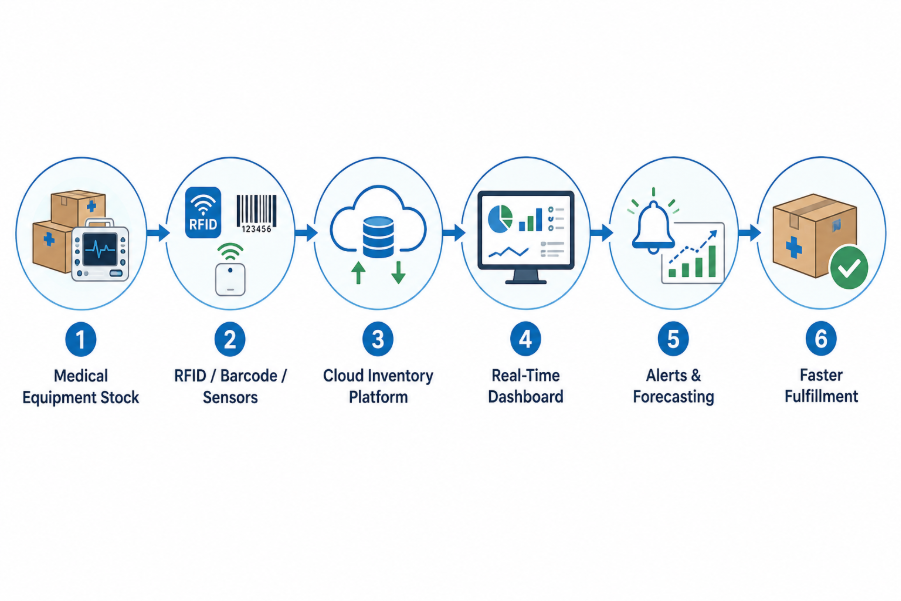
Figure: IoT-based smart inventory workflow for medical equipment suppliers
Real-Time Equipment Tracking Across Warehouses, Hospitals, Repairs, and Returns
Medical equipment does not always stay inside one warehouse. It may move between multiple points before it returns to stock or reaches the next customer. This is where real-time medical equipment inventory tracking becomes valuable.
A supplier may need to track equipment across:
- Central warehouse
- Branch warehouse
- Hospital client location
- Demo site
- Rental location
- Repair center
- Return inventory
- Field technician
With RFID and IoT asset tracking in healthcare, suppliers can reduce misplaced assets and improve dispatch planning. For example, if a hospital urgently needs a patient monitor or diagnostic device, the supplier should know whether the item is available, under repair, already dispatched, or placed at another client site.
This level of healthcare supply chain visibility helps teams avoid wrong commitments and improves service reliability.
Real-World Scenario: How Smart Inventory Can Support a Medical Equipment Supplier
Consider a medical equipment supplier in Bengaluru that serves hospitals, clinics, and diagnostic centers across different locations. The company manages patient monitors, diagnostic devices, surgical accessories, spare parts, and demo equipment. Earlier, the team depended on manual updates, phone calls, and warehouse records to confirm availability.
With an IoT-enabled inventory system, each high-value item can be tracked through RFID, barcode, or sensor-based data. The warehouse team can check whether equipment is available, dispatched, under repair, placed at a demo site, or ready for delivery. Managers can also view low-stock alerts, maintenance schedules, and demand trends from a centralized dashboard.
This kind of setup can help suppliers reduce confusion, improve dispatch planning, and respond faster to urgent hospital requirements without depending only on manual follow-ups.
Predictive Inventory Analytics for Demand Forecasting and Reorder Planning
Inventory planning becomes stronger when suppliers can study demand patterns instead of depending only on past assumptions. Predictive inventory analytics for healthcare helps suppliers understand which products are moving quickly, which items are slow-moving, and which categories need faster replenishment.
For medical equipment suppliers, this can support:
- Demand forecasting based on hospital order history
- Identification of fast-moving and slow-moving products
- Reorder level planning
- Seasonal demand planning
- Emergency stock planning
- Better purchase decisions
- Reduced dead stock
With predictive IoT analytics solutions, suppliers can study stock movement, hospital demand, reorder patterns, and delivery pressure before shortages affect fulfillment. This does not mean the system will predict every requirement perfectly. But it can help teams make better decisions with real usage and movement data.
Smart Alerts for Expiry, Warranty, Calibration, and Maintenance
Healthcare inventory is not only about counting products. Medical equipment and related supplies often need condition tracking, service readiness, and lifecycle monitoring. WHO highlights that medical devices support diagnosis, treatment, monitoring, and rehabilitation. It also explains that proper availability and management of medical devices are important for patient outcomes. (World Health Organization)
For smart inventory for medical equipment suppliers, IoT-enabled alerts can help track:
- Low-stock items
- Expiry dates
- Warranty deadlines
- Calibration schedules
- Preventive maintenance
- Service due dates
- Damaged or returned equipment
- Temperature deviation for sensitive stock
These alerts reduce dependency on manual follow-ups. They also help suppliers avoid situations where equipment is technically available in inventory but not ready for delivery because it needs service, calibration, or documentation.
What a Smart IoT Inventory Dashboard Should Show
A smart IoT inventory dashboard helps medical equipment suppliers view stock availability, equipment location, low-stock alerts, expiry risks, maintenance status, and demand trends from one system.
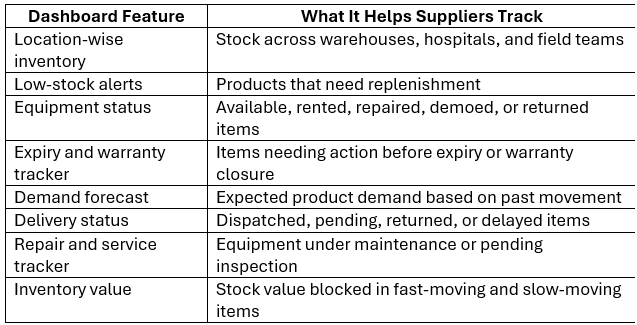
An IoT analytics dashboard for healthcare should be simple enough for operations teams and detailed enough for decision-makers. The goal is not to overload users with data. The goal is to show the right inventory insight at the right time.
Why Bengaluru Healthcare Suppliers Need Localized IoT Inventory Systems
Bengaluru has a strong healthcare and health-tech ecosystem, including hospitals, diagnostic centers, clinics, startups, and medical distributors. For suppliers serving this market, demand may come from multiple locations in a short time. A manual inventory process can slow down dispatch decisions and create confusion between warehouse, sales, service, and delivery teams.
IoT solutions for healthcare suppliers in Bengaluru should be designed around local operating realities. Suppliers may need location-wise stock visibility, faster dispatch planning, field team coordination, and better tracking of equipment movement across client sites. A localized system can help them respond faster without depending only on phone calls, spreadsheets, or delayed reports.
Data Security and Compliance Considerations for Healthcare IoT Systems
Connected healthcare systems need security planning from the beginning. Even if an inventory platform does not store patient records, it may still manage device data, supplier records, hospital-related information, service history, and operational workflows.
Important security practices include:
- Role-based access
- Data encryption
- Secure APIs
- Device authentication
- Cloud security
- Audit logs
- User permission controls
- Regular system updates
For secure healthcare IoT systems, security should be built into the platform from the start. This helps protect connected device data, reduce unauthorized access, maintain reliable system performance, and support safer inventory operations across warehouses, field teams, and healthcare clients.
Business Benefits of IoT Analytics for Medical Equipment Suppliers
The value of IoT analytics in healthcare comes from better visibility, faster decisions, and fewer manual gaps. For suppliers, the business impact can be seen across warehouse operations, purchase planning, dispatch, and customer service.
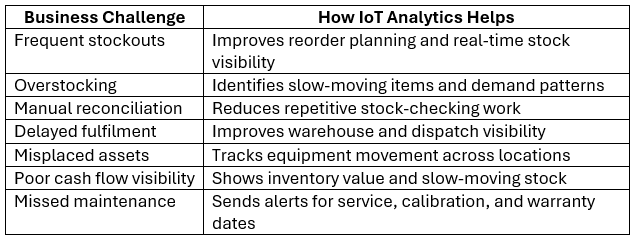
These benefits should be viewed as practical improvements, not guaranteed outcomes. A well-designed system can help reduce errors, improve planning, and support better decision-making, but results depend on implementation quality, data accuracy, team adoption, and integration with existing workflows.
How Medical Equipment Suppliers Can Start with IoT Inventory Transformation
Suppliers do not need to digitize everything at once. A phased approach is often more practical.
- Identify high-value, fast-moving, and expiry-sensitive inventory.
- Map warehouse, dispatch, repair, rental, demo, and return workflows.
- Choose tracking methods such as barcode, RFID, BLE, or sensors.
- Connect inventory data to a centralized cloud dashboard.
- Add alerts for low stock, expiry, maintenance, calibration, and warranty.
- Use analytics for demand forecasting and reorder planning.
- Integrate with ERP, CRM, or warehouse software if required.
A reliable healthcare software development company can help suppliers design a secure platform that connects inventory, warehouse, delivery, and analytics workflows. This is especially useful when standard software does not match the supplier’s actual operating process.
How Theta Technolabs Can Help Healthcare Suppliers Build Smart Inventory Systems
Medical equipment suppliers need inventory systems that match how their teams actually work. A standard platform may not always support rental equipment, demo units, repair stock, field movement, warehouse updates, alerts, and supplier-specific reporting in one place.
Theta Technolabs can help healthcare suppliers build custom IoT-enabled inventory systems for better visibility and control. The solution can be designed around real supplier workflows instead of forcing teams to adjust to a rigid platform.
The team can support:
- Custom IoT inventory platforms
- RFID, BLE, barcode, and sensor integration
- Web dashboards for decision-makers
- Mobile apps for warehouse and field teams
- Cloud-based inventory systems
- Predictive analytics and reporting
- Secure healthcare software development
- ERP, CRM, and third-party system integrations
For IoT solutions for healthcare suppliers in Bengaluru, this approach can help connect inventory data, field activity, warehouse movement, and business reporting into one practical system.
Frequently Asked Questions
What is IoT analytics in healthcare inventory management?
IoT analytics in healthcare inventory management uses connected devices, RFID tags, barcode systems, sensors, cloud platforms, and dashboards to track stock movement in real time. It helps medical equipment suppliers monitor availability, location, usage, alerts, and demand trends from one connected system.
How does IoT help medical equipment suppliers manage inventory?
IoT helps medical equipment suppliers improve inventory visibility by tracking equipment movement across warehouses, hospitals, repair centers, demo sites, and field teams. It can reduce manual tracking, improve stock accuracy, send low-stock alerts, and support faster fulfillment for healthcare clients.
Why do medical equipment suppliers in Bengaluru need smart inventory systems?
Medical equipment suppliers in Bengaluru often serve hospitals, clinics, diagnostic centers, and healthcare businesses across multiple locations. A smart inventory system helps them manage urgent demand, track equipment availability, reduce stock gaps, and coordinate better between warehouse, sales, service, and delivery teams.
What features should a healthcare inventory dashboard include?
A healthcare inventory dashboard should include location-wise stock visibility, low-stock alerts, equipment status, expiry and warranty tracking, repair status, delivery updates, demand forecasts, and inventory value. These features help suppliers make faster decisions and manage healthcare supply chain visibility more effectively.
Conclusion
Medical equipment suppliers in Bengaluru need more than manual stock updates to manage fast-moving healthcare inventory. With hospital demand, equipment movement, service schedules, and stock availability becoming more time-sensitive, real-time visibility is now important for better planning and fulfillment.
IoT analytics in healthcare helps suppliers monitor inventory, track equipment movement, forecast demand, reduce stock gaps, and improve healthcare supply chain visibility. For smart inventory for medical equipment suppliers, the real value comes from better control, faster decisions, and stronger coordination across warehouses, field teams, and healthcare clients.
Improve Inventory Control Across Healthcare Supply Chains
If your healthcare supply business wants to improve inventory visibility, reduce manual tracking, or build a connected equipment monitoring platform, Theta Technolabs can help you design a practical IoT solution around your workflow.
From IoT-based inventory tracking and healthcare dashboards to mobile apps, cloud platforms, and predictive analytics, the solution can be built to match how your teams manage stock, equipment movement, and daily operations.
To discuss your smart inventory system, contact Theta Technolabs at sales@thetatechnolabs.com