

Getting a trade license for a telehealth business in Dubai takes a few weeks. Getting the platform behind it approved to actually touch patient data is a different problem altogether, and it's the one that catches most founders off guard.
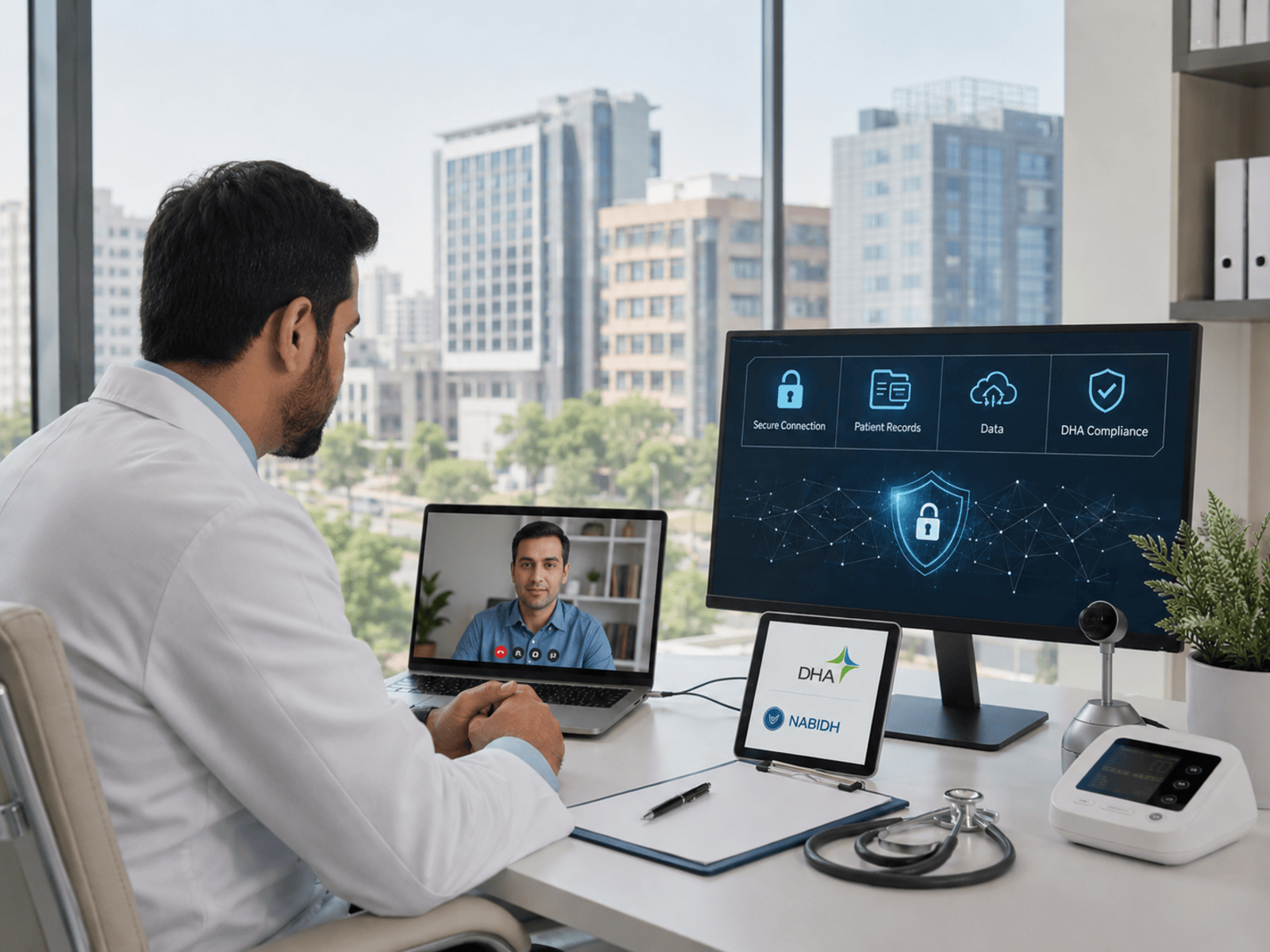
Here's the real issue: a DED commercial license tells the government you're allowed to run a business. It says nothing about whether your app is allowed to store a patient's blood test results, run a video consultation, or send a prescription to a pharmacy. That approval comes from the Dubai Health Authority, and it's earned through the architecture of the platform itself how data is hosted, how identity is verified, how records move between systems.
This guide walks through what that actually involves, in plain terms. By the time you're done reading, you'll know what DHA checks for, why NABIDH integration isn't optional, and where most first-time builds run into trouble before they ever reach an audit.
The Regulatory Foundation You're Actually Building On
Before any line of code gets written, it helps to know which rules you're building to, because "DHA compliant" isn't one checkbox; it's a stack of requirements from a few different sources.
DHA telehealth framework licensing itself works on two levels. There's facility-level licensing, which covers your platform and business as a whole, and individual practitioner licensing, which means every doctor consulting through your app needs their own DHA professional license. You can have a perfectly engineered platform and still be unable to operate if the doctors on it aren't individually licensed.
Underneath that sits the UAE Health Data Law (Federal Law No. 2 of 2019), which is the piece that actually dictates where patient data can live. In short: health data generated in the UAE has to be hosted inside the UAE, and cross-border transfer is generally prohibited unless a health authority grants a specific exception. This is not a soft guideline; it's the single most common reason platforms fail their DHA review, because teams default to whatever cloud region is cheapest or most familiar rather than checking residency rules first.
Layered on top is Federal Decree-Law No. 45 of 2021, the UAE's federal personal data protection law, which governs consent, data handling, and retention more broadly. It's broadly similar in spirit to GDPR, so if your team has built for European markets before, the concepts will feel familiar even if the specifics differ.
One more thing worth clarifying early, because it trips people up constantly: DHA governs healthcare in the Emirate of Dubai specifically. Abu Dhabi runs its own system through the Department of Health (DOH), with its own health information exchange called Malaffi instead of NABIDH. If your platform ever expands beyond Dubai, you're not just adding users; you're adding a second regulatory framework.
The Technical Pieces DHA Actually Inspects
This is where the guide gets practical, because compliance on paper and compliance in your codebase are two different things.
Data hosting. Every database, backup, log file, and failover server holding patient information needs to sit on UAE-region cloud infrastructure think AWS Middle East or Azure UAE, not a US or European region. On top of that, DHA expects strong encryption for patient data security telehealth AES-256 for data sitting at rest and TLS 1.3 for data moving between the app and your servers. In plain terms: even if someone got physical access to your storage or intercepted network traffic, the data would be unreadable without the right keys.
Identity verification. Patients need to be who they say they are before a consultation starts, and in the UAE this typically involves verifying identity against Emirates ID, often through the UAE PASS digital identity system that many government and healthcare services rely on. This isn't just a compliance checkbox; it's what lets a doctor trust the person on the other end of the video call is actually the patient in the record.
The consultation engine itself. Video and audio consultations typically run on WebRTC, which is the standard most secure video platforms are built on. DHA cares about session logging here; every consultation needs an audit trail, and if a session is recorded, the platform needs explicit, documented patient consent captured before recording starts, not buried in a terms-of-service page nobody reads.
Language. Arabic and English support isn't a nice-to-have for the UAE market DHA effectively treats it as a baseline expectation, including right-to-left layout support in Arabic, not just translated text dropped into an English-first design.
Getting this layer right is genuinely most of the healthcare app development effort on a telehealth build. It's also where a lot of budget gets spent redoing work that should have been designed correctly from the start.
Connecting to NABIDH - Why It's Mandatory
NABIDH integration is Dubai's health information exchange platform, run by DHA, that connects hospitals, clinics, and licensed telehealth platforms across the Emirate so a patient's records can move securely between the providers treating them.
If your telehealth app handles clinical data, connecting to NABIDH isn't optional it's how a patient's consultation notes, lab results, and prescriptions become visible to their other doctors, and how you stay inside DHA's interoperability rules. Technically, this connection runs on HL7 FHIR healthcare integration standards, which are the common languages healthcare systems use to describe things like admissions, clinical notes, and diagnostic history in a structured, machine-readable way, so that two completely different pieces of software can understand the same patient record.
There's also a consent layer built into this. Your platform's interface needs to let patients explicitly opt in or out of having their data shared through NABIDH, and that choice has to be recorded, not assumed.
Before any of this goes live, DHA requires testing through the NABIDH sandbox — a safe testing environment where you validate that your data formatting, authentication, and record transmission actually work correctly before a real audit happens. Skipping proper sandbox testing, or rushing through it, is one of the most common reasons platforms get sent back for rework.
Clinical Workflows: Prescriptions and Insurance
Beyond infrastructure, a telehealth platform development Dubai project has to support how care actually gets delivered and paid for.
E-prescriptions need to route through DHA-approved prescription systems, and there's a hard line here worth knowing early: DHA's own telehealth standards state that controlled, semi-controlled, and narcotic medications cannot be prescribed or dispensed through telehealth services at all. Non-controlled medications can generally be prescribed through a virtual consultation. This isn't a gray area to design around it needs to be built as a hard constraint in your system logic.
On the payment side, insurance claims and pre-authorizations for virtual consultations typically route through eClaimLink, DHA's electronic claims platform used across Dubai's healthcare sector. If your platform supports insured patients, this integration determines whether a consultation actually gets reimbursed, which matters as much to your business model as it does to the patient experience.
The Realistic Path to Launch
Most teams that get through telemedicine licensing Dubai approval smoothly follow roughly this sequence:
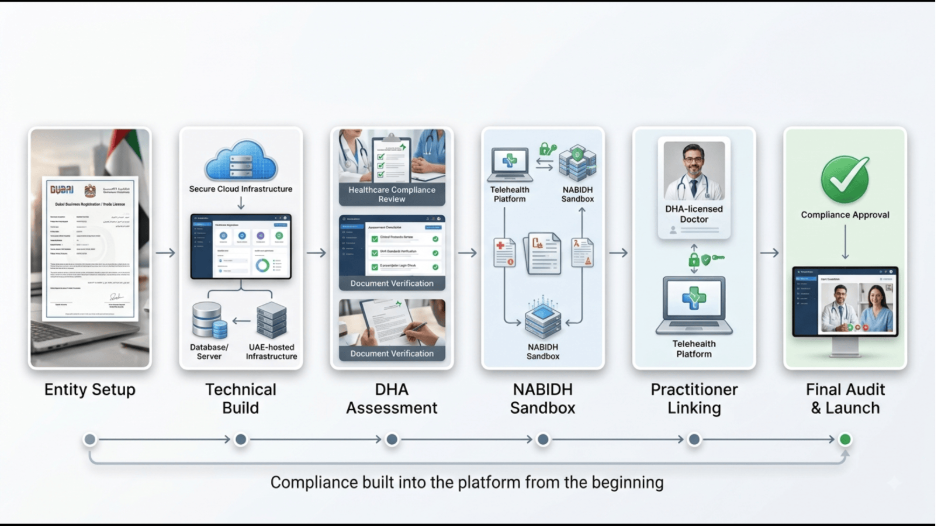
Figure: Six-step workflow for launching a DHA-compliant telehealth platform in Dubai
- Entity setup — securing your DED or free zone trade license
- Technical build — development on properly configured, UAE-hosted infrastructure from day one
- DHA initial assessment — facility-level review of your platform and documentation
- NABIDH sandbox certification — validating your data exchange before going live
- Practitioner linking — connecting DHA-licensed doctors to the platform
- Final audit and launch — DHA's last review before you can operate
Timelines vary a lot depending on how complete your architecture is going in. Teams that treat compliance as part of the initial build tend to move through this faster than teams that build first and try to retrofit compliance afterward.
Where Builds Actually Go Wrong
A few patterns show up again and again in platforms that get sent back for rework:
- Hosting live data, backups, or logs outside the UAE, usually because a team defaults to a familiar cloud region instead of checking residency rules first
- Requesting a DHA audit without properly completing NABIDH sandbox testing first
- Treating Arabic language support as a translation task instead of a proper localized build, including layout direction
- Weak or missing role-based access control, so staff can see more patient data than their role actually requires
Every one of these is avoidable, and every one of them is far cheaper to fix at the design stage than after the platform is already built.
How We Approach This
At Theta Technolabs, we build DHA-compliant telehealth platform projects with compliance treated as part of the architecture from the first sprint, not something bolted on before an audit. On the technical side, we typically work with Node.js for backend services that need to handle NABIDH's data exchange reliably, Flutter for cross-platform mobile apps that need to run consistently for both patients and doctors, and Angular for admin and provider-facing web dashboards that need to be fast and secure.
Alongside the compliance layer, we also build in practical AI where it genuinely helps things like smarter appointment scheduling or automated documentation support without letting it get in the way of the core clinical workflow. This is where our work as an AI-powered healthcare solutions Dubai partner ties directly into the compliance side of a build, rather than sitting on top of it as an afterthought.
If you're evaluating a healthcare app development company in Dubai for a telehealth project and want to talk through what your specific build would actually require, reach us at sales@thetatechnolabs.com.
Frequently Asked Questions
1. What does DHA require for a telehealth platform to be compliant?
At minimum, DHA requires UAE-based data hosting, strong encryption standards, NABIDH interoperability through HL7/FHIR, patient consent management, and proper facility and practitioner licensing.
2. What is NABIDH and do I need to integrate with it?
NABIDH is Dubai's health information exchange, run by DHA. If your platform handles clinical data - consultation notes, prescriptions, diagnostic history; integration is required, not optional.
3. Can I tele-prescribe controlled medications in Dubai?
No. DHA's telehealth standards explicitly prohibit prescribing or dispensing controlled, semi-controlled, and narcotic medications through telehealth services; non-controlled medications can typically be prescribed through a virtual consultation.
4. How long does DHA certification take?
It depends heavily on how compliance-ready the platform's architecture is going into the review. Platforms built with UAE hosting, NABIDH integration, and proper consent flows from the start tend to move through certification considerably faster than platforms trying to retrofit these requirements later.