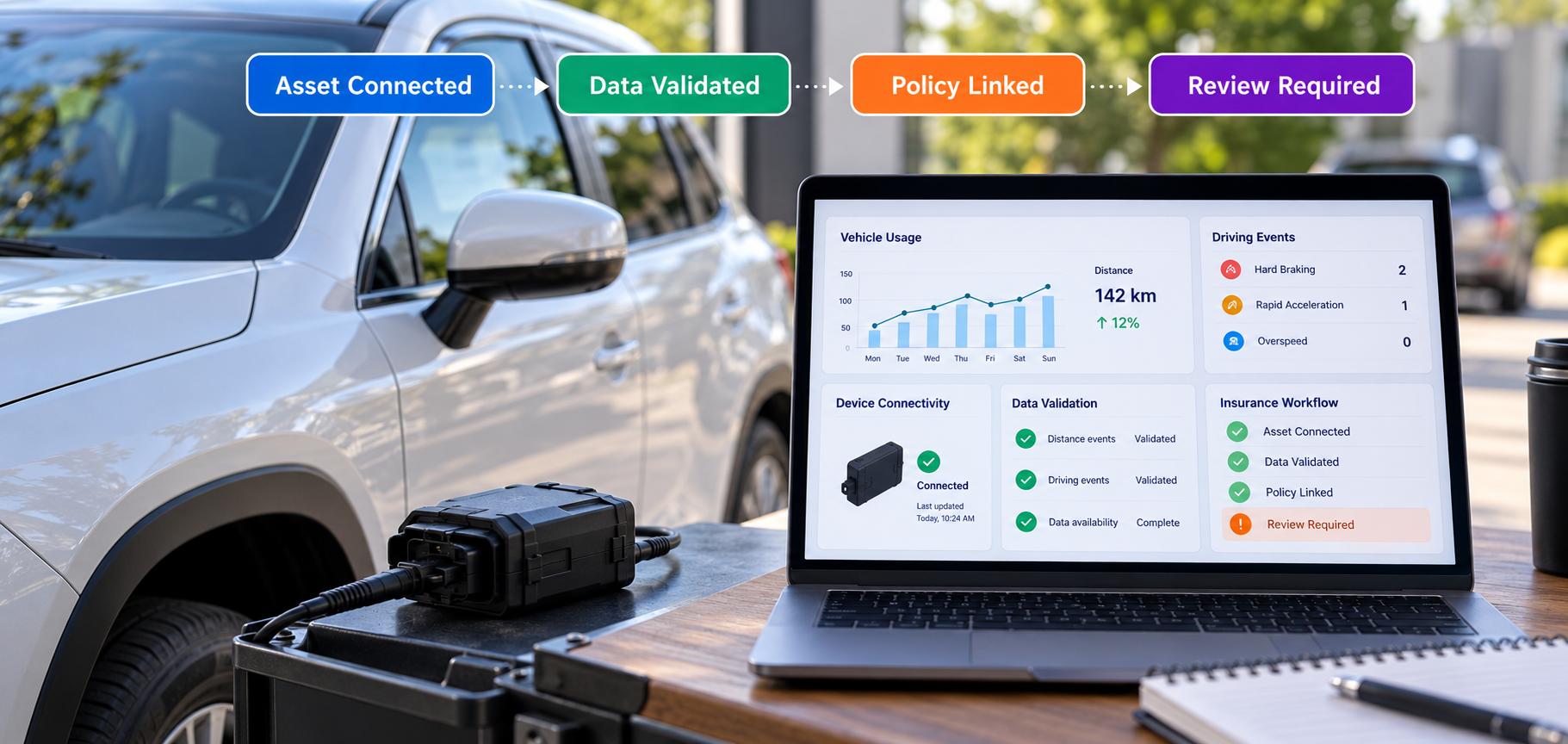


A usage-based insurance platform becomes useful only when the data coming from vehicles or other connected assets can be trusted, linked to the correct policy, and converted into controlled insurance inputs. Raw telemetry by itself is not enough.
For teams planning usage-based insurance software development, the real design problem is connecting connected asset data with policy, pricing, review, and audit workflows.
What Connected Asset Data Means for Usage-Based Insurance
Usage-based insurance commonly relies on information captured from connected vehicles, onboard devices, mobile apps, or telematics systems. The National Association of Insurance Commissioners telematics guidance notes that UBI can use connected cars, OBD devices, and mobile applications, with data such as mileage, time of day, GPS location, acceleration, braking, and cornering.
An insurance telematics platform should therefore be able to receive information from more than one source. The platform should not assume that every policy will depend on the same hardware or provider.
Raw connected vehicle data should not move directly into pricing logic. It first needs to be checked, normalized, and converted into approved insurance signals.
For example, pay as you drive insurance may rely mainly on verified distance or usage during a defined period. Pay how you drive insurance may also consider permitted behavioral indicators. The exact inputs depend on product design, customer consent, regulatory requirements, and the insurer's approved rating approach.
The Core Architecture of a Usage-Based Insurance Platform
A practical usage-based insurance architecture separates device connectivity from insurance logic.
A typical flow is:
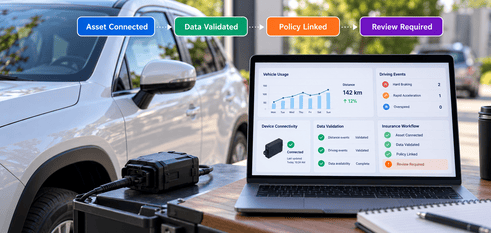
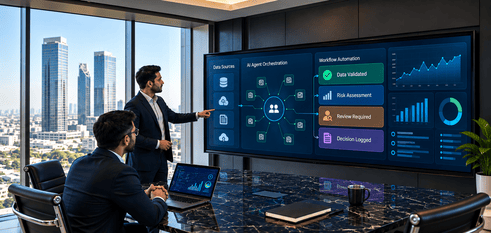
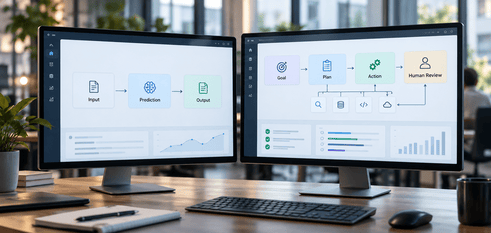
Connected Asset → Data Ingestion → Identity Mapping → Validation → Normalization → Usage or Risk Logic → Insurance Rules → Policy Workflow → Review and Audit
Secure Ingestion from Multiple Connected Sources
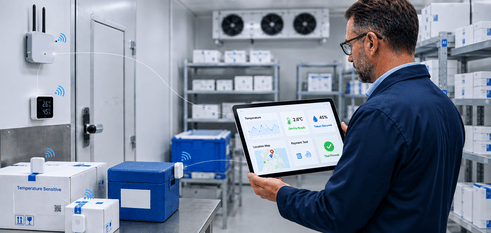
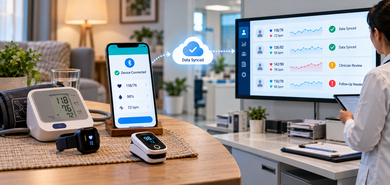
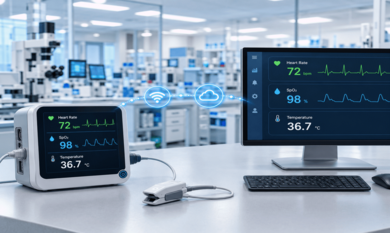
Data may arrive through OEM APIs, IoT gateways, mobile applications, telematics services, or event streams. The ingestion layer should accept these sources without making the core insurance application dependent on one device vendor.
A telematics data platform can standardize incoming events before they reach policy systems. This is where IoT platform development becomes important. Connectivity, APIs, device management, and data processing can be handled as a dedicated layer rather than being mixed directly into insurance rules.
Map the Device, Asset, Customer, and Policy
Device identity is not the same as insurance identity. A platform may need to maintain a relationship such as:
Device ID → Asset ID → Customer ID → Policy ID
These relationships can change when a device is replaced, ownership changes, a policy renews, or a telemetry provider changes. Keeping mapping history helps associate events with the correct policy period.
Validate and Normalize Incoming Events
Connected systems should expect imperfect data. Validation rules can check for missing fields, duplicate events, unexpected timestamps, inconsistent units, delayed records, and values outside expected operating ranges.
Normalization then converts provider-specific formats into a common internal structure. This gives downstream insurance services one consistent event format even when multiple data providers are involved.
Turning Asset Events into Insurance Product Inputs
An IoT insurance platform should not send every sensor reading directly into policy or pricing systems. It should first create derived signals that have a clear insurance purpose.
For a motor UBI product, these may include verified mileage for a defined period, usage frequency, driving-event summaries, or approved behavioral indicators. A connected commercial asset product might use operating hours or another permitted usage measure. The product team should define exactly which signals are needed before engineering teams build the ingestion logic.
The telemetry layer and insurance rule layer should also remain separate.
The telemetry layer understands devices, timestamps, asset events, connectivity, and normalized data. The insurance layer understands policy terms, product configuration, rating rules, eligibility, exceptions, and review requirements.
This separation is useful in fintech software development because device integrations and insurance product rules can change at different times. A new telematics provider should not require a rewrite of rating logic, and a product-rule update should not require changes to every device connector.
What Happens When Connected Data Is Incomplete?
Missing telematics data should be treated as an exception, not automatically interpreted as low usage.
A device can go offline, a mobile app may lose permission or connectivity, events can arrive late, and two systems may send the same record. A device-to-policy mapping can also become invalid during a policy period. In some cases, repeated unexplained device disconnections or permission changes may also need to be reviewed as possible tampering or data-integrity issues.
The platform therefore needs explicit handling for incomplete or uncertain data. A practical process is to flag the affected period, apply the insurer's approved fallback rule where one exists, record why it was used, and route uncertain or repeated disconnect patterns for review. Depending on the insurance product, the approved fallback may use standard pricing or another predefined treatment rather than treating missing data as verified low usage.
A missing reading is not the same as a verified reading of zero activity, so the platform should preserve that distinction.
It should also retain processing history, including the data source, connectivity status, processing result, applied rule, fallback use, and review status. This supports troubleshooting, auditability, and investigation of unusual patterns such as repeated disconnects or unexpected data gaps.
Connect the Data Layer with the Insurance Workflow
Once usage signals are validated, they can feed controlled insurance processes. Depending on the product, this may include rating calculations, usage-based discounts, renewal analysis, eligibility checks, customer dashboards, underwriting review, or exception queues.
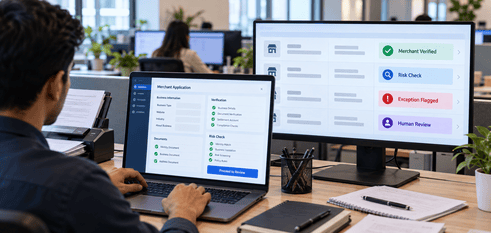
Raw IoT data should not be treated as an automatic final insurance decision. It is better to use validated signals as inputs to approved business rules, with review where the product or regulatory process requires it.
Building a Usage-Based Insurance Platform for InsurTech
For teams evaluating InsurTech software development in Hyderabad, the first design decision should not be which dashboard to build. It should be which connected data is actually required by the insurance product and how that data will move into existing policy workflows.
The technical scope may include telematics or OEM integrations, APIs, event processing, asset-to-policy mapping, secure cloud storage, configurable rules, customer and operations dashboards, and audit logs.
For Hyderabad-based InsurTech teams, IoT & BLE solutions in Hyderabad can support the device connectivity and data-processing layer, but the architecture should also define how telemetry is validated, normalized, and connected with insurance business logic.
For projects requiring IoT development services in Hyderabad, integration planning should also cover data ownership, permissions, retention, error handling, and security controls.
A Practical Build Sequence for a UBI Product
A UBI product is easier to develop when the insurance requirements are defined before the device architecture.
- Define the insurance product first. Decide which usage signals affect pricing, eligibility, discounts, or review.
- Confirm the available data sources. Identify the OEM API, mobile app, telematics device, fleet system, or other approved source.
- Create the identity model. Define how device, asset, customer, and policy records are related over time.
- Define a normalized event structure. Convert provider-specific messages into one internal data format.
- Create validation and exception rules. Decide how the system should treat late, missing, duplicate, or conflicting data.
- Integrate approved signals with insurance rules. Keep telemetry processing separate from product and policy logic.
- Add monitoring and auditability. Record source, processing result, applied rule, exception status, and review activity.
Frequently Asked Questions
What data is used in usage-based insurance?
It depends on the product and permitted data sources. Common inputs can include mileage, time-based usage, location-related data, acceleration, braking, and other driving events. Insurers should collect only what the approved product requires.
How does telematics data connect with an insurance platform?
Telemetry enters through a device, app, OEM interface, or telematics service. The platform validates it, links it to the correct asset and policy, derives approved usage signals, and passes them to insurance rules or review workflows.
What is the difference between PAYD and PHYD insurance?
PAYD generally focuses on how much a vehicle is used, such as verified mileage. PHYD considers aspects of how it is driven, using permitted behavioral signals. The exact rating approach depends on the insurer's product rules and regulatory requirements.
Can insurers use data from different telematics providers?
Yes. A normalization layer can convert provider-specific events into a consistent internal format. This allows the insurance application to work with multiple approved data sources without building separate policy logic for every provider.
What happens if telematics data is missing?
The platform should flag the affected period and follow an approved exception or fallback process. Missing data should not automatically be treated as proof of low or zero usage. Repeated unexplained disconnects or unusual data gaps may also be flagged for review as possible data-integrity or tampering issues.
Conclusion
A useful UBI product is more than a telematics dashboard. It needs a reliable connection between assets, device identities, customers, policies, validated usage signals, insurance rules, and audit records.
The integration stack should depend on where the telemetry originates. MQTT and services such as AWS IoT Core can support aftermarket telematics hardware, IoT gateways, and directly connected devices. Cloud-to-cloud vehicle or telematics integrations may instead use REST APIs, webhooks, or provider-specific APIs. Python or similar backend technologies can then process and normalize the incoming data before approved signals reach insurance workflows. The final architecture should match the data source, existing insurance systems, security requirements, and deployment model.
For teams handling InsurTech software development in Hyderabad, the practical goal is to create a controlled path from connected-device events to insurance workflows without making policy logic dependent on one telemetry source. This allows the platform to adapt as product rules, integrations, and connected assets change.
For support in designing and developing a usage-based insurance platform, contact Theta Technolabs at sales@thetatechnolabs.com.
Meta Details -
Meta Title: Usage-Based Insurance Platform Design in Hyderabad
Meta Description: Learn how to design a usage-based insurance platform in Hyderabad using connected asset data, telematics, validation, and policy workflows.
URL Slug: usage-based-insurance-platform-connected-asset-data-hyderabad
Schema Markup -
<script type="application/ld+json">
{
"@context": "https://schema.org",
"@graph": [
{
"@type": "Organization",
"@id": "https://www.thetatechnolabs.in/#organization",
"name": "Theta Technolabs",
"url": "https://www.thetatechnolabs.in/",
"logo": {
"@type": "ImageObject",
"@id": "https://www.thetatechnolabs.in/#logo",
"contentUrl": "https://cdn.prod.website-files.com/66166eb62e948eebaa50f7a6/66166eb62e948eebaa50f8a8_theta-dark-logo.svg"
}
},
{
"@type": "WebSite",
"@id": "https://www.thetatechnolabs.in/#website",
"url": "https://www.thetatechnolabs.in/",
"name": "Theta Technolabs",
"publisher": {
"@id": "https://www.thetatechnolabs.in/#organization"
},
"inLanguage": "en-IN"
},
{
"@type": "WebPage",
"name": "Designing Usage-Based Insurance Platforms with Connected Asset Data",
"description": "Learn how to design a usage-based insurance platform in Hyderabad using connected asset data, telematics, validation, and policy workflows.",
"isPartOf": {
"@id": "https://www.thetatechnolabs.in/#website"
},
"breadcrumb": {
},
"mainEntity": {
},
"inLanguage": "en-IN"
},
{
"@type": "BreadcrumbList",
"itemListElement": [
{
"@type": "ListItem",
"position": 1,
"name": "Home",
"item": "https://www.thetatechnolabs.in/"
},
{
"@type": "ListItem",
"position": 2,
"name": "Blog",
"item": "https://www.thetatechnolabs.in/blog"
},
{
"@type": "ListItem",
"position": 3,
"name": "Designing Usage-Based Insurance Platforms with Connected Asset Data",
}
]
},
{
"@type": "BlogPosting",
"mainEntityOfPage": {
},
"headline": "Designing Usage-Based Insurance Platforms with Connected Asset Data",
"description": "Learn how to design a usage-based insurance platform in Hyderabad using connected asset data, telematics, validation, and policy workflows.",
"author": {
"@type": "Organization",
"@id": "https://www.thetatechnolabs.in/#organization",
"name": "Theta Technolabs",
"url": "https://www.thetatechnolabs.in/"
},
"publisher": {
"@id": "https://www.thetatechnolabs.in/#organization"
},
"articleSection": [
"FinTech",
"InsurTech",
"IoT and BLE Development"
],
"keywords": [
"usage-based insurance platform",
"usage-based insurance software development",
"insurance telematics platform",
"usage-based insurance architecture",
"connected asset data",
"connected vehicle data",
"telematics data platform",
"IoT insurance platform",
"pay as you drive insurance",
"pay how you drive insurance",
"InsurTech software development in Hyderabad",
"IoT development services in Hyderabad"
],
"about": [
{
"@type": "Thing",
"name": "Usage-Based Insurance"
},
{
"@type": "Thing",
"name": "Insurance Telematics"
},
{
"@type": "Thing",
"name": "Connected Asset Data"
},
{
"@type": "Thing",
"name": "Internet of Things"
},
{
"@type": "Thing",
"name": "InsurTech"
}
],
"inLanguage": "en-IN"
},
{
"@type": "FAQPage",
"mainEntity": [
{
"@type": "Question",
"name": "What data is used in usage-based insurance?",
"acceptedAnswer": {
"@type": "Answer",
"text": "It depends on the product and permitted data sources. Common inputs can include mileage, time-based usage, location-related data, acceleration, braking, and other driving events. Insurers should collect only what the approved product requires."
}
},
{
"@type": "Question",
"name": "How does telematics data connect with an insurance platform?",
"acceptedAnswer": {
"@type": "Answer",
"text": "Telemetry enters through a device, app, OEM interface, or telematics service. The platform validates it, links it to the correct asset and policy, derives approved usage signals, and passes them to insurance rules or review workflows."
}
},
{
"@type": "Question",
"name": "What is the difference between PAYD and PHYD insurance?",
"acceptedAnswer": {
"@type": "Answer",
"text": "PAYD generally focuses on how much a vehicle is used, such as verified mileage. PHYD considers aspects of how it is driven, using permitted behavioral signals. The exact rating approach depends on the insurer's product rules and regulatory requirements."
}
},
{
"@type": "Question",
"name": "Can insurers use data from different telematics providers?",
"acceptedAnswer": {
"@type": "Answer",
"text": "Yes. A normalization layer can convert provider-specific events into a consistent internal format. This allows the insurance application to work with multiple approved data sources without building separate policy logic for every provider."
}
},
{
"@type": "Question",
"name": "What happens if telematics data is missing?",
"acceptedAnswer": {
"@type": "Answer",
"text": "The platform should flag the affected period and follow an approved exception or fallback process. Missing data should not automatically be treated as proof of low or zero usage. Repeated unexplained disconnects or unusual data gaps may also be flagged for review as possible data-integrity or tampering issues."
}
}
]
}
]
}
</script>